Skip to content
Fuel System Problems Causing Poor Performance: A Master Technician’s Guide to Diagnosis and Repair
By Hank Riggs, ASE Certified Master Technician (L1 Advanced Engine Performance Specialist)
15+ Years Turning Wrenches, Diagnosing Drives, and Solving the Toughest Automotive Mysteries
Ezoic – wp_under_page_title – under_page_title
End Ezoic – wp_under_page_title – under_page_title
When your car’s engine stumbles, hesitates, or flat-out refuses to pull like it used to, your gut might scream “transmission trouble” or “ignition coil failure.” And sure, thosecanbe culprits. But after a decade and a half spent elbow-deep in engine bays from weekend project cars to daily-driven commuters, I can tell you this with absolute certainty:fuel system problemsare among themost commonandmost misunderstoodroot causes of poor vehicle performance.
Think of your engine as a high-precision air-fuel blender. For every molecule of air it gulps down, it needs a specific, finely metered dose of fuel. Mess with that ratio – too little fuel (lean), too much fuel (rich), or inconsistent fuel delivery – and you’ve got a recipe for drivability disasters. The good news? Many fuel system issues are diagnosable and fixable, even by a determined DIYer with the right knowledge and tools.
Ezoic – wp_under_first_paragraph – under_first_paragraph
End Ezoic – wp_under_first_paragraph – under_first_paragraph
In this comprehensive guide, we’ll break down the critical components of the modern fuel system, explore the telltale symptoms of failure, and give you a systematic, technician-approved approach to pinpointing whetherfuel system problemsare sabotaging your ride’s performance. We’ll dive deep into the usual suspects:fuel pump failure,injector problems, erraticfuel pressure, and the often-overlookedfuel filter. By the end, you’ll have the confidence to tackle diagnosis and understand when it’s time to call in the pros.
Why the Fuel System Matters: It’s All About Precision Delivery
Before we jump into failures, let’s establish why the fuel system is so critical. Modern engines, especially those with direct injection or sophisticated variable valve timing, operate under incredibly tight tolerances. The Engine Control Module (ECM) constantly calculates the exact amount of fuel needed based on inputs from dozens of sensors (Mass Air Flow, Oxygen sensors, Throttle Position, Engine Coolant Temp, etc.).
Ezoic – wp_under_second_paragraph – under_second_paragraph
End Ezoic – wp_under_second_paragraph – under_second_paragraph
This calculated fuel amount is delivered via fuel injectors – essentially high-speed, electronically controlled valves – that spray a precise mist of fuel into the intake ports or directly into the combustion chamber. This spray pattern, timing, and volume must be spot-on for efficient combustion.
Any disruption in the flow, pressure, or atomization of this fuel throws a wrench into the ECM’s calculations. The result? Poor acceleration, rough idling, hard starts, increased emissions, and that frustrating lack of power you feel when you mash the gas pedal. It’s not just abouthavingfuel; it’s about having theright amountof fuel, delivered at theright pressure, sprayed in theright pattern, at theright time. Get any part of that chain wrong, and performance suffers.
Ezoic – wp_mid_content – mid_content
End Ezoic – wp_mid_content – mid_content
The Usual Suspects: Common Fuel System Components & Their Failure Modes
Let’s meet the key players in your fuel delivery team and understand how each one can go rogue:
1. The Fuel Pump: Your System’s Beating Heart (Often Drowning in Silence)
- Role:Located inside the fuel tank (in most modern vehicles), the electric fuel pump’s job is simple but vital: draw fuel from the tank and push it under pressure through the lines to the engine’s fuel rail and injectors. It must maintain consistent pressure regardless of engine demand (idle vs. wide-open throttle).
- Failure Modes & Symptoms:
- Gradual Wear:This is the most common failure mode. The pump’s internal components – brushes, commutator, impeller – wear down over time (especially with low fuel levels, which cause overheating, or dirty fuel).Symptoms:Loss of power during hard acceleration or sustained high speeds (e.g., highway merging or climbing hills), where demand is highest. The pump simply can’t keep up. You might also experience extended cranking times before the engine starts, as the pump struggles to build initial pressure.
- Complete Failure:Less common but dramatic. The pump stops working entirely.Symptoms:Engine cranks normally butwon’t start(a classicengine cranks no startscenario). You won’t hear the usual brief “whirring” sound from the tank when you first turn the key to the “ON” position (before cranking).
- Intermittent Failure:A failing pump might work when cool but cut out when hot, or vice-versa. This can cause sudden stalling or loss of power that’s hard to reproduce consistently.
- DIY Check:Listen for the prime cycle (2-second whir) when turning the key to “ON.” Check fuel pressure at the rail (requires a gauge – see diagnosis section). Low or zero pressure points strongly to a pump (or its circuit) issue.Crucial Note:Always rule out simpler/cheaper causes like a clogged filter or faulty relaybeforecondemning the pump. Replacing a fuel pump is labor-intensive (often requiring tank removal) and expensive.
Ezoic – wp_long_content – long_content
End Ezoic – wp_long_content – long_content
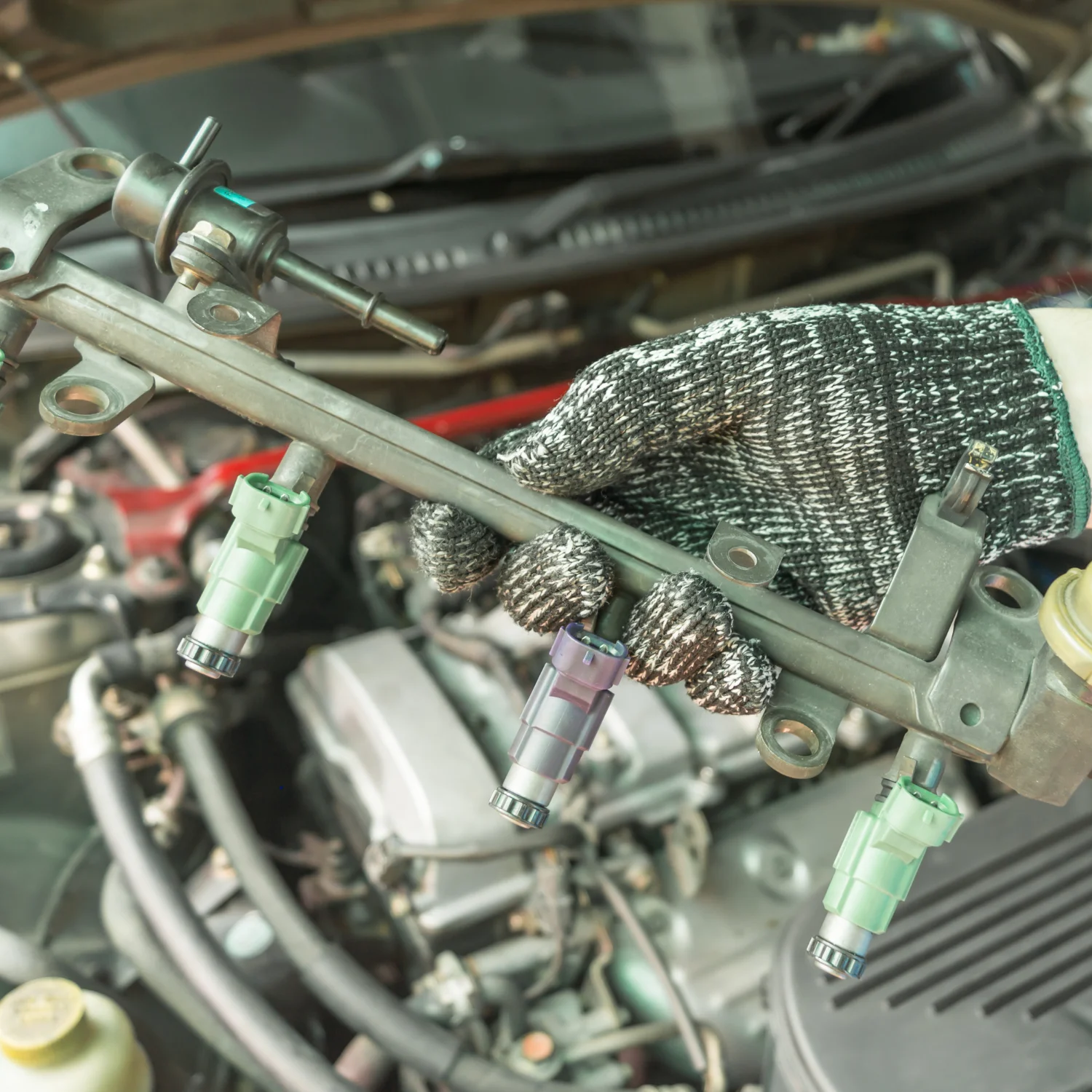
2. Fuel Injectors: The Precision Sprayers (Prone to Clogging and Leakage)
- Role:These are the business end of fuel delivery. The ECM sends a precise electrical pulse to each injector, opening a tiny valve for a calculated duration (pulse width), allowing pressurized fuel to spray into the intake port or combustion chamber in a specific atomized pattern.
- Failure Modes & Symptoms:
- Clogging/Restriction:Over time, varnish deposits from low-quality fuel, ethanol blends, or general age can build up on the injector nozzle tip or internal passages.Symptoms:This is a prime cause ofpoor accelerationand rough idling. A restricted injector deliverslessfuel than commanded, causing a lean condition on that cylinder. You’ll feel hesitation or stumbling, especially during tip-in (light acceleration). Misfires on a specific cylinder (detectable with a scan tool reading misfire codes like P0301, P0302, etc.) are a dead giveaway. Performance may improve slightly after using a strong fuel system cleaner, but severe clogs usually require professional cleaning or replacement.
- Leaking/Dripping:Worn injector seals or internal pintle seats can cause fuel to leakpastthe injector when it should be closed.Symptoms:Hard starting (especially when hot – excess fuel floods the cylinder), rough idle, rich exhaust smell (unburned fuel), excessive fuel consumption, and potential catalytic converter damage from the raw fuel. A leaking injector can also cause a hydro-lock if severe enough (though rare).
- Electrical Failure:The solenoid coil inside the injector can short or go open circuit.Symptoms:Complete lack of fuel delivery to that cylinder, causing a severe misfire, rough idle, significant power loss, and a check engine light with a specific injector circuit code (e.g., P0201 for injector 1 circuit).
- DIY Check:While specialized equipment (like an injector scope or flow bench) is ideal, you can often correlate symptoms with misfire codes. Performing an “injector balance test” (measuring fuel pressure drop when each injector is pulsed individually) is possible with advanced scan tools but tricky. For clogs, a qualitytop-tierfuel injector cleaner added to a near-empty tankmighthelp with mild cases, but don’t expect miracles on severely restricted units. Listen for the clicking sound of injectors operating with a mechanic’s stethoscope – a dead injector will be silent.
3. Fuel Pressure: The Goldilocks Zone (Not Too High, Not Too Low)
- Role:Fuel pressure is theforcepushing fuel to the injectors. It’s regulated by the Fuel Pressure Regulator (FPR – either on the fuel rail or integrated into the tank/pump module) to maintain a constant differential pressure relative to the intake manifold vacuum (for port injection) or a very high fixed pressure (for direct injection). This ensures the injectors deliver the correct volume per millisecond of open time.
- Failure Modes & Symptoms:
- Low Fuel Pressure:Caused by a weak pump, clogged filter, restricted line, or a faulty FPR stuck open.Symptoms:Identical to a weak fuel pump –poor acceleration, hesitation under load, hard starting, potential stalling. The engine runs lean overall because insufficient pressure means less fuel volume delivered per injector pulse.
- High Fuel Pressure:Caused by a faulty FPR stuck closed, a pinched or blocked return line (on return-style systems), or sometimes a faulty pump.Symptoms:Engine runs rich – black smoke from exhaust, strong fuel smell, poor fuel economy, rough idle, potential spark plug fouling (wet, black sooty plugs). Can also damage injectors over time.
- Erratic/Unstable Pressure:Pressure gauge needle fluctuates wildly. Often caused by air in the system (leaky line, bad pump inlet), a failing pump, or a sticking FPR.Symptoms:Surging idle, random hesitation, inconsistent performance.
Ezoic – wp_longer_content – longer_content
End Ezoic – wp_longer_content – longer_content
- DIY Check: This is arguably the SINGLE MOST IMPORTANT diagnostic step for suspected fuel system issues.Youneeda fuel pressure gauge. Most vehicles have a Schrader valve test port on the fuel rail (looks like a tire valve). Connect the gauge, turn the key to “ON” (don’t start), note the prime pressure. Start the engine and note idle pressure. Rev the engine to 2500-3000 RPM and watch for stability and correct pressure (consult your service manual for specs!). Then, turn the key off and watch the pressure hold for several minutes (shouldn’t drop rapidly – indicates a leaking injector or check valve/fuel pump problem). This simple test eliminates guesswork.
4. The Fuel Filter: The Silent Guardian (Often Neglected Until It Chokes)
- Role:Positioned in the fuel line (either in-tank near the pump or externally on the frame rail/engine bay), the filter traps dirt, rust, and debris from the fuel tank before it reaches the sensitive injectors and pump. It’s a sacrificial component designed to be replaced periodically.
- Failure Modes & Symptoms:
- Clogging:This is theonlyfailure mode. As the filter media loads up with contaminants, it restricts fuel flow.Symptoms:Develops gradually, mirroring low fuel pressure symptoms:loss of power under acceleration, hesitation, rough running, especially when the engine demands maximum fuel flow. In severe cases, it can cause hard starting or even prevent the engine from starting. The restriction worsens as the filter loads and as engine demand increases (heat can also cause some contaminants to swell, worsening restriction).
- DIY Check: Check your owner’s manual!Many modern vehicles have “lifetime” in-tank filters, but this often means “lifetime of the pump assembly.” External filters absolutely require periodic replacement (typically every 30,000-60,000 miles, or as specified). If you’re experiencing performance issues and your external filter hasn’t been changed in a long time (or ever!), it’s a prime suspect. A clogged filter is one of the cheapest and easiest fixes for fuel flow problems.Learn more about recognizing the specific signs of aclogged fuel filter.
Ezoic – wp_longest_content – longest_content
End Ezoic – wp_longest_content – longest_content
Beyond the Basics: Other Potential Fuel System Culprits
While the big four above cause the vast majority of issues, don’t overlook these:
- Fuel Lines:Cracked, kinked, or collapsed lines (especially older rubber sections) can restrict flow or leak fuel (major fire hazard!). Inspect for damage, especially near sharp edges or heat sources.
- Fuel Tank Vent System (EVAP):A clogged EVAP canister or vent valve can create a vacuum in the tank as fuel is used, preventing the pump from drawing fuel effectively. Symptoms mimic a clogged filter or weak pump, often worsening as the tank empties. You might hear a “whoosh” when removing the gas cap.
- Fuel Quality:Bad gas – contaminated with water, excessive ethanol, or just old/varnished fuel – can cause running issues, clog injectors, and damage components. If problems started right after a fill-up, suspect fuel quality.
- Electrical Issues:Blown fuses, faulty relays (especially the fuel pump relay), or damaged wiring to the pump or injectors can cause complete or intermittent failures. Always check fuses first!
Ezoic – wp_incontent_5 – incontent_5
End Ezoic – wp_incontent_5 – incontent_5
Your Step-by-Step Diagnostic Roadmap: Finding the Real Problem
Throwing parts at a car is expensive and frustrating. Follow this logical sequence, honed over countless shop bays:
- Gather Information & Verify Symptoms: Exactlywhen does the problem occur? (Cold start? Hot start? Idle? Acceleration? Highway cruise?) Any accompanying noises, smells, or warning lights? Use an OBD2 scanner to check for stored trouble codes – they are invaluable clues (e.g., P0171/P0174 = System Lean; P0087 = Fuel Rail Pressure Too Low; P0260-P0299 = Injector Circuit/Performance).
- The Visual & Audible Inspection:Pop the hood! Look for obvious leaks, damaged lines, disconnected vacuum hoses (some FPRs use vacuum!), or corroded connectors. Listen for the fuel pump prime cycle. Listen for injector clicking.
- Check the Simple & Cheap Stuff FIRST:
- Fuses & Relays:Locate the fuel pump and EFI fuses/relays in your fuse box (refer to the diagram on the lid or your manual). Swap the fuel pump relay with a known-good identical relay (like the horn relay) as a quick test.
- Fuel Level:Is there actually enough gas? Sounds silly, but low fuel exacerbates pump problems and can cause pickup issues.
- Fuel Filter:When was it last changed? If it’s external and overdue,replace it. It’s cheap insurance and a common fix. Understand the direct link between a dirty filter andfuel delivery problems.
Ezoic – wp_incontent_6 – incontent_6
End Ezoic – wp_incontent_6 – incontent_6
- Test Fuel Pressure (THE CRITICAL STEP):As detailed earlier, use a gauge. Compare readings to factory specifications at key on prime, idle, under load (revving), and after shutdown (leak-down test). This test alone will point you directly towards the pump, filter, regulator, or injectors.
- Interpret the Pressure Test Results:
- No/Low Prime Pressure:Check power/ground to pump (test light/multimeter at pump connector), check relay/fuses, check for clogged filterbeforepump. If power is good, pump is likely bad.
- Pressure Drops Under Load:Weak pump or severely clogged filter.
- Pressure Too High:Stuck-closed FPR or blocked return line (if applicable).
- Pressure Drops Rapidly After Shutdown:Leaking injector(s) or faulty pump check valve.
- Pressure Normal:The problem likelyisn’tthe delivery system (pump/filter/regulator). Suspect injectors (clogged/leaking), sensors (MAF, O2), ignition system, or mechanical issues (vacuum leaks, compression). Revisit your symptom analysis and codes.
- Investigate Injectors:If pressure is good but misfires or poor running persist, injector issues are likely. Use scan tool data for misfire counts per cylinder. Consider professionalinjector cleaningor replacement. For suspected leaks, a fuel pressure leak-down test combined with removing spark plugs to check for wetness can confirm.
- When in Doubt, Seek Professional Diagnosis:Modern fuel systems, especially high-pressure direct injection (often 2000+ PSI!), involve complex components and significant safety risks (high pressure, fire hazard, electrical). If you lack the tools (like a high-pressure DI gauge), experience, or confidence,do not hesitate to visit a qualified repair shop. Misdiagnosis can lead to unnecessary expense and potential damage. Our comprehensive guide onpoor acceleration causesdives deeper into differentiating fuel issues from other potential problems like transmission slippage or ignition faults.
Ezoic – wp_incontent_7 – incontent_7
End Ezoic – wp_incontent_7 – incontent_7
Prevention is Cheaper Than Cure: Fuel System Maintenance Tips
An ounce of prevention truly is worth a pound of cure, especially with fuel systems:
- Use Top-Tier Detergent Gasoline:Brands meeting Top Tier standards (like Shell, Chevron, Exxon, Mobil, Costco, etc.) contain significantly higher levels of detergents proven to keep injectors and intake valves clean. Avoid bargain-basement gas stations with questionable fuel quality.
- Don’t Run on Empty:Keep your tank at least 1/4 full whenever possible. The fuel helps cool the electric pump. Running low forces the pump to work harder and hotter, drastically shortening its life. It also stirs up sediment from the tank bottom, clogging the filter faster.
- Replace External Fuel Filters on Schedule:Don’t wait for symptoms. If your vehicle has an external filter, change it per the manufacturer’s recommendation (usually 30k-60k miles). It’s a small cost for big protection.
- Use Quality Fuel Injector Cleaners Sparingly:If you feel your car is running slightly rough or lacking pep, aqualityinjector cleaner (like Techron Concentrate Plus, Sea Foam, or Red Line SI-1) added to afulltank of gasmighthelp with mild deposits. Don’t overdo it – once every 3,000-5,000 miles is plenty, or just use Top Tier gas consistently. Avoid cheap “miracle in a bottle” products.
- Address Small Leaks Immediately:A tiny fuel drip can quickly become a major fire hazard. Inspect lines regularly.
Ezoic – wp_incontent_8 – incontent_8
End Ezoic – wp_incontent_8 – incontent_8
Knowing When to Call the Pros: Safety First!
While diagnosing fuel pressure is a great DIY skill,exercise extreme caution:
- Relieve Fuel Pressure Safely:Before disconnectinganyfuel line, you MUST relieve system pressure. Methods vary (fuse/relay removal and cranking, depressurizing valve on rail, specific scan tool commands). Consult your service manual. Fuel spraying under pressure can ignite.
- No Sparks, No Flames:Work in a well-ventilated area, away from ignition sources (cigarettes, pilot lights, sparks from tools). Have a fire extinguisher rated for flammable liquids (Class B) nearby.
- High-Pressure Direct Injection (GDI):These systems operate atextremelyhigh pressures (often 500-3000+ PSI).Do not attempt to service high-pressure fuel lines, rails, or pumps without specific training, tools, and procedures.Improper handling can cause serious injury. Diagnosis usually stops at the low-pressure side for DIYers; high-pressure issues need a pro.
- In-Tank Pump Replacement:Dropping the fuel tank is heavy, awkward, and involves significant fire and spill risks. If you’re not experienced and properly equipped, this is best left to the shop.
Ezoic – wp_incontent_9 – incontent_9
End Ezoic – wp_incontent_9 – incontent_9
The Bottom Line: Don’t Let Fuel System Problems Drain Your Drive
Poor performance robs you of the joy of driving and can lead to bigger, costlier repairs down the line (like a melted catalytic converter from running rich, or engine damage from chronic lean misfires). By understanding the critical role of each fuel system component – the pump, injectors, pressure regulator, and filter – and learning the systematic diagnostic approach outlined here, you’re empowered to tackle many common issues yourself.
Start with the basics: listen for the pump, check fuses and relays, andalways, always test fuel pressure. Don’t neglect the humble fuel filter. Use quality fuel. And when the problem points to complex high-pressure systems or you’re unsure, respect the risks and seek professional help. Your wallet, your safety, and your car’s longevity will thank you.
Ezoic – wp_incontent_10 – incontent_10
End Ezoic – wp_incontent_10 – incontent_10
Remember, a healthy fuel system isn’t just about getting from A to B; it’s about the smooth, responsive, and efficient drive you deserve. Now go diagnose that hesitation!
Got a specific fuel system symptom you’re battling? Share your experiences and questions in the comments below!
Ezoic – wp_incontent_11 – incontent_11
End Ezoic – wp_incontent_11 – incontent_11