How to Read Check Engine Light Codes: OBD2 Scanner Guide
Your check engine light just turned on, and you want to know whether your car is safe to drive. An OBD2 scanner can reveal the stored diagnostic trouble codes and help you identify the affected system. However, a code does not automatically identify the failed part. This guide explains how to read check engine light codes, understand common results, and decide what to check next.
What Does a Check Engine Light Mean?
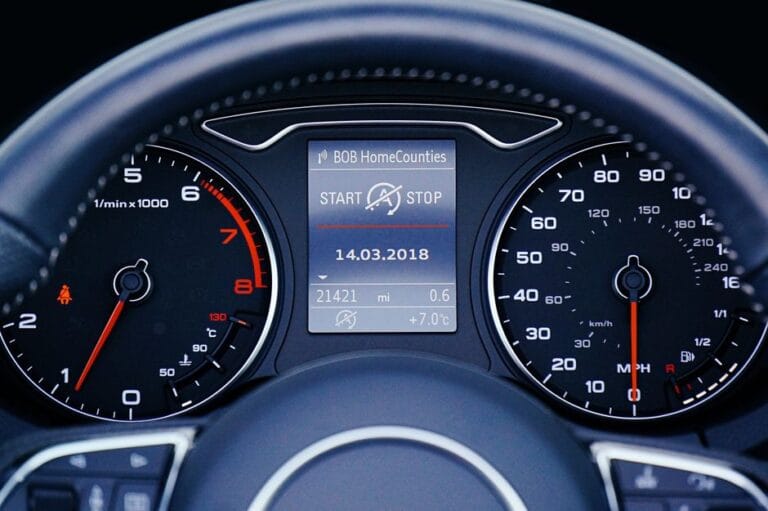
A check engine light means the engine computer has detected a fault or condition that requires attention. The stored diagnostic trouble code, or DTC, identifies the system or condition involved. Further testing is usually necessary to determine the actual cause.
Modern vehicles use sensors and control modules to monitor engine operation, emissions, and related systems. When monitored values fall outside expected limits, the engine control module may store a code and illuminate the malfunction indicator lamp (MIL).
Possible causes include a loose fuel cap, an evaporative emissions leak, an ignition misfire, an oxygen sensor circuit fault, or a catalytic converter efficiency problem. The seriousness depends on the symptoms, the code, and the vehicle.
Is It Safe to Drive With the Check Engine Light On?
A steady amber check engine light generally allows time for careful assessment, but the vehicle should be diagnosed promptly. A flashing check engine light often indicates an active misfire that can damage the catalytic converter. Severe shaking, power loss, overheating, or other serious symptoms require immediate attention.
| Warning light or symptom | What to do |
|---|---|
| Steady amber check engine light | Check for unusual symptoms and arrange diagnosis soon. Avoid heavy loads if the engine runs poorly. |
| Flashing check engine light | Reduce engine load, pull over safely, and shut off the engine if the light continues flashing or the engine runs roughly. Arrange professional assistance. |
| Red oil pressure warning | Stop safely and shut off the engine immediately. Check the owner’s manual and oil level only when safe. |
| Engine overheating warning | Stop safely and switch off the engine. Never open a hot radiator or coolant reservoir cap. |
| Check engine light with severe shaking or power loss | Stop driving when safe and arrange inspection or towing. |
What Do You Need to Read Check Engine Codes?
You need an OBD2-compatible scanner, access to the vehicle’s diagnostic port, and the vehicle identification details when the scanner requests them. A basic code reader is sufficient for many engine-related checks, while advanced scanners offer additional system coverage and testing functions.
- OBD2 code reader: Reads diagnostic trouble codes from supported systems.
- Vehicle owner’s manual: Helps identify the diagnostic port and vehicle-specific procedures.
- Phone or tablet: Needed for compatible Bluetooth scanners.
- Notebook or phone camera: Records codes and freeze-frame data before clearing.
- Flashlight: Helps locate the diagnostic port.
- Repair information: Provides vehicle-specific diagnostic procedures and specifications.
Which OBD2 Scanner Should You Choose?
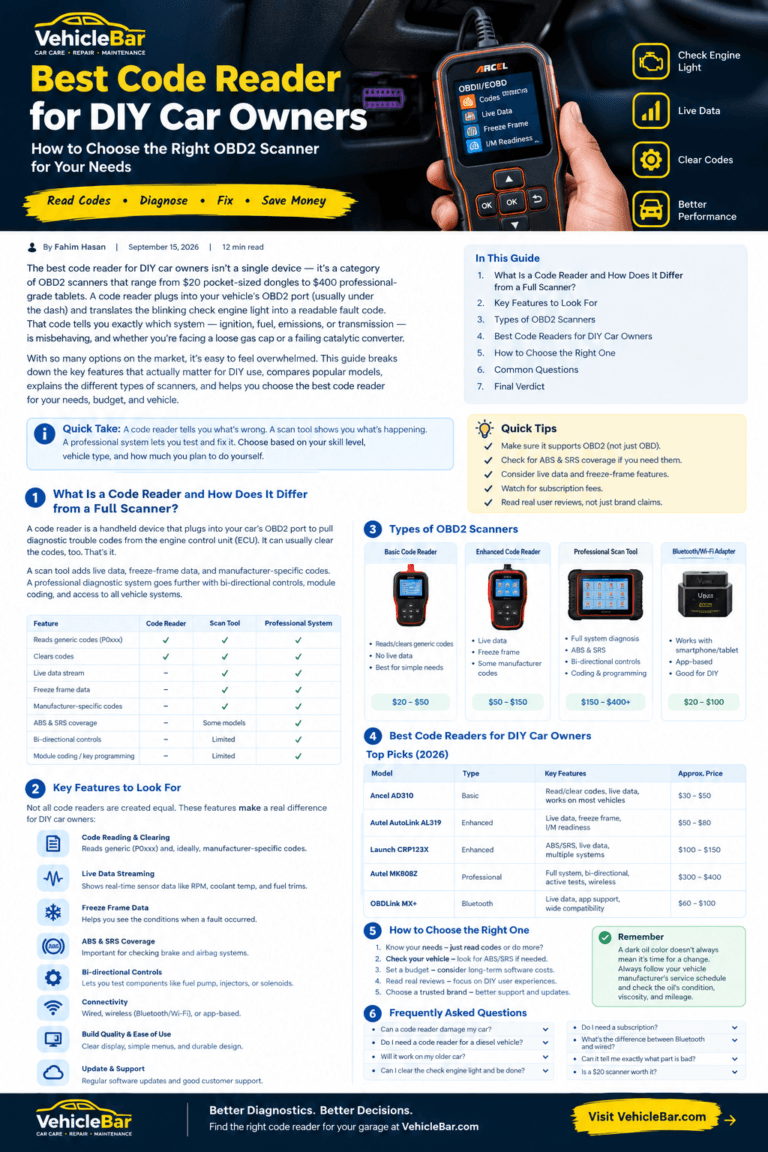
The right scanner depends on the diagnostic work you plan to perform. Basic readers usually handle standard powertrain codes, while more advanced tools may support ABS, airbag, transmission, live data, and bidirectional controls. Confirm compatibility with your vehicle before buying.
| Scanner type | Typical capabilities | Best for |
|---|---|---|
| Basic code reader | Reads and may clear supported engine codes | Occasional DIY checks |
| Bluetooth OBD2 scanner | Displays supported codes and live data through an app | Drivers who prefer smartphone diagnostics |
| Advanced diagnostic scanner | May support additional modules, special tests, and bidirectional controls | Experienced DIY users and technicians |
Scanner features vary by model, vehicle year, and manufacturer. A tool that reads engine codes may not read ABS or airbag codes. Check the manufacturer’s supported-vehicle list before purchasing.
Where Is the OBD2 Port Located?
The OBD2 port is commonly located beneath the dashboard on the driver’s side, near the steering column. Depending on the vehicle, it may sit above the pedals, behind a small removable panel, or near the center console.
- Park the vehicle on a safe, level surface.
- Apply the parking brake and switch off the ignition.
- Inspect beneath the driver’s dashboard for a 16-pin trapezoid-shaped connector.
- Check the owner’s manual if you cannot locate the port.
Most US-market passenger vehicles from model year 1996 onward support OBD2, although compatibility and diagnostic coverage vary by market and vehicle. Some vehicles outside the United States use different implementation dates or requirements.
How Do You Read Check Engine Light Codes With an OBD2 Scanner?
To read check engine codes, connect a compatible scanner, switch the ignition to the position specified by its instructions, and select the code-reading function. Save all results before clearing codes or disconnecting the scanner.
Prepare the Vehicle
Park safely, apply the parking brake, and switch off the engine. Follow the scanner’s instructions and the vehicle manufacturer’s guidance. Keep hands, clothing, and cables away from moving or hot components.
Connect the OBD2 Scanner
Locate the diagnostic port and insert the scanner connector carefully. The plug should fit without excessive force. If it does not fit, check its orientation and compatibility rather than forcing it.
Switch the Ignition On
For many vehicles, the scanner needs the ignition switched on while the engine remains off. Push-button vehicles may require a specific button sequence. Follow the scanner’s instructions for your vehicle.
Select the Vehicle and Read Codes
Allow the scanner to establish communication. Enter the vehicle details if requested, then choose “Read Codes,” “DTCs,” or a similarly named option. Menu names vary by scanner.
Record Every Code
Write down stored, pending, and permanent codes when available. Record the mileage, symptoms, and any freeze-frame information. Photograph the screen if that is easier.
Research the Codes
Look up each code using reliable repair information for your specific vehicle. A general code description is a starting point, not a final diagnosis.
Test Before Replacing Parts
Inspect the affected system and perform the recommended tests. Depending on the code, this may involve checking wiring, connectors, hoses, sensor readings, fuel pressure, or mechanical condition.
Verify the Repair
After correcting the fault, follow the appropriate repair and verification procedure. Clear codes only when appropriate, then check whether the fault returns and whether the relevant readiness monitors complete.
What Do OBD2 Diagnostic Trouble Codes Mean?
OBD2 codes use a letter followed by four characters. The first letter identifies the general system, while the remaining characters provide more specific information about the detected condition.
- P — Powertrain: Engine, emissions, and some transmission-related faults.
- B — Body: Certain body and comfort-system faults.
- C — Chassis: Certain chassis, steering, and suspension-related faults.
- U — Network: Communication faults between control modules.
Not every scanner supports every category. Some codes are standardized, while others are manufacturer-specific. Always use the correct code definition for the vehicle.
What Are the Most Common Check Engine Codes?
Common powertrain codes identify conditions such as engine misfires, catalyst efficiency problems, lean fuel mixtures, evaporative emissions leaks, and coolant temperature issues. Their possible causes overlap, so test results and vehicle-specific procedures are essential.
| Code | General meaning | Possible causes to investigate |
|---|---|---|
| P0300 | Random or multiple-cylinder misfire detected | Ignition faults, fuel delivery problems, vacuum leaks, or mechanical issues |
| P0420 | Catalyst system efficiency below threshold, Bank 1 | Catalyst deterioration, exhaust leaks, sensor faults, or other engine problems |
| P0171 | System too lean, Bank 1 | Intake leaks, air measurement errors, fuel delivery issues, or exhaust-related sensor problems |
| P0456 | Small evaporative emissions system leak detected | Fuel cap sealing problems, damaged hoses, leaking connections, or faulty EVAP components |
| P0128 | Coolant temperature below the expected thermostat regulating temperature | Thermostat problems, coolant temperature sensor faults, or related cooling-system issues |
These descriptions are general. Manufacturer-specific diagnostic information may add important details, and a code alone does not confirm that any particular component has failed.
How Do You Diagnose a P0300 Random Misfire Code?
A P0300 code means the engine computer has detected random or multiple-cylinder misfires. Possible causes include worn spark plugs, ignition coil faults, fuel delivery problems, intake leaks, or mechanical engine problems.
Start by checking for related codes and reviewing the available freeze-frame data. Inspect accessible ignition components and connectors when safe. Follow vehicle-specific testing procedures before replacing spark plugs, coils, injectors, or other parts.
If the engine shakes heavily or the check engine light flashes, stop driving when safe. Continued operation during an active misfire can damage the catalytic converter.
For more information, see our engine misfire diagnosis guide, if available on VehicleBar.
What Should You Check When Code P0420 Appears?
P0420 indicates that the catalyst system efficiency is below the threshold monitored by the engine computer. The catalytic converter may be deteriorating, but an exhaust leak, sensor problem, or underlying engine fault can also affect diagnosis.
A technician may inspect exhaust connections, review oxygen sensor data, check for related codes, and perform manufacturer-specified tests. Sensor readings must be interpreted in context rather than judged by one universal voltage rule.
Do not replace the catalytic converter based on P0420 alone. Confirm the cause before buying expensive parts.
How Do You Troubleshoot a P0171 Lean Condition?
P0171 indicates that the engine computer has detected a lean condition on Bank 1. Possible causes include unmetered air entering the intake, incorrect airflow measurement, inadequate fuel delivery, or other faults affecting the air-fuel mixture.
Check for related codes and inspect accessible intake hoses and connectors. A technician may review short-term and long-term fuel trims, test for vacuum leaks, and measure fuel pressure when the diagnostic procedure requires it.
Fuel-trim values depend on operating conditions and vehicle design. Do not condemn a sensor based on a single reading without confirming the manufacturer’s specifications.
What Should You Check for a P0456 EVAP Leak Code?
P0456 indicates that the evaporative emissions system has detected a small leak. The system prevents fuel vapors from escaping into the atmosphere. A sealing problem, damaged hose, loose connection, or faulty valve may cause the code.
- Check whether the fuel cap is correctly fitted, if the vehicle uses one.
- Inspect accessible EVAP hoses and connections for visible damage.
- Check for related codes and follow the vehicle-specific diagnostic procedure.
- Arrange an appropriate leak test if the cause remains unclear.
Some vehicles use capless fuel-filler systems, so a conventional gas-cap check may not apply. Do not replace EVAP components until the fault has been confirmed.
Should You Clear Check Engine Codes Before Fixing the Problem?
No. Record the codes and available diagnostic data before clearing anything. Erasing codes does not repair the underlying fault, and clearing them too early can remove useful diagnostic information or reset emissions readiness monitors.
To clear codes after a repair, use the scanner’s “Clear Codes” or “Erase Codes” function when appropriate. Follow the scanner instructions, then recheck the vehicle and verify that the problem has been corrected.
Can You Read Check Engine Codes Without a Scanner?
Sometimes, but the method depends on the vehicle and diagnostic system. Some older vehicles provide manufacturer-specific self-diagnostic procedures, while modern OBD2 vehicles generally require a compatible scanner for reliable code retrieval.
Do not assume that cycling the ignition, pressing odometer buttons, or counting dashboard flashes will reveal a code on every vehicle. Incorrect procedures may produce no useful information. Consult the owner’s manual or a service manual for the exact make, model, and year.
What Is Freeze-Frame Data, and Why Does It Matter?
Freeze-frame data is a snapshot of selected operating conditions recorded when a fault was detected. Depending on the vehicle and code, it may include engine speed, vehicle speed, coolant temperature, and fuel-trim information.
This information helps a technician understand the conditions surrounding the fault. Record it before clearing codes because the data may be lost or replaced when diagnostic information changes.
What Are Live Data and Advanced Diagnostic Tests?
Live data displays sensor readings and operating values while the vehicle is running or under specified test conditions. It can help diagnose faults that a stored code alone cannot explain.
Depending on the problem, diagnosis may require:
- Comparing sensor readings with manufacturer specifications.
- Reviewing short-term and long-term fuel trims.
- Testing electrical circuits, power supplies, grounds, and connectors.
- Checking fuel pressure or engine compression when indicated.
- Performing an approved smoke test for suspected intake or EVAP leaks.
- Checking technical service bulletins and applicable manufacturer repair information.
Advanced tests may involve fuel systems, hot engine components, moving parts, or pressurized equipment. Use the proper service procedure and safety equipment, or seek professional help.
How Much Does Check Engine Light Diagnosis Cost?
The cost depends on the vehicle, the fault, local labor rates, and the testing required. Reading a code is usually simpler than identifying the failed component. A basic scanner is a reusable tool, while professional diagnosis may involve labor, specialist equipment, and additional tests.
| Diagnostic option | What it provides | Important limitation |
|---|---|---|
| Basic personal scanner | Code retrieval and, on some models, basic live data | May not access all modules or perform advanced tests |
| Parts-store code reading | May provide a code-reading service, depending on the location | Code reading is not the same as a complete diagnosis |
| Professional workshop | Vehicle-specific testing and diagnostic equipment | Fees and repair costs vary by shop and fault |
Before approving a repair, ask whether the quoted price covers code reading, diagnosis, parts, labor, and verification. Avoid estimating the repair cost from a code alone.
What Mistakes Should You Avoid When Reading OBD2 Codes?
- Replacing parts immediately: A code identifies a detected condition, not necessarily the failed component.
- Clearing codes too soon: Save all codes and available freeze-frame information first.
- Ignoring related codes: Several codes may point toward a shared electrical, air, fuel, or mechanical problem.
- Using the wrong code definition: Confirm the exact vehicle and manufacturer information.
- Ignoring symptoms: Engine shaking, overheating, smoke, unusual noises, or loss of power can change the urgency.
- Assuming the light staying off proves success: The fault may be intermittent, and readiness monitors may not have completed.
When Should You Take Your Car to a Professional?
Professional diagnosis is recommended when the engine runs roughly, a warning light flashes, several systems report faults, or basic checks do not identify the cause. Specialist testing may also be necessary for intermittent electrical problems, fuel pressure faults, and mechanical engine issues.
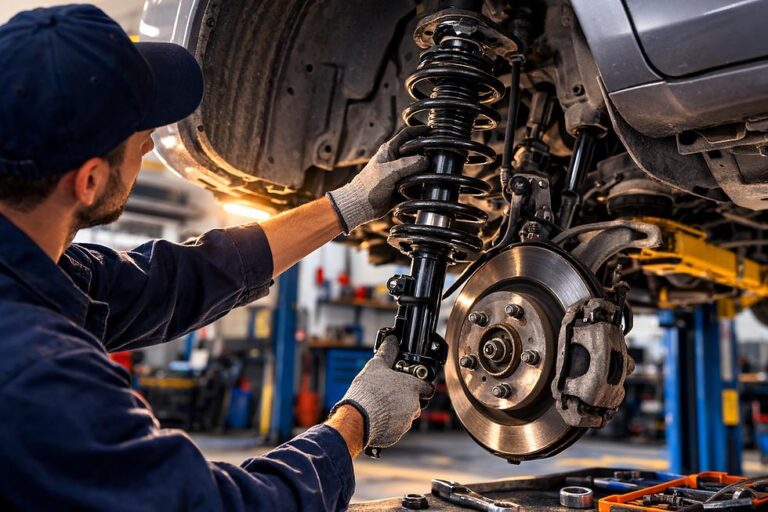
Seek qualified assistance for airbag systems, high-voltage hybrid or electric vehicle components, and other safety-critical systems unless you have the correct training and equipment. Never work underneath a vehicle supported only by a jack.
How Can You Help Prevent Check Engine Light Problems?
Routine maintenance cannot prevent every fault, but it can help reduce avoidable problems and reveal issues earlier.
- Follow the vehicle manufacturer’s maintenance schedule.
- Use the specified engine oil and correct service fluids.
- Inspect air-intake hoses and accessible electrical connectors when appropriate.
- Address rough running, unusual noises, and warning lights promptly.
- Use the correct fuel grade and follow manufacturer recommendations.
- Keep records of diagnostic codes, repairs, and maintenance.
- Investigate recurring faults instead of repeatedly clearing codes.
Frequently Asked Questions
Can I drive with a steady check engine light?
Sometimes, if the vehicle runs normally and no other warning or serious symptom appears. Arrange diagnosis promptly and stop driving if the engine runs roughly, overheats, loses power severely, or develops another urgent warning.
What should I do if the check engine light flashes?
Reduce engine load and pull over safely. If the light continues flashing or the engine runs roughly, shut off the engine and arrange professional assistance. Continued driving can damage the catalytic converter.
Will disconnecting the battery clear check engine codes?
Disconnecting the battery may erase some stored information, depending on the vehicle, but it is not a recommended diagnostic shortcut. It can reset learned settings and readiness monitors. Use a compatible scanner and follow the manufacturer’s procedure.
Can a check engine light turn off by itself?
Yes. Some faults stop recurring, allowing the light to turn off after the vehicle’s monitoring system records successful checks. Stored or permanent codes may remain. An extinguished light does not always mean the underlying issue has been repaired.
Why does the check engine light return after clearing codes?
The fault may still exist or may recur when the relevant monitoring conditions are met. Read the returning codes, compare them with the original results, and diagnose the cause instead of repeatedly erasing the warning.
Do I need an expensive OBD2 scanner?
Not for every job. A compatible basic reader may be enough to retrieve standard engine codes. Advanced diagnostics may require a scanner that supports additional modules, live data, or bidirectional tests.
Can an OBD2 code tell me exactly which part is bad?
Usually not. The code describes a monitored fault or condition. Inspection and testing are needed to determine whether the cause is a sensor, wiring, a leak, a mechanical problem, or another component.
Can I clear codes before an emissions test?
Clearing codes may reset emissions readiness monitors and can leave the vehicle unready for testing. Repair the fault, follow the correct drive-cycle procedure, and check monitor status before the inspection.
Final Verdict: Read the Code, Then Diagnose the Cause
Learning how to read check engine light codes is a useful DIY skill. A compatible OBD2 scanner helps identify the affected system, record diagnostic information, and guide the next step. However, replacing parts based only on a code can waste money and leave the real problem unresolved.
Record every code, review the available freeze-frame data, follow vehicle-specific diagnostic procedures, and verify the repair. If the check engine light flashes or the vehicle shows serious symptoms, prioritize safety and seek professional assistance.