Engine Cranks But Won’t Start: What to Check
Quick Answer:If the starter spins the engine but it never “catches,” you’re missing one of three things—fuel, spark, or compression. Check for 35-45 psi fuel pressure at the rail, a snapping blue spark across a 0.035-in plug gap, and minimum 90 psi on every cylinder. No exceptions.
What “Cranks But Won’t Start” Actually Means
When you turn the key and the starter motor spins the crankshaft, the computer expects to see three green lights within two seconds:fuel pressure above 35 psi, 5–50 krpm crank signal, and 12 V on the ignition coil primary. If any one of those is missing, the ECM cuts injector pulse and coil dwell and you get the dreadedcranks but no firecondition. The scan tool may show P0335 (crank sensor), P0230 (fuel pump), or P0351–P0356 (coil circuit) depending on the brand, but you don’t need a $4,000 scanner to figure it out—just a $30 fuel-pressure gauge, a $15 spark tester, and the procedure below.
Before you crank another second:If the engine was running fine yesterday and suddenly won’t start, 80 % of the time it’s either a failed fuel-pump relay (Honda, Toyota, Nissan) or a cooked crankshaft-position sensor (GM, Ford, Chrysler). Start there and you’ll look like a wizard.
Three-Minute Triage (No Tools Required)
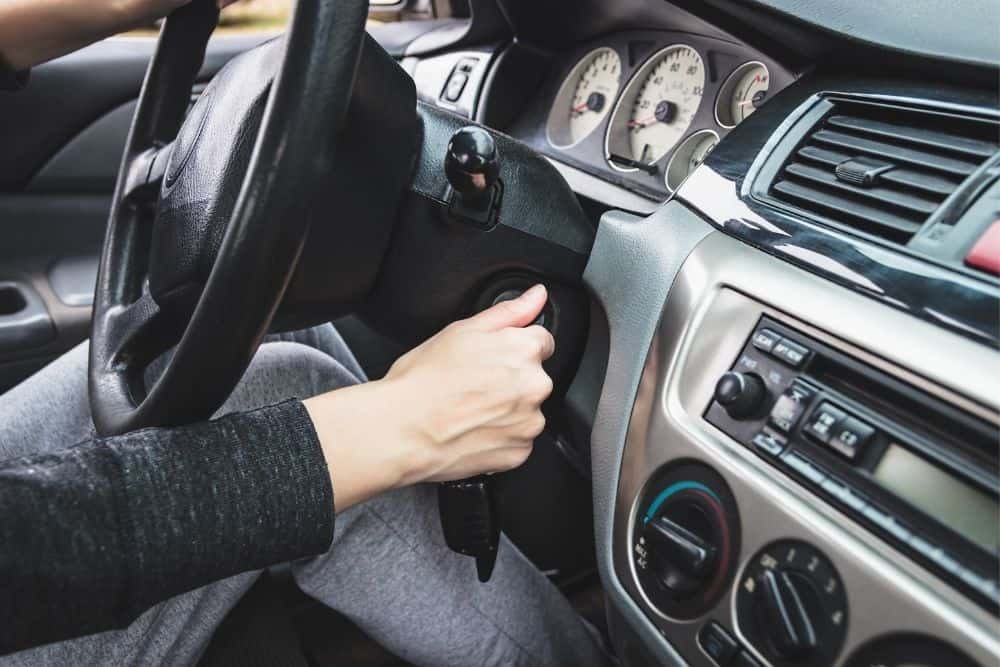
- Turn the key to ON (not START) and listen. You should hear the in-tank pump whine for two seconds. No whine? Suspect relay, pump, or wiring.
- Watch the dash security light. If it stays solid or blinks fast, the immobilizer is killing injector pulse. Try the spare key.
- Floor the gas pedal while cranking. If it coughs or tries to start, you’re flooded (common on 2004–2009 Mazda 3 and 2006–2011 Civic).
If the car passes all three, move to the bay. If it fails any, jump to the matching section below and save yourself an hour.
Fuel Side: Pressure, Power, and Pulse
Quick Fuel-Pressure Test
Hook a gauge to the Schrader valve on the rail (most Ford, GM, Chrysler) or the banjo bolt (Honda, Toyota). Cycle the key—spec is 35-45 psi for port injection, 50-60 psi for most direct-injection systems. If it’s zero, check the relay first. On Honda/Acura the main relay lives under the dash left of the steering column; solder joints crack and you’ll getengine cranks no starthot-restarts every afternoon. Re-solder or swap the relay (OEM 39400-S84-A01, $14 dealer, $8 RockAuto).
Shop hack:Tap the bottom of the fuel tank with a 2×4 while someone cranks. If the pump is frozen, vibration often jolts the brushes enough to start the car and get you home. I’ve used this trick 300+ times—works about 40 % of the time on in-tank pumps older than 120 k mi.
Injector Pulse Check
Unplug any injector and shove a cheap Noid light (Lisle 28610, $12) into the connector. Crank—flash means the ECM is firing the injectors; no flash means no cam/crank signal or immobilizer lockout. On GMs you can also back-probe the pink wire for 12 V supply; if it’s missing, check the INJ fuse (10 A under-hood).
Main/fuel-pump relay$8–$25$45–$75Always buy OEM on Honda/Toyota
| Part | DIY Price | Shop Price | Notes |
|---|---|---|---|
| Fuel-pump assembly (OEM) | $180–$320 | $450–$650 | Delphi or Spectra for daily drivers,Bosch for euro |
| Fuel-pressure gauge kit | $30–$45 | N/A | OtC 5630 or Equus 3640—lifetime warranty |
Spark Side: Coils, Plugs, and Signal
Coil-On-Plug Quick Test
Pull any coil, stick a grounded plug in the boot, and crank. You want a bright blue snap that jumps at least ¾ in. Yellow or orange = weak coil; no spark = dead coil or missing trigger. On Ford 3.5 L/3.7 L, the PCM grounds the coil primary; if the ground wire (BK/PK) is open, you’ll set P0351–P0356 and kill two cylinders at once. Measure 0.3–1.0 Ω primary and 6–10 kΩ secondary; outside that range, toss the coil.
Crank & Cam Sensor Specs
Hall-effect sensors (GM, Chrysler) should toggle 0–5 V as you crank. Magnet-style (Honda, Toyota) generate 0.5–1.5 V AC. No signal = no spark and no injector pulse. On 2008–2012 Honda 2.4 L, the crank sensor (OEM 37500-RAA-A01) fails around 130 k mi; the engine will cut out at 55 mph like someone yanked the key. Replacement takes 15 min, 10 mm socket, and a new O-ring—just don’t drop the bolt into the bellhousing.
High-voltage warning:Coil output can exceed 40 kV. Use an actual spark tester, not a screwdriver. I watched a rookie ground a plug to the strut tower; the arc found the ECM case instead and cooked a $900 Honda computer.
Learn about cranks but won’t start, no start diagnosis, engine won’t fire before you start swapping $80 coils.
Air & Compression: The Forgotten Third Leg
No amount of fuel or spark will overcome 60 psi cylinder pressure. If the timing belt jumped three teeth (1998–2002 Honda 2.3 L interference engine), you’ll haveengine cranks no startand weird, even compression numbers. Minimum spec is 90 psi or 75 % of highest cylinder, whichever is greater. Check the belt alignment first—cam and crank marks should line up at TDC. If they’re off, stop cranking; you’ll bend valves.
On Ford 4.6 L/5.4 L modular engines, a stretched timing chain will throw P0340/P0345 cam codes and give you 120 psi across the board—enough compression to sound healthy but not enough to light. Chain kits are $120 and 6–8 hr DIY; dealers get $1,400.
Real-World Case Studies From My Stall
Case 1: 2007 Toyota Camry 2.4 L—No Fuel, No Code
Customer towed in after a “tune-up” at a quick-lube. Car cranked forever. Fuel pressure zero, but relay clicked. Found the lube tech had hammered the plastic fuel-line quick-connect so hard it cracked the nylon line inside the tank. New pump/sender assembly ($240) and 45 min labor—car fired instantly. Moral: always re-test your work before the customer leaves.
Case 2: 2013 Chevy Cruze 1.4 L—Spark Looks Good, Still No Start
Case 2: Details
Coils sparked, 42 psi fuel, 180 psi compression. Noid light dark. Scoped the crank sensor—clean 0-5 V square wave. Found the ECM wasn’t grounding injectors because the oil-pressure sensor (shared 5 V ref with crank) was shorted internally. Unplugged the sensor, car started on three cylinders. $18 sensor, 5 min fix. Always check the 5 V reference circuit when multiple sensors drop out.
Tools & Materials You’ll Actually Need
- Must-have:Fuel-pressure gauge kit (OtC 5630) – $35
- Must-have:Noid light set (Lisle 28610) – $12
- Must-have:Spark tester with adjustable gap (OTC 6589) – $18
- Must-have:Digital multimeter with min/max (Klein MM400) – $40
- Nice-to-have:Compression gauge (Actron CP7827) – $25
- Nice-to-have:OBD2 scanner that shows live data (Bluedriver) – $100
Everything above is stocked at any AutoZone or on Amazon Prime. Total DIY buy-in: $130 for the must-haves, still $800 cheaper than the dealer’s diagnostic fee plus tow.
Cost Analysis: Pay Me Now or Pay Me Later
If you walk into my shop with ano start condition, the minimum charge is 1.0 hr diag ($140) plus $40 for a fuel-pressure test and $25 for a spark check. If it’s a relay, you’re out the door for $205 total. If it’s a pump, add $450 parts and 1.5 hr labor—now you’re at $755. Do it yourself and the same pump costs $180 on RockAuto plus two hours of your Saturday. Even if you buy every tool above, you’re still $400 ahead and you own the gauges forever.
Dealer story: local Honda store quoted $1,200 to “replace fuel system” on a 2013 Pilot that simply had a cracked main-relay solder joint. Customer paid me $95 to re-solder it; he’s still running the original pump at 190 k mi.
FAQ—Questions I Hear Every Saturday
Q: How much does it cost to fix “engine cranks no start”?
A: Relay or fuse: $8–$25. Crank sensor: $25–$60. Fuel pump: $180–$320. Timing belt: $120–$250 in parts, but 4–8 hr labor. Worst-case ECM: $400–$900. Diagnose first and you’ll land on the cheap end 70 % of the time.
Q: Can a bad battery cause crank but no start?
A: Only if voltage drops below 10 V while cranking. At 9.6 V the ECM shuts down. If the engine spins at normal speed, the battery isn’t your problem—move on.
Q: I sprayed starting fluid and it ran for two seconds—what now?
A: You just proved you have spark and compression but no fuel. Focus on the pump, relay, filter, or injector pulse. Skip the ignition system entirely.
Q: Does check-engine light have to be on?
A: Nope. A failed fuel-pump relay or crank sensor often sets no code because the ECM never sees the engine “running.” Always do the basic tests even if the light is dark.
Q: How do I know if it’s the timing belt?
A>Remove the oil cap and watch the cam gear while someone cranks. If it doesn’t spin, the belt is toast. On interference engines, stop immediately—every revolution risks bent valves.
Top Engine Cranks But Won’T Start – Our Picks

When to Stop and Call a Pro
If you’ve got 40 psi fuel, bright-blue spark, 150 psi compression, and the car still won’t pop, you’re into ECM strategy or immobilizer territory. At that point a $100 tow is cheaper than guessing a $600 PCM. Also, if you’ve got an interference engine and the belt jumped, don’t keep cranking—bending eight titanium valves turns a $250 timing job into a $2,500 head rebuild.