What Causes Blue Smoke Exhaust?
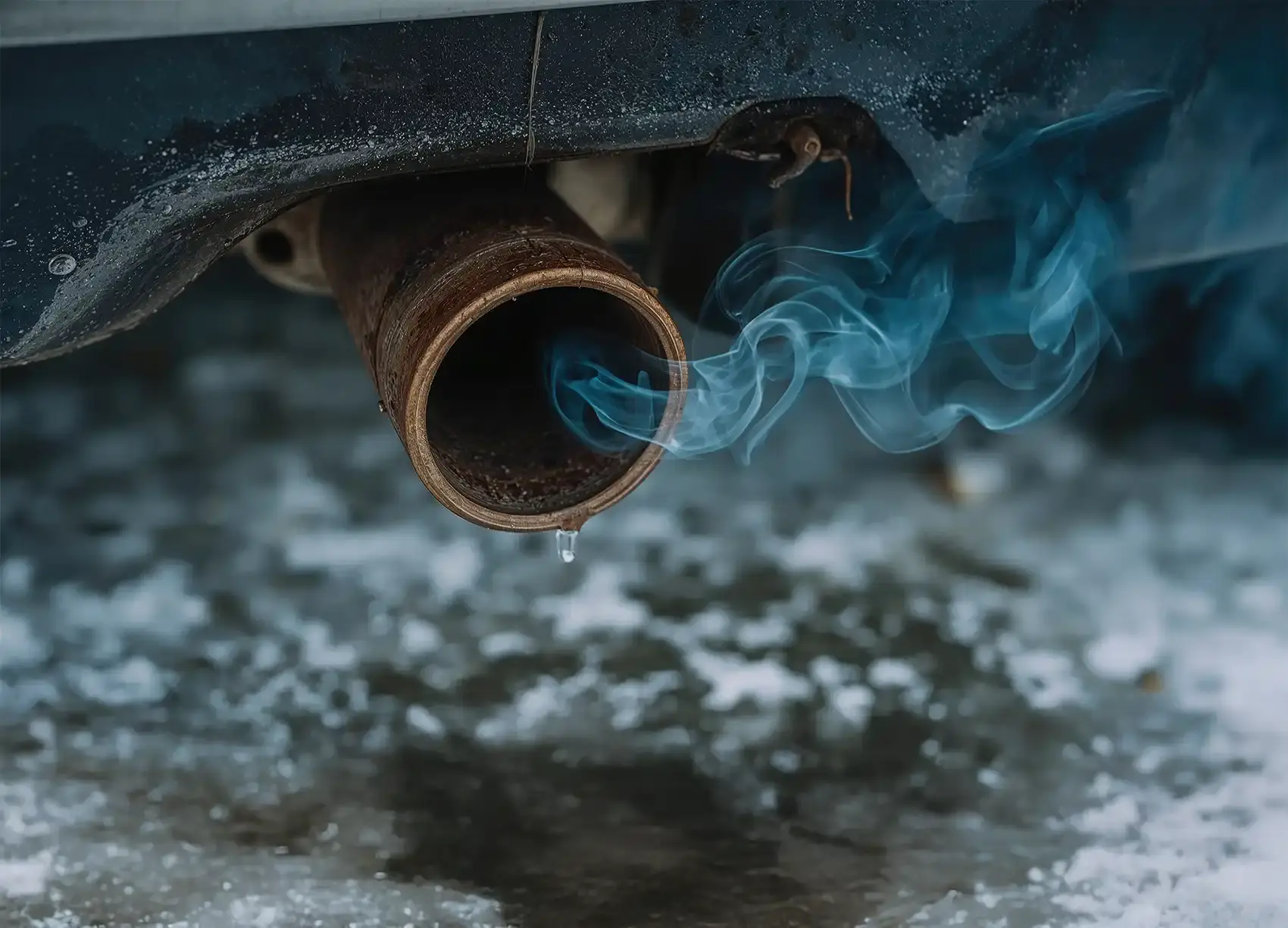
When you see blue smoke exhaust, your engine is burning motor oil along with fuel. Unlike white smoke (coolant-related) or black smoke (fuel-rich mixture), blue smoke has a sharp, acrid smell—often described as “burning oil.” This isn’t normal wear-and-tear. It’s a symptom of internal engine failure that will only get worse.
The three main culprits:
- Worn valve seals – Oil leaks past the seals down the valve guides during idle or deceleration.
- Worn piston rings – Oil enters the combustion chamber past the rings under load or acceleration.
- Forced induction issues – Turbocharger seals failing (on turbo engines) can also cause oil to enter the intake and burn.
Less common but worth checking: a clogged PCV (Positive Crankcase Ventilation) system, excessive crankcase pressure, or using oil that’s too thin for your engine.
Before diving into parts, learn more about the broader symptoms and implications in our guide to blue exhaust smoke, burning oil smoke, oil smoke diagnosis.

Diagnosing the Source: Valve Seals vs. Piston Rings
Not all oil burning smoke is created equal. The timing and driving conditions when smoke appears tell you *where* the problem lies.
• Smoke on startup only? → Likely valve seals.
• Smoke under acceleration or sustained load? → Likely piston rings.
• Constant blue smoke regardless of conditions? → Could be both, turbo failure, or severe internal wear.
Cold-Start Smoke = Valve Seal Failure
Here’s what happens: when the engine sits, oil pools around the valve stems. If the seals are worn or hardened (common after 80,000–120,000 miles), that oil drips into the combustion chamber. On startup, it burns off instantly—hence the puff of blue smoke exhaust.
I’ve seen this constantly on 2008–2012 Audi A4 2.0T models—Audi issued TSB 15-09-10 specifically addressing premature valve seal wear. Same with 2003–2007 Toyota Camry V6 (2GR-FE engine): the seals harden and crack around 100K miles.
Smoke Under Load = Piston Ring Wear
When you accelerate hard, cylinder pressure spikes. If the piston rings are worn or stuck (often due to carbon buildup or infrequent oil changes), oil from the crankcase gets forced past the rings into the combustion chamber. This creates sustained blue smoke exhaust under throttle—not just at startup.
On high-mileage Ford F-150 5.0L Coyote engines (2011–2017), ring land wear on the pistons is a known issue. Ford even extended the warranty on some models.
Step-by-Step Diagnostic Procedures
Test 1: The Acceleration/Deceleration Observation
Time: 10 minutes
Tools: None
Let the engine sit cold overnight (at least 6 hours).
Start the engine and watch the exhaust. A brief puff of blue smoke that disappears within 5–10 seconds points to valve seals.
Drive the car to operating temp. On an open road, accelerate firmly (4,000+ RPM), then quickly let off the gas. If you see blue smoke during deceleration, it’s likely valve seals. If smoke appears only during acceleration and lingers, suspect piston rings.
Test 2: Compression and Leak-Down Tests
Time: 45–60 minutes
Tools: Compression tester (OTC 5606 or equivalent), leak-down tester (Actron CP7830), socket set, spark plug socket (5/8″ or 16mm depending on engine)
Disable ignition and fuel systems (remove fuel pump fuse and coil connectors).
Remove all spark plugs. Install compression gauge into cylinder #1.
Crank engine 5–6 revolutions. Record pressure. Repeat for all cylinders.
Healthy range: 140–180 PSI (gasoline engines). Variation between cylinders should be ≤10%.
If compression is low, perform a leak-down test. Introduce 100 PSI of air into the cylinder at TDC (top dead center). Listen at the oil filler cap (rings) and throttle body (valves).
• Air hissing at oil cap = worn piston rings.
• Air hissing at intake = bad intake valve seal.
• Air hissing at exhaust = bad exhaust valve seal.
Test 3: PCV System Inspection
A clogged PCV valve can cause excessive crankcase pressure, forcing oil past seals. Replace the PCV valve if it doesn’t rattle when shaken. OEM part numbers:
- Honda: 17110-PLM-A01 ($12)
- Toyota: 11811-31020 ($9)
- Ford: W8349 ($8)
Common Models Prone to Oil Burning Smoke
Some engines are notorious for oil consumption and blue smoke exhaust due to design flaws or material choices. Here’s a cheat sheet:
| Vehicle | Engine | Typical Mileage of Onset | Root Cause |
|---|---|---|---|
| 2006–2011 Subaru Impreza/Outback | EJ25 2.5L | 75,000–100,000 mi | Weak piston ring design, oil control ring clogging |
| 2008–2015 Audi A4/A5 | CAEB 2.0T | 80,000–120,000 mi | Hardened valve stem seals |
| 2010–2015 Nissan Altima | QR25DE 2.5L | 90,000+ mi | Piston ring land wear |
| 2011–2017 BMW 328i | N20 2.0T | 60,000–100,000 mi | Valve seal degradation + turbo seal leaks |
If you own one of these, check your oil level every 1,000 miles. Many manufacturers consider 1 quart per 1,000 miles “acceptable”—but that’s a fast track to engine failure.
Repair Options: DIY vs Professional
Valve Seal Replacement (DIY Possible on SOHC Engines)
Difficulty: Moderate (SOHC), Difficult (DOHC)
Time: 6–10 hours
Parts Cost: $35–$80 for seal kit (e.g., Victor Reinz VS-1189 for Honda K-series)
Special Tools Needed: Valve spring compressor (e.g., OTC 7834, ~$120), air adapter for leak-down tester
Piston Ring Replacement (DIY Not Recommended)
This requires a full engine teardown—cylinder honing, new pistons, rings, bearings, and gaskets. Unless you have a clean garage, engine hoist, torque wrench, and micrometer set, leave this to a pro.
Professional Cost Range:
• Short block rebuild: $2,800–$4,500
• Long block replacement (remanufactured): $3,200–$5,500
• Complete rebuild with head work: $4,000–$7,000
Turbocharger Seal Repair
On turbo engines (e.g., VW 2.0T, BMW N20), blue smoke could be from failed turbo seals. Replacing the turbo is often cheaper than engine work.
OEM Turbo Prices:
• VW/Audi CTS Turbo: $650–$900 (Melett or OEM)
• BMW N20: $720–$1,100 (Pierburg or Garrett reman)
Cost Analysis: Fix vs Ignore
| Scenario | Upfront Cost | Long-Term Risk |
|---|---|---|
| Replace valve seals (DIY) | $100–$150 | Low—restores normal oil consumption |
| Use oil additive (e.g., Sea Foam, Rislone) | $10–$20 | High—temporary mask, doesn’t fix wear |
| Ignore and top off oil | $50/month | Extreme—risk of spun bearings, seized engine |
| Professional ring job | $3,500 avg | Low—if done correctly with quality parts |
For more on consumption patterns and repair paths, see our deep dive on oil consumption problems.
Tools & Materials List
Must-Have Tools
- Compression tester – OTC 5606 (~$50, Amazon/AutoZone)
- Leak-down tester – Actron CP7830 (~$90)
- Socket set – 3/8″ drive, 8–19mm
- Spark plug socket – 5/8″ or 16mm with rubber insert
- Torque wrench – click-type, 10–150 ft-lbs (e.g., TEKTON 24335)
Nice-to-Have Tools
- Valve spring compressor – OTC 7834 (~$120)
- Borescope camera – Depstech WF028 (~$60, lets you inspect cylinder walls)
- Engine crane – only if doing full teardown
Common Parts (Model-Specific Examples)
- Honda K24 valve seals – Victor Reinz VS-1189 ($42)
- Toyota 2GR-FE seal kit – Fel-Pro VS 50499 ($38)
- PCV valve (universal) – Standard Motor Products CV762 ($7)
Troubleshooting Flowchart
Use this “If X, then Y” guide to narrow your diagnosis:
- If smoke only on cold start → Check valve seals with leak-down test. Consider seal replacement.
- If smoke under hard acceleration → Perform compression test. Low readings? Suspect rings.
- If you’re burning 1+ quart every 1,000 miles → Don’t delay—this is beyond normal wear.
- If blue smoke appears after an oil change → Verify correct viscosity (e.g., 5W-30 vs. 0W-20). Wrong oil can increase consumption.
- If smoke smells sweet or is accompanied by coolant loss → Might be white smoke misidentified—see our guide on white smoke exhaust.
FAQ: Real Questions from My Customers
How much does it cost to fix blue smoke exhaust?
It depends entirely on the cause. Replacing valve seals yourself costs under $100. A professional valve job runs $800–$1,500. If piston rings are shot, expect $2,800–$5,000 for a rebuild. Turbo seal replacement: $600–$1,200 installed.
Can I drive my car if it’s blowing blue smoke?
Short distances? Yes—but check oil every 500 miles. Long-term? No. Burning oil means less lubrication, which leads to overheating, bearing wear, and catastrophic failure. I once towed a 2013 Maxima that ran out of oil on the highway—engine welded itself at 70 mph.
Is blue smoke always oil?
99% of the time, yes. Very rarely, transmission fluid can enter the intake via a vacuum line (on older automatics with modulator valves), but that’s almost extinct in modern cars. If you’re sure it’s blue (not gray or white), it’s oil.
Will thicker oil stop blue smoke?
Temporarily, maybe—but it’s a band-aid. Using 10W-40 in an engine designed for 0W-20 increases oil pressure and may reduce leakage past worn seals. But it also reduces fuel economy and increases startup wear. Not a real fix.
How do I check for oil consumption accurately?
After an oil change, reset your odometer. Check oil every 500 miles using the dipstick on level ground, engine off for 10 minutes. Record miles per quart. Anything over 1 quart per 2,000 miles warrants investigation. Learn more in our guide to oil consumption problems.
Final Thoughts: Don’t Ignore the Smoke
Blue smoke exhaust isn’t just an annoyance—it’s your engine crying for help. The good news? If caught early, many cases are fixable with moderate DIY effort or a manageable shop bill. But if you wait until you’re topping off oil weekly, you’re looking at a full rebuild or replacement.
Difficulty-wise, diagnosing the issue is easy (you can do it in your driveway). Fixing valve seals is moderate—doable for a weekend warrior with patience. Replacing piston rings? That’s a job for a seasoned builder with the right tools.
Realistically, expect to spend $100–$150 if it’s just seals and you do it yourself. If it’s rings, budget $3,500+. But that’s still cheaper than a new car—and far safer than risking a seized engine on the highway.
From my bay to yours: catch it early, test thoroughly, and don’t let oil burning smoke become your normal. Your engine will thank you—with another 100,000 trouble-free miles.