Loss of Power While Driving: Troubleshooting Guide
It was a busy Tuesday afternoon in the shop, pouring rain outside, when Mrs. Johnson rolled in with her 2012 Honda Accord. She was shaking a bit—told me she’d been merging onto the highway when the car just bogged down. Foot to the floor, RPMs climbing, but barely hitting 50 mph with traffic barreling up behind her. Scary stuff. I’ve seen that panic in customers’ eyes more times than I can count over my 15 years turning wrenches. Turns out it was a failing fuel pump starving the engine under load. We got her fixed up same day, but it reminded me how sudden power loss while driving can catch anyone off guard.
If you’re dealing with loss of power driving, whether it’s sudden power loss on the highway, engine bogging when you accelerate, or the dash lighting up with a “reduced power” warning, you’re in the right place. I’ve diagnosed hundreds of these cases across everything from daily drivers to performance builds. We’ll walk through the most common culprits, how to troubleshoot safely, and what it’ll cost to fix—DIY or shop.
Bottom line: Don’t ignore it. What starts as hesitation can leave you stranded or worse. But most causes are fixable without breaking the bank if you catch them early.
Quick Answer: Most Common Causes of Loss of Power While Driving
- Clogged fuel filter or failing fuel pump
- Dirty/faulty Mass Air Flow (MAF) sensor
- Clogged catalytic converter
- Engine entering limp mode due to sensor faults
- Bad spark plugs, ignition coils, or throttle body issues
Start with an OBD2 scan—it’s your best first step.
Understanding the Symptoms
Loss of power can show up in different ways. Sometimes it’s gradual—like the car feels sluggish uphill. Other times it’s sudden: you’re cruising along and bam, no response from the gas pedal.
Key symptoms I’ve seen in the bay:
- Engine bogging or hesitation when accelerating
- Sudden power loss at highway speeds
- Check engine light with “reduced power” or limp mode message
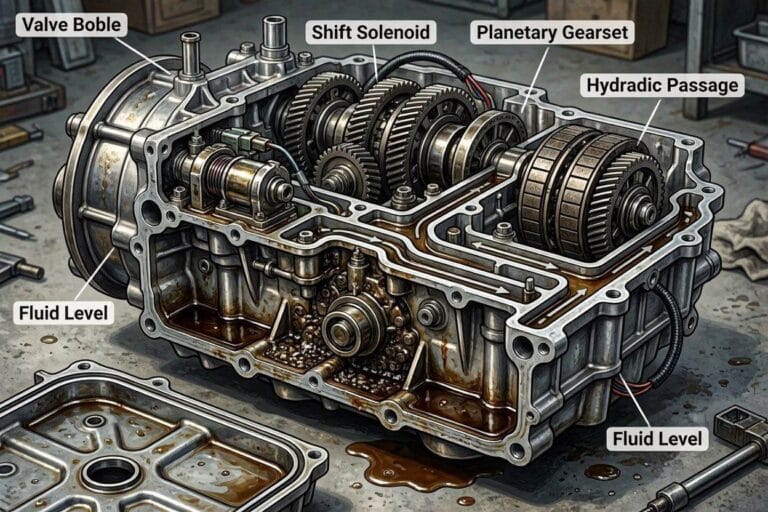
- High RPMs but no speed gain (feels like transmission slipping, but often engine-related)
- Rough idle that smooths out, then power drops under load
If your car goes into limp mode—usually limited to 30-50 mph and low RPMs—it’s the computer’s way of protecting the engine from further damage.
Tools & Materials You’ll Need
Must-Have Tools:
- OBD2 scanner (BlueDriver or Innova 5610 recommended—$100-300 on Amazon)
- Fuel pressure gauge kit ($30-60, Harbor Freight or AutoZone loaner)
- Basic hand tools: 10mm-14mm sockets, screwdrivers
- MAF sensor cleaner (CRC brand, $8-12)
- Shop rags and safety glasses
Nice to Have:
- Scan tool with live data (shows fuel trim, boost, etc.)
- Vacuum gauge for checking restrictions
- Backpressure tester for catalytic converter diagnosis
Safety First
Never work under a running vehicle without proper support. Fuel system work involves flammable liquids— no smoking, good ventilation, fire extinguisher nearby. If you’re not comfortable dropping the fuel tank for pump access, tow it to a shop. One spark can turn bad to worse fast.
Wear PPE: gloves, eye protection. Disconnect battery before electrical work.
Step-by-Step Troubleshooting for Loss of Power Driving
Always start simple. 80% of these I’ve fixed were basic maintenance items customers overlooked.
Scan for Codes
Plug in your OBD2 scanner under the dash (driver’s side). Look for codes like P0171/P0174 (lean condition), P0300 series (misfires), P0420 (catalyst efficiency), or P0299 (turbo underboost).
Even if no light is on, there might be pending codes. Live data is gold—watch fuel trims, MAF readings, and O2 sensor activity.
Time: 10 minutes
Check the Basics
Air filter dirty? Replace it—$15-30 fix that’s caused more power loss calls than I can count.
Fuel level low or old gas? Bad fuel can cause bogging.
Visual inspection: Look for loose vacuum hoses, cracked intake boots (especially on turbos).
Test Fuel Delivery
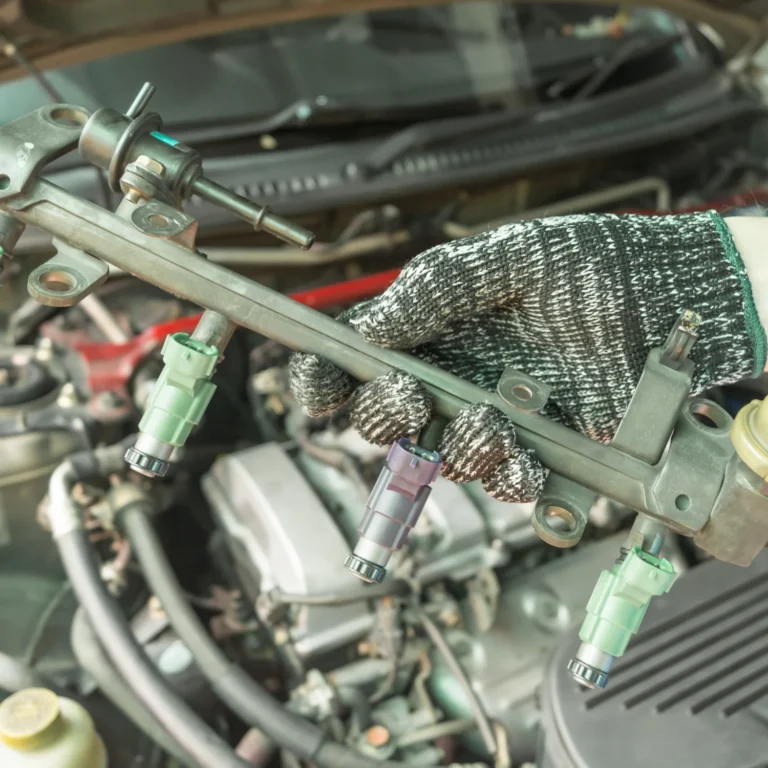
Most gasoline engines need 30-60 PSI at the rail (check your model’s spec—e.g., many Hondas/Toyotas around 40-50 PSI key-on, engine-off).
Rent a gauge from AutoZone. Connect to Schrader valve on fuel rail.
If pressure low: Clogged filter first ($20-50 part), then pump.
Clean the MAF Sensor
I’ve revived dozens of sluggish cars with this 10-minute job.
Locate MAF (between air box and throttle body). Unplug, remove 2 screws.
Spray 10-15 bursts of CRC MAF cleaner on the wires. Let dry fully.
Pro tip: Don’t touch the wires or use regular cleaner—ruins it.
If cleaning doesn’t help, replacement $80-200 OEM recommended.
Check for Exhaust Restriction (Clogged Cat)
Engine feels strangled? Rotten egg smell? Cat might be plugged.
Quick test: Vacuum gauge at idle should hold steady 18-22 inHg. If drops under acceleration, restriction likely.
Or loosen O2 sensor before cat— if power returns, it’s clogged.
Replacement: See cost section below.
Ignition and Sensors
Bad plugs/coils cause misfires and power loss under load. Check for codes.
Throttle body dirty? Clean it—common on 100k+ miles.
Common Causes and Real Shop Stories
Here’s what I’ve seen most:
| Cause | Symptoms | DIY Fix Cost | Shop Cost |
|---|---|---|---|
| Clogged Fuel Filter | Hesitation under load, sudden power loss | $20-80 parts | $150-300 |
| Failing Fuel Pump | Power loss at speed, hard starts hot | $200-600 parts | $800-1500 |
| Dirty MAF Sensor | Engine bogging, poor acceleration | $10 cleaner | $100-200 diag/clean |
| Clogged Catalytic Converter | Reduced power, sulfur smell | N/A (welding needed) | $1000-2500 |
| Limp Mode (Sensor Fault) | Sudden reduced power warning | Varies | $200-800 |
Learn more about related issues like poor acceleration causes, fuel system problems, and catalytic converter problems that often tie into sudden power loss, engine loses power, or general power loss diagnosis.
Pro Tip:I’ve saved customers thousands by cleaning a MAF or replacing a $40 fuel filter instead of jumping to “needs new engine.” Always verify basics first.
Cost Analysis: DIY vs Professional
Fuel pump replacement: DIY $300-700 parts (tank drop tough), shop $1000-1500 average in 2025.
Catalytic converter: Rarely DIY-friendly, $1200-2500 shop (parts heavy with precious metals).
MAF clean: DIY $10, shop diag $150.
Money-saving trick: Buy quality parts—cheap pumps fail early. I’ve seen aftermarket cats trigger codes repeatedly.
FAQ
Why does my car lose power while driving but no check engine light?
Common with mechanical issues like clogged filter or weak pump. No light until it throws a code under load. Scan anyway—pending codes often show.
How much does it cost to fix sudden power loss?
$100 for simple filter/MAF clean up to $2500 for cat or turbo issues. Average I’ve billed: $400-800.
Is it safe to drive with reduced engine power?
No—pull over safely. Limp mode protects the engine, but you’re limited and vulnerable in traffic.
Can a bad transmission cause engine power loss?
Feels similar—slipping trans revs high no speed. But check engine codes first; trans issues usually set their own.
Will a clogged catalytic converter cause power loss?
Yes, big time. Engine can’t breathe out exhaust. I’ve seen cars barely move with plugged cats.
What’s the difference between engine bogging and limp mode?
Bogging feels sluggish response; limp mode caps RPM/speed with warning light.
Can bad gas cause loss of power?
Absolutely—water or old fuel starves engine. Drain tank if suspected.
Top Loss Of Power While Driving – Our Picks
Final Thoughts from the Bay
Loss of power while driving is frustrating and scary, but 9 times out of 10 it’s something straightforward like fuel delivery or a sensor. Difficulty level: Moderate for most DIYers with basic tools and a scanner.
Total potential cost: $100 for simple fixes to $2000+ for major like cat replacement. Catch it early and you’re looking at pocket change.
Grab a good OBD2 tool, start with the scan, and work methodically. You’ll save money and gain confidence. I’ve watched customers go from panicked to proud after fixing their own ride.
Drive safe out there—if it’s beyond your comfort zone, get it to a trusted shop. Better safe than stranded.