📋 Table of Contents
- 1. Introduction to ATF: Why It Matters
- 2. Understanding ATF: The Semantic Layer
- 3. Synthetic vs. Conventional: A Deep Dive
- 4. Viscosity, Low-Viscosity Fluids & Modern Transmissions
- 5. OEM Specifications: Dexron VI, Mercon LV, Toyota WS & Beyond
- 6. Transmission Types & Fluid Compatibility
- 7. Top Rated ATF Products for 2025
- 8. In-Depth Product Analysis & Recommendations
- 9. How to Check, Maintain & Change Your Fluid
- 10. Troubleshooting Common Transmission Issues
- 11. Frequently Asked Questions (FAQ)
- 12. Conclusion & Next Steps
1. Introduction to Automatic Transmission Fluid: Why It Matters More Than You Think
Your automatic transmission is one of the most sophisticated hydraulic systems in your vehicle. It is not simply an engine oil alternative—it is a purpose-engineered fluid that performs multiple critical functions simultaneously:
- Hydraulic Pressure Generation: ATF creates and maintains the pressure needed to engage and disengage clutch packs, apply brake bands, and shift gears seamlessly.
- Friction Modulation: Friction modifiers in the fluid control the exact grip of clutch plates. Too much friction causes harsh shifts; too little causes slippage and overheating.
- Thermal Regulation: The fluid absorbs heat from friction and transfers it to the transmission cooler, maintaining optimal operating temperatures (typically 160°F–200°F).
- Lubrication: Despite being hydraulic in nature, ATF also reduces wear between gear teeth, bearings, and valve bodies.
- Corrosion & Oxidation Prevention: Additives protect against rust and prevent the fluid from breaking down under high temperature and pressure.
In 2025, transmission tolerances are tighter than ever. A single quart of the wrong fluid specification can trigger:
- Transmission shudder during shifts
- Delayed gear engagement
- Burnt clutch smell
- Overheating and thermal failure
- Complete loss of hydraulic pressure (total transmission failure)
- Voided manufacturer warranty
The Hidden Cost of Wrong Fluid Selection
The average transmission rebuild costs between $2,500 and $4,000 for a basic automatic, and $4,000–$8,000 for modern CVTs and dual-clutch transmissions. A $30–$60 bottle of the correct ATF is a pittance compared to this cost. Yet countless owners save $20 by buying a “universal” fluid, only to face a $3,000 repair 18 months later.
Worse, if the fluid mismatch causes damage before the factory warranty expires, the manufacturer may deny the claim, citing “improper maintenance” or “non-approved fluid.”
2. Understanding Automatic Transmission Fluid: The Semantic Layer
ATF is not a monolithic product. It is a family of fluids, each engineered for a specific transmission type and operating condition. To choose correctly, you must understand the core semantic entities and how they differ.
What Is ATF? A Detailed Definition
Automatic Transmission Fluid is a specialized hydraulic oil formulated to:
- Maintain consistent viscosity (thickness) across a wide temperature range (from −20°F in winter to +300°F inside a transmission)
- Provide precise friction characteristics that allow clutches to modulate torque without slipping or grabbing
- Resist oxidation and thermal degradation far better than conventional motor oil
- Contain anti-wear additives that protect gears and bearings under extreme pressure
- Include detergents and dispersants that keep contaminants in suspension, preventing sludge formation
- Maintain a stable foam resistance, so bubbles do not form and cause erratic pressure
The Evolution of ATF: From Dexron to Modern Specs
The history of ATF specifications reveals how transmission technology has evolved:
- Dexron (1956–1968): Original General Motors specification. Designed for 2-speed and 3-speed automatics.
- Dexron II (1973): Updated for 3-speed to 5-speed transmissions. Still conventional mineral oil.
- Dexron III (1993): Extended service intervals. Introduced better oxidation resistance. Used in most vehicles 1993–2010.
- Dexron VI (2006): Modern standard. Lower viscosity for improved fuel economy. Compatible with 6-speed and 8-speed transmissions. The most common specification today.
- Mercon (Ford equivalent): Ford’s parallel to Dexron. Mercon V is the low-viscosity equivalent to Dexron VI.
- Toyota WS (World Standard): Toyota’s proprietary low-viscosity spec, used in modern Camrys, Corollas, and Highlanders.
- Honda Z1: Honda’s specification for its CVTs and automatics.
- Subaru Lineartronic: Subaru CVT fluid, not interchangeable with other CVT fluids.
This is the manufacturer’s prescribed fluid type. It is found in your owner’s manual (usually under “Capacities and Specifications”). This is not a suggestion—it is a requirement. Using a non-approved fluid is grounds for warranty denial and transmission damage.
3. Synthetic vs. Conventional: A Complete Comparison
The first fork in the road when selecting ATF is the synthetic vs. conventional decision. This choice affects performance, longevity, and cost.
Conventional ATF: The Traditional Approach
Composition: Conventional ATF is refined from crude oil. Base mineral oils are blended with additives (detergents, anti-wear agents, friction modifiers, anti-foam compounds) to meet the OEM specification.
Advantages:
- Lower Cost: Conventional fluids typically cost $4–$10 per quart.
- Proven Track Record: Used in billions of vehicles since the 1970s.
- Backward Compatibility: Older vehicles (pre-2000) were designed for conventional fluids.
Disadvantages:
- Oxidation Sensitivity: Mineral oil oxidizes (breaks down) more readily at high temperatures. Typical service life is 30,000–50,000 miles.
- Thermal Instability: Conventional fluids lose viscosity quickly under sustained heat (e.g., towing in summer). This causes pressure loss and clutch slippage.
- Sludge Formation: Oxidized fluid becomes thick and gunky, clogging valves and restricting flow.
- Poor Cold Flow: In winter, conventional fluids become sluggish, causing delayed shifts and incomplete engagement.
Best For: Pre-2000 vehicles with loose tolerances, occasional drivers with low mileage, budget-conscious owners, and vehicles that will not see extended service intervals.
Synthetic ATF: The Modern Standard
Composition: Synthetic ATF is not derived from crude oil. Instead, it is synthesized from carefully engineered base stocks (such as polyalphaolefins or esters) and blended with advanced additives. The molecular structure is uniform and optimized for transmission performance.
Advantages:
- Superior Thermal Stability: Synthetic fluids resist degradation at high temperatures. They maintain viscosity and friction characteristics even at 300°F+.
- Extended Service Life: Many synthetics can go 60,000–100,000 miles between changes, compared to 30,000–50,000 for conventional.
- Better Cold-Start Performance: Lower pour points allow the fluid to flow freely in sub-zero temperatures, ensuring smooth shifts in winter.
- Lower Oxidation Rate: Synthetic fluids break down much more slowly, reducing sludge and varnish formation.
- Improved Friction Stability: The consistent molecular structure provides more predictable friction modulation, resulting in smoother shifts.
- Better Seal Compatibility: Many synthetics contain conditioners that help prevent leaks in aging seals.
Disadvantages:
- Higher Cost: Synthetic ATF typically costs $8–$20 per quart, 2–3× the price of conventional.
- Potential Incompatibility: Older vehicles designed for conventional fluid may experience seal swelling or compatibility issues (rare, but possible).
- Overkill for Low-Mileage Vehicles: If a car is driven <5,000 miles/year, the extended service life is not needed.
Best For: Modern vehicles (2005+), high-mileage cars (75,000+ miles), towing, performance driving, warm climates, and owners seeking maximum transmission protection.
Synthetic Blend: The Middle Ground
Some manufacturers offer “synthetic blend” ATF—a mixture of mineral oil and synthetic base stocks. These typically offer 50–70% of the thermal and oxidation benefits of full synthetic at 30–50% of the cost. Valvoline MaxLife is a popular synthetic blend.
When to Use: Budget-conscious owners with modern vehicles, or drivers seeking a stepping-stone between conventional and full synthetic.
4. Viscosity, Low-Viscosity Fluids & Modern Transmission Design
Viscosity—the thickness of the fluid—is one of the most misunderstood aspects of ATF selection. It is also one of the most critical.
What Is Viscosity and Why Does It Matter?
Viscosity is measured in centistokes (cSt) at 40°C and 100°C. In simple terms, it describes how “thick” the fluid is.
- Low viscosity: Thin fluid, flows easily, reduces drag, improves fuel economy.
- High viscosity: Thick fluid, provides thicker film protection, better for high-load conditions.
In a transmission, viscosity affects:
- Gear Engagement Speed: Thinner fluid flows faster through solenoids and clutch passages, allowing quicker, smoother shifts.
- Fuel Economy: Thinner fluid reduces parasitic drag on the engine, improving MPG (can add 0.5–2% efficiency).
- Clutch Grip: The friction modifiers in the fluid must work with the viscosity to achieve the right amount of slip. Wrong viscosity = wrong friction characteristics.
- Cooling Efficiency: Thinner fluid flows to the cooler more easily, improving heat dissipation.
Standard Viscosity ATF (Dexron III, Mercon V)
Older specifications like Dexron III and Mercon V are thicker (higher viscosity). They were formulated for 3-speed to 5-speed automatics with looser tolerances and higher friction modulation demands.
Typical viscosity range: 7.5–10 cSt at 100°C.
Used in vehicles: 1970s–2005 (approximately).
Low-Viscosity ATF (Dexron VI, Mercon LV, Toyota WS)
Modern 6-speed, 8-speed, and 10-speed automatics require low-viscosity (LV) fluid. These transmissions have tighter tolerances and are designed to shift faster and more frequently. Thinner fluid is essential for:
- Rapid pressure build-up in solenoid circuits
- Quicker gear changes (shifting times measured in milliseconds)
- Reduced power loss and improved fuel economy
- Better cooling in tight gear sets
Typical viscosity range: 5.5–8 cSt at 100°C.
Common low-viscosity specifications:
- Dexron VI: GM standard since 2006. Used in Chevrolets, Cadillacs, GMCs, and many non-GM vehicles.
- Mercon LV: Ford equivalent to Dexron VI. Used in Fords, Lincolns, Mercurys.
- Toyota WS: Toyota’s proprietary low-viscosity spec, used in modern Camrys, Corollas, Highlanders, Priuses.
- Honda Z1: Honda’s low-viscosity spec for its automatics and CVTs.
⚠️ Critical Warning: Never interchange standard and low-viscosity fluids. This is one of the most common and expensive mistakes in ATF selection.
- Using standard (thick) fluid in a modern LV transmission: The fluid is too thick to flow through the solenoid circuits. Shifts will feel sluggish and delayed. Pressures will not build properly. The transmission will overheat. Expect severe damage within 5,000–10,000 miles.
- Using low-viscosity fluid in an older transmission: The thin fluid cannot provide sufficient friction modulation. Clutch plates will slip. The transmission will shudder and overheat. Expect failure within 2,000–5,000 miles.
The “Multi-Vehicle” Myth
Marketing departments have created a category called “Multi-Vehicle” or “Universal” ATF, claiming a single fluid works across multiple OEM specs. Bottles often claim compatibility with “Dexron III, Dexron VI, Mercon V, Mercon LV, and Honda Z1.”
The Reality: These are formulation compromises. While they may technically meet the bare minimum requirements of multiple specs, they are optimized for none of them. They represent a trade-off in friction modulation, viscosity stability, and thermal performance.
OEM-Spec Fluid: Engineered specifically for your transmission. Superior performance and longevity.
Multi-Vehicle Fluid: Jack-of-all-trades, master of none. Acceptable for emergencies or temporary use, but not ideal for long-term ownership.
When Multi-Vehicle Fluid Is Acceptable:
- Emergency top-up when you cannot find the OEM spec
- As a bridge fluid for a short-term purpose
- For vehicles that will be sold within 1–2 years
When Multi-Vehicle Fluid Is Not Acceptable:
- For long-term ownership (5+ years)
- For high-mileage vehicles (75,000+ miles)
- For vehicles experiencing transmission issues
- For performance or towing applications
5. OEM Specifications Decoded: Dexron VI, Mercon LV, Toyota WS & Beyond
Your vehicle’s owner’s manual specifies exactly which ATF it requires. This section decodes the major OEM specifications in use today.
General Motors: Dexron VI Standard
Used in: Chevrolet, GMC, Cadillac, and select non-GM vehicles (Fiat, Ferrari, Lamborghini, etc.).
Key Characteristics:
- Low-viscosity fluid for 6+ speed automatics
- Improved oxidation resistance vs. Dexron III
- Extended service life (60,000–100,000 miles possible)
- Backward compatible with Dexron III (not vice versa)
Introduced: 2006
Common Dexron VI Fluids: ACDelco Dexron VI, Valvoline Dexron VI, Castrol Transmax, Mobil 1 Synthetic.
Ford: Mercon LV Standard
Used in: Ford, Lincoln, Mercury vehicles (2010+).
Key Characteristics:
- Equivalent to Dexron VI but with Ford-specific friction modifiers
- Low-viscosity design for 6–10 speed automatics
- Not interchangeable with Mercon V (older standard)
- Excellent thermal stability for towing
Introduced: 2010
Common Mercon LV Fluids: Motorcraft Mercon LV, Castrol Transmax, Valvoline MaxLife.
Toyota: WS (World Standard)
Used in: Toyota, Lexus, Scion vehicles (2004+).
Key Characteristics:
- Proprietary Toyota specification
- Very low viscosity, designed for compact gear sets
- Must be used in Toyota CVTs and automatics—no substitutes
- Premium pricing but essential for reliability
Introduced: 2004
Common Toyota WS Fluids: Toyota Genuine WS, Mobil 1 Synthetic ATF, Valvoline MaxLife (some versions).
Honda: Z1 Specification
Used in: Honda, Acura vehicles (2003+).
Key Characteristics:
- Honda’s proprietary specification
- Used in both traditional automatics and CVTs
- Very specific friction characteristics—substitutes not recommended
- Excellent for smooth, responsive shifts
Introduced: 2003
Common Honda Z1 Fluids: Honda Genuine Z1, Mobil 1 Synthetic ATF Z1, some aftermarket synthetics.
Chrysler: ATF+4
Used in: Dodge, Jeep, Chrysler vehicles (1998+).
Key Characteristics:
- Original Mopar specification
- Not compatible with other fluids
- More demanding friction modulation than Dexron VI
- Critical for smooth shifting in older Mopar automatics
Introduced: 1998
Common ATF+4 Fluids: Mopar ATF+4, Valvoline MaxLife, some aftermarket synthetics.
6. Transmission Types & Fluid Compatibility: Not All Automatics Are Created Equal
Not all automatic transmissions use the same fluid. In fact, using the wrong fluid for your specific transmission type is a critical error that can cause catastrophic damage within weeks.
Traditional Automatics (Planetary Gear Sets)
How They Work: Traditional automatics use a system of planetary gear sets, brake bands, and multiple clutch packs. The fluid engages and disengages these components via hydraulic pressure.
- Standard ATF (Dexron III, Dexron VI, Mercon V, Mercon LV, ATF+4)
- Friction modifiers that allow smooth clutch engagement
- Viscosity appropriate to your specific OEM spec
Fluid Compatibility: Most traditional automatics are flexible. A 2010 GM vehicle using Dexron VI can accept a quality aftermarket Dexron VI fluid without issue. However, always verify your OEM spec first.
Common Vehicles: Most sedans, SUVs, and trucks built before 2020.
CVT (Continuously Variable Transmission)
How They Work: CVTs replace fixed gear ratios with a belt or chain that continuously adjusts its position on variable-diameter pulleys. This allows infinite gear ratio adjustments, resulting in smoother acceleration and better fuel economy.
Fluid Requirements: CVT fluids are fundamentally different from traditional ATF. The friction modifiers must:
- Prevent Belt Slipping: The fluid must maintain a very specific coefficient of friction so the belt grips the pulleys without slipping.
- Protect Against Metal Debris: CVTs generate more metal particles than traditional automatics. The fluid must suspend and separate these particles.
- Maintain Viscosity Stability: Even tiny viscosity variations can cause belt slippage or shudder.
Critical Warning: Standard ATF will destroy a CVT. The friction modifiers are incompatible with the belt material. Within 1,000–5,000 miles, you will experience severe shudder, slipping, and complete transmission failure.
Common CVT Specifications:
- Honda CVT Fluid: Proprietary to Honda automatics.
- Toyota CVT Fluid (FE/FE0): Used in Toyota, Lexus, and some Subaru CVTs.
- Subaru Lineartronic Fluid: Proprietary to Subaru CVTs. Not interchangeable with Toyota CVT fluid.
- Nissan CVT Fluid (NS2): Used in Nissan and Infiniti CVTs.
Fluid Cost & Availability: CVT fluids are more expensive ($15–$25/quart) and less widely available than standard ATF. When the time comes for a CVT fluid change, this should factor into your vehicle purchase decision.
Common Vehicles: Honda Civic, Honda Accord (many models), Toyota Camry (many models), Nissan Altima, Subaru Outback, Jeep Renegade.
DCT (Dual Clutch Transmission)
How They Work: A DCT is essentially two manual transmissions in one housing. Two separate clutches alternate shifts between odd and even gears, allowing faster, more efficient gear changes than traditional automatics or CVTs.
Fluid Requirements: DCT fluids must serve dual roles:
- Gear Oil: Lubricating the gears
- Hydraulic Fluid: Controlling the clutches
This demands a specialized formulation with:
- Higher viscosity than traditional ATF (more gear oil-like)
- Precise friction modulation for smooth clutch modulation
- Excellent anti-wear protection
Critical Warning: DCT fluids are not interchangeable with standard ATF or other transmission types. The fluid must be OEM-spec. Using the wrong fluid will cause harsh shifts, clutch slip, or complete hydraulic failure.
Common DCT Specifications:
- Volkswagen/Audi DQ250/DQ500: Used in Volkswagen, Audi, Porsche, Lamborghini.
- BMW ZF 8-Speed: Used in BMW and Mini Cooper.
- Ford PowerShift: Used in Ford Fiesta, Focus (some markets).
- Hyundai/Kia DCT: Increasingly common in modern Hyundai and Kia vehicles.
Fluid Cost & Complexity: DCT fluid changes require special equipment and dealer knowledge. A simple drain-and-fill may cost $200–$400. A full flush can exceed $600–$800.
Common Vehicles: Volkswagen Golf, Audi A3, BMW 3-Series, Ford Fiesta, Hyundai Elantra (some models).
7. Top Rated ATF Products for 2025: Tier-Ranked Recommendations
Best ATF Fluids for 2025
As an Amazon Associate, VehicleBar earns from qualifying purchases at no extra cost to you.
TIER 1: Best Overall
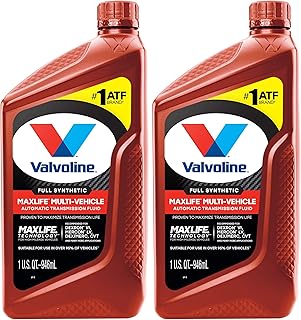
Valvoline MaxLife ATF
Synthetic Blend | Multi-Vehicle | Dexron VI/Mercon LV Compatible
TIER 1: Premium Choice


8. In-Depth Product Analysis: Why These Fluids Rank Highest
Tier 1: Valvoline MaxLife Multi-Vehicle ATF
Why It Wins
Valvoline MaxLife is the “Swiss Army Knife” of transmission fluids. It is a synthetic blend that covers an unusually broad range of OEM specifications:
- Dexron VI (GM)
- Mercon LV (Ford)
- Toyota WS
- Honda Z1
- Chrysler ATF+4
- Backward compatible with older Dexron III and Mercon V vehicles
The formulation includes seal conditioners that actively help rejuvenate dried-out seals in high-mileage vehicles. This can prevent small leaks from becoming major problems.
Thermal & Oxidation Performance
Valvoline MaxLife offers excellent oxidation resistance. In laboratory testing, it maintains viscosity stability to approximately 250°F, making it suitable for towing and warm climates.
Real-World Performance
In real-world use, owners report:
- Smoother shifts after fluid change
- Reduced transmission shudder in high-mileage vehicles
- No fluid leaks after using the product (attributed to seal conditioning)
- Consistent performance across multiple vehicle types within a household
Best Applications
- Daily drivers (50,000–150,000 miles): Excellent choice for vehicles that have accumulated significant mileage.
- Multi-vehicle households: If you own a Chevy, Ford, and Toyota, one fluid covers all three.
- Preventative maintenance: The seal conditioning properties can extend transmission life.
- Budget-conscious owners: Synthetic blend pricing without sacrificing quality.
Cost
Approximately $8–$12 per quart. For a typical 6–8 quart transmission, expect $48–$96 per service.
Tier 1: Mobil 1 Synthetic ATF
Why It Wins
Mobil 1 Synthetic ATF is a full synthetic (not a blend) engineered for maximum performance. It is often the factory fill fluid for luxury vehicles (BMW, Porsche, Lamborghini) and high-performance cars.
The formulation emphasizes shear stability—the ability to maintain viscosity under extreme pressure. In modern 8 and 10-speed automatics, the fluid is subjected to intense pressure and shear forces. Mobil 1 resists viscosity breakdown better than competing products.
Thermal Stability
Mobil 1 maintains its viscosity and friction characteristics to approximately 280°F, making it exceptional for:
- Towing heavy loads in summer heat
- Performance driving (spirited acceleration, repeated hard shifts)
- Vehicles driven in desert or tropical climates
Real-World Performance
Owners of performance vehicles and those who tow regularly report:
- The sharpest, quickest shifts of any ATF tested
- No transmission temperature elevation during highway towing
- Consistent performance even in sustained high-heat situations (mountain passes, desert driving)
- The longest service life before fluid degradation becomes apparent
Best Applications
- Performance vehicles: Sports cars, high-torque engines, those seeking maximum shift responsiveness.
- Towing: If you regularly tow trailers or haul cargo, Mobil 1’s thermal stability is worth the premium.
- Newer vehicles (2015+): Modern 8 and 10-speed automatics benefit most from full synthetic properties.
- Owners seeking maximum longevity: The superior anti-wear package means fewer wear particles and longer transmission life.
Cost
Approximately $15–$20 per quart. For a typical transmission, expect $90–$160 per service.
Tier 2: Castrol Transmax Full Synthetic
Why It Wins
Castrol Transmax is a full synthetic that emphasizes smooth shift quality. Castrol’s proprietary “Fluid Strength Technology” uses advanced friction modifiers that:
- Smooth out rough, hesitant shifts
- Reduce shift shudder in vehicles with slightly worn clutch packs
- Improve responsiveness in older automatics
This makes it particularly valuable for vehicles experiencing minor transmission issues short of complete failure.
Thermal & Oxidation Performance
Castrol Transmax is formulated for excellent thermal stability, maintaining viscosity to approximately 260°F. It is often recommended for:
- Heavy-duty towing applications
- Vehicles driven in consistently warm climates
- High-stress driving patterns (frequent city driving with stop-and-go shifts)
Real-World Performance
Users report:
- Noticeably smoother shifts within 100 miles of a fluid change
- Reduced “slip and grab” feeling in automatics with worn friction material
- No transmission overheating during towing
- A “quieter” transmission overall (less noise during shifts)
Best Applications
- High-mileage vehicles (100,000+ miles): The friction modifiers are optimized for worn transmissions.
- Towing applications: Excellent thermal stability and shift quality under load.
- Vehicles with shift quality issues: If your transmission hesitates or shudders slightly, Castrol’s friction package can help.
- Budget-conscious full-synthetic seekers: Priced between MaxLife and Mobil 1.
Cost
Approximately $12–$16 per quart. For a typical transmission, expect $72–$128 per service.
Valvoline MaxLife
Type: Synthetic Blend
Mobil 1 Synthetic
Type: Full Synthetic
Castrol Transmax
Type: Full Synthetic
9. How to Check, Maintain & Change Your Transmission Fluid
The Dipstick Check Procedure (Traditional Automatics)
Many modern vehicles have eliminated the transmission dipstick, relying on sealed systems. However, if your vehicle has a dipstick, regular checking is important.
Step-by-Step Dipstick Check
Interpreting the Dipstick
Fluid Level: The dipstick will have two marks (HOT and COLD, or MIN and MAX for warm fluid). The level should be between these marks when the fluid is at operating temperature.
Fluid Color & Smell:
- Bright Pink/Red: New fluid. Normal.
- Light Brown: Expected after 10,000–20,000 miles. Normal.
- Dark Brown or Black: Oxidized, burnt fluid. Change immediately.
- Reddish-Brown with Metallic Sheen: Metal particles in the fluid. Transmission damage likely. Seek professional diagnosis.
- Sweet, “Burnt Toast” Smell: Clutch material burning. Change fluid immediately and have transmission inspected.
- Strong, Acrid Smell: Severe overheating. Stop driving immediately.
⚠️ Critical Warning: Do not overfill. Transmission fluid expands as it heats. Overfilling causes the fluid to aerate (foam), which:
- Reduces hydraulic pressure
- Causes erratic, harsh shifts
- Increases friction, generating heat
- Accelerates fluid degradation
- Can lead to complete transmission failure
Fill to the middle of the HOT range, not the maximum.
Transmission Fluid Change Methods
Method 1: Drain and Fill (Recommended for High-Mileage Vehicles)
How It Works: You drain the ATF from the transmission pan via the drain plug, and refill with fresh fluid.
Fluid Replaced: Approximately 30–50% of the total fluid. The rest remains in the torque converter, cooler lines, and valve body.
Cost: $200–$400 (DIY: $50–$100 in fluid + supplies)
Advantages:
- Safest method for high-mileage vehicles with potential internal damage
- Less stress on seals and valve bodies
- Lowest risk of dislodging debris and causing failure
- Can be done more frequently (every 30,000–50,000 miles)
Disadvantages:
- Does not fully replace the fluid (40–50% old fluid remains)
- Multiple drain-and-fill cycles needed to fully renew the fluid
Best For: High-mileage vehicles (100,000+ miles), vehicles with history of overheating, vehicles in unknown condition.
Method 2: Transmission Flush (Full System Exchange)
How It Works: A specialized machine connects to the transmission cooler lines and forces new fluid through the entire system, displacing 100% of the old fluid.
Fluid Replaced: Approximately 100% (torque converter, cooler, lines, valve body).
Cost: $400–$800 (depending on vehicle and location)
Advantages:
- Complete fluid replacement
- Removes accumulated sludge and varnish
- Highest probability of fully restoring transmission cleanliness
Disadvantages:
- Higher cost
- In very neglected transmissions, can dislodge large debris that clogs passages (rare, but risky)
- More stress on aging seals
Best For: Well-maintained vehicles, newer vehicles, vehicles with clean service history.
Fluid Change Intervals by Vehicle Age & Mileage
| Vehicle Age | Mileage | Conventional ATF Interval | Synthetic ATF Interval | Notes |
|---|---|---|---|---|
| 0–5 years | 0–50,000 miles | Every 30,000 miles (severe) / 50,000 (normal) | Every 60,000–80,000 miles | New vehicles: follow manufacturer recommendation |
| 5–10 years | 50,000–100,000 miles | Every 30,000 miles | Every 50,000–60,000 miles | Increased interval due to synthetic properties |
| 10+ years | 100,000+ miles | Every 20,000–30,000 miles (consider more frequent) | Every 40,000–50,000 miles | High-mileage vehicles: more frequent changes recommended |
Severe Driving Conditions: Reduce intervals by 25–30% if you regularly:
- Tow trailers or haul cargo
- Drive in stop-and-go city traffic
- Drive in consistently hot climates (above 85°F average)
- Make frequent short trips without warm-up periods
10. Troubleshooting Common Transmission Issues Related to Fluid
Transmission Shudder During Shifts
Symptoms: A vibration or shuddering feeling during acceleration or gear changes, often accompanied by a “grabbing” sensation.
Primary Cause: Degradation of friction modifiers in the ATF. The clutch plates grab and release rapidly instead of smoothly engaging.
Solution:
- Check and smell the fluid. Dark brown or black = fluid is burnt.
- Drain and fill with fresh, OEM-spec ATF.
- If the problem persists after a fluid change, the transmission likely has internal wear and requires professional service.
Delayed Engagement (Transmission Takes Time to Shift into Gear)
Symptoms: A 1–3 second delay when shifting from Park to Drive or Reverse, as if the transmission is “thinking.”
Primary Cause: Low fluid level or excessively viscous (thick) fluid that flows slowly through solenoid circuits.
Solution:
- Check fluid level. Top off if low.
- If fluid is old, dark, or excessively thick, perform a drain and fill with the correct fluid spec.
- If the problem persists, the transmission’s valve body or solenoids may be sticking. Professional diagnosis needed.
Transmission Overheating (Warning Light, Limp Mode)
Symptoms: Dashboard warning light, reduced power, transmission stuck in one gear, or a burning smell.
Primary Cause: Fluid breakdown due to age, wrong viscosity, or insufficient cooling capacity.
Solution:
- Immediate: Stop driving. Check fluid level and condition.
- Short-term: Perform a drain and fill with fresh, correct-spec ATF.
- Medium-term: Check transmission cooler and cooling fins for blockage or dirt. A clogged cooler can cause overheating even with fresh fluid.
- If persistent: Professional transmission service required.
Fluid Leaks
Symptoms: Red fluid visible under the car, puddles in the driveway, or a sharp, acrid smell.
Possible Causes: Worn seals, cracked pan, loose drain plug, or (rarely) an overfilled transmission.
Solution:
- First: Check fluid level. It may be lower than expected.
- Second: Inspect the transmission pan and drain plug for visible damage or looseness.
- Third: Try a fluid change with a synthetic fluid that includes seal conditioners (e.g., Valvoline MaxLife). Small leaks sometimes improve with better sealing.
- If leak persists: Professional transmission service, seal replacement, or pan gasket service needed.
Burnt Smell (Clutch Burning)
Symptoms: A strong, sweet “burnt toast” or acrid smell, often with visible smoke or steam.
Primary Cause: Clutch plates slipping excessively, generating friction and heat beyond the fluid’s cooling capacity.
Solution:
- Immediate: Pull over safely. Turn off the engine and allow to cool (do not drive further).
- Check fluid: The fluid may be excessively dark, indicating severe overheating.
- Possible causes:
- Wrong fluid viscosity (too thin, causing slippage)
- Severely degraded friction modifiers
- Internal transmission wear causing clutch slip
- Solution: Professional transmission diagnostic. The transmission may be near failure.
11. Frequently Asked Questions (FAQ)
Q: Can I mix different brands of ATF as long as the specification matches?
A: Yes, as long as both fluids meet the same OEM specification (e.g., both are Dexron VI), mixing is generally safe. However, it is not ideal. Different manufacturers use different friction modifiers and additives, and mixing can reduce effectiveness. For optimal performance, stick to one brand. In an emergency, mixing brands of the same spec is acceptable as a temporary solution.
Q: What does “Lifetime Fluid” or “Lifetime ATF” mean?
A: It is marketing terminology used by manufacturers to reduce perceived maintenance costs at sale. “Lifetime” typically refers to the manufacturer’s warranty period (usually 3–10 years or 30,000–100,000 miles), not the actual mechanical life of the transmission. In reality, “lifetime fluid” degrades over time and may cause problems after 80,000–120,000 miles.
Our Recommendation: Change “lifetime” fluid every 60,000–100,000 miles or every 5–7 years, whichever comes first, regardless of manufacturer claims. This prevents potential issues and can extend overall transmission life by 50,000+ miles.
Q: Why is my transmission shuddering after a fluid change?
A: Possible causes:
- Wrong fluid spec used: If you switched to a different specification (e.g., Dexron VI instead of Toyota WS), the friction characteristics are incompatible. Replace with the correct spec immediately.
- Fluid not properly “settled”: New fluid needs a short break-in period. Drive gently for 20–30 miles to allow the friction modifiers to distribute evenly. Shudder may improve or disappear.
- Air bubbles in the system: If fluid was overfilled, aeration can cause shudder. Check level and adjust to the correct range.
- Existing internal wear: If the transmission had worn clutch packs before the fluid change, the new fluid’s superior friction modulation can sometimes make the wear more apparent. The transmission may need professional service.
Q: Is synthetic ATF worth the extra cost?
A: Yes, for most modern vehicles. Here is the math:
- Conventional ATF: Change every 30,000 miles, $30–$50 per change = $100–$150 per 100,000 miles.
- Synthetic ATF: Change every 60,000 miles, $80–$120 per change = $130–$200 per 100,000 miles.
The cost difference is minimal, and synthetic provides:
- Longer service intervals (fewer changes overall)
- Better protection in hot climates or when towing
- Reduced risk of transmission failure (insurance against a $4,000 repair)
Exception: If you drive <5,000 miles/year, the extended service life is not fully utilized. Conventional fluid may be acceptable.
Q: Can I use transmission fluid as a substitute for power steering fluid?
A: No, do not do this. Although both are hydraulic fluids, they have different viscosities, friction profiles, and additives. Using ATF in a power steering system can cause:
- Erratic power steering behavior
- Seal degradation
- Pump damage
Always use the fluid specified in your owner’s manual.
Q: How long does transmission fluid last in storage?
A: Properly stored ATF (sealed, cool, dark location) can last 3–5 years. However, after opening, the fluid should be used within 6–12 months, as it oxidizes when exposed to air. Never reuse drained fluid—it has accumulated wear particles, water, and contaminants.
Q: What is the difference between a transmission cooler and a transmission fluid cooler?
A: They are the same thing. The “transmission cooler” is a heat exchanger that removes heat from the ATF. It works by circulating fluid through a small radiator-like core, where air passing through cools the fluid. A clogged or inefficient cooler is a common cause of transmission overheating.
12. Conclusion & Next Steps: Protect Your Transmission Investment
Your automatic transmission is a marvel of engineering—and a vulnerability. A $30 bottle of the correct ATF today can prevent a $4,000 rebuild next year.
The Key Takeaways
- Verify Your OEM Spec: Check your owner’s manual for the exact ATF specification. This is not a suggestion; it is a requirement.
- Understand Your Transmission Type: Traditional automatic, CVT, or DCT require different fluids. Using the wrong type is catastrophic.
- Choose Synthetic for Modern Vehicles: The cost difference is minimal, and the protection is substantial.
- Establish a Change Schedule: Conventional ATF every 30,000–50,000 miles. Synthetic every 60,000–80,000 miles. High-mileage vehicles may benefit from more frequent changes.
- Monitor Fluid Condition: Regular dipstick checks catch problems early. Dark, burnt, or metallic-scented fluid demands immediate attention.
- Act on Warning Signs: Shudder, delayed engagement, overheating warnings, or burnt smells are not cosmetic issues—they are signs of imminent failure. Address them immediately.
Tier-Based Recommendation Summary
Budget-Conscious
Valvoline MaxLife
Synthetic blend, multi-vehicle compatibility, seal conditioning. The best value for most drivers.
Cost: $48–$96/service
Balanced Performance
Castrol Transmax
Full synthetic, excellent shift smoothness, great for high-mileage and towing.
Cost: $72–$128/service
Maximum Protection
Mobil 1 Synthetic
Full synthetic, superior thermal stability, ideal for performance and towing. The best transmission fluid available.
Cost: $90–$160/service
Your Action Plan
- Today: Find your vehicle’s owner’s manual (physical copy or PDF online). Note the ATF specification under “Capacities and Specifications.”
- This Week: Check your transmission fluid level and condition using the dipstick method (if your vehicle has one). Note color and any burnt smell.
- If fluid is old or dark: Order the correct fluid and schedule a drain and fill at a trusted mechanic or DIY if experienced. Use one of the recommended fluids above.
- Going Forward: Establish a regular change schedule based on your vehicle age, mileage, and driving conditions. Mark calendar reminders.
- Monitor Dashboard: Transmission warning lights are serious. Do not ignore them. They indicate overheating, pressure loss, or other critical issues.