The $3 Filter That Nearly Killed a $28,000 Engine
It was sweltering in the Bay Area last August—104°F with that dry, dusty Central Valley wind blowing through the shop doors. A woman pulled up in a 2019 Toyota RAV4, saying it “just doesn’t feel right.” Hesitation on takeoff, rough idle at red lights, and that unsettling *putt-putt* when she accelerated onto the freeway.
I popped the hood and found an air filter so caked in dust and pollen it looked like a chimney sweep’s rag. You couldn’t even see light through it. When I pulled it out, 3/4 of the pleats were completely sealed shut.
“How long since you last checked this?” I asked.
“Never,” she said. “I thought it lasted the life of the car.”
That filter cost $3. The carbon buildup it caused in the intake manifold? Nearly $800 to clean. And if she’d kept driving another 5,000 miles, the MAF sensor and catalytic converter would’ve been next. All because no one told her to watch for the early signs of a dirty air filter.
After 16 years as an ASE-certified master tech, I can tell you this: your engine breathes like you do. Starve it of clean air, and it *will* choke. Here are the 7 symptoms I see most—and why ignoring them is a fast track to expensive repairs.
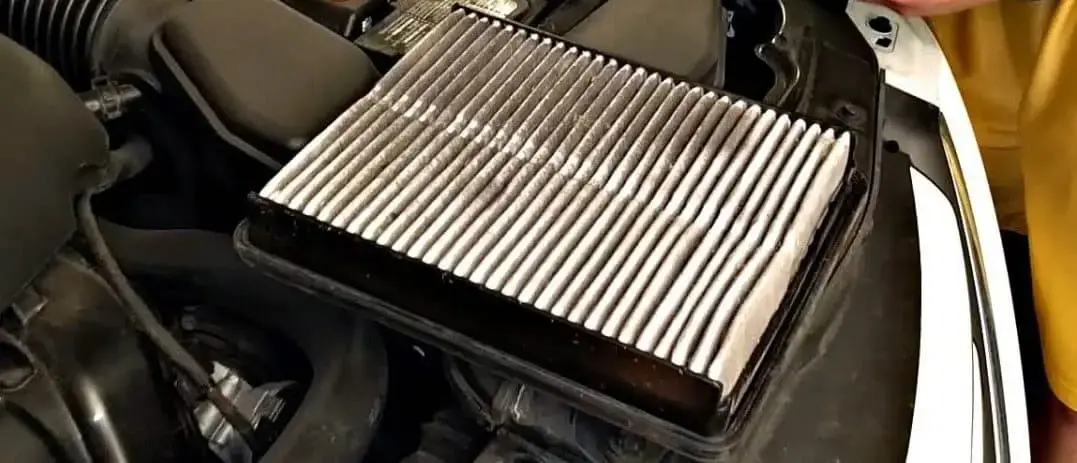
Why Your Engine Needs Clean Air (And What Happens When It Doesn’t)
Your engine is an air pump. For every gallon of fuel it burns, it needs about **9,000 gallons of air**. That air passes through the air filter before hitting the mass airflow (MAF) sensor, throttle body, and combustion chamber.
When the filter gets clogged:
- Airflow drops → engine runs rich (too much fuel, not enough air)
- MAF sensor reads incorrectly → ECU miscalculates fuel trim
- Combustion becomes inefficient → power drops, emissions rise
- Carbon builds up on valves and pistons → long-term wear
I’ve seen intake manifolds on direct-injection engines (like Ford EcoBoost or VW TSI) completely coated in black gunk after 60,000 miles with a neglected filter. Cleaning that isn’t just labor-intensive—it’s preventable.
Dirty Air Filter Symptom #1: Reduced Engine Performance
This is the most common complaint: “My car feels sluggish.”
When airflow is restricted, the engine can’t make full power. You’ll notice it most during:
- Merging onto highways
- Climbing hills
- Passing slower vehicles
The ECU may even trigger “limp mode” to protect the engine, capping RPMs at 3,000–4,000. If you’re experiencing this, check the air filter before assuming it’s a fuel pump or turbo issue. Many [acceleration problems](poor-acceleration-causes) start with something as simple as a clogged filter.
Dirty Air Filter Symptom #2: Poor Fuel Economy
Counterintuitive, but true: a dirty air filter can **lower MPG**.
Here’s why: the oxygen sensors detect excess fuel in the exhaust (because there’s not enough air to burn it). The ECU responds by *not reducing fuel*, trying to “correct” a problem that’s actually airflow-related. Result? You burn more gas for less power.
In EPA testing, a severely restricted filter reduced fuel economy by **6–11%** in older port-injected engines. On modern direct-injection engines, the effect is smaller but still measurable—especially in stop-and-go traffic.
If your MPG dropped suddenly and you haven’t changed driving habits, pop the air box before blaming the gas station.
Dirty Air Filter Symptom #3: Rough Idle or Stalling
A rough idle—especially one that worsens when the A/C kicks on—is a classic sign of airflow restriction.
At idle, the engine needs a precise air/fuel mix. If the filter is 70%+ blocked, the throttle body can’t pull enough air through the MAF sensor housing. The ECU overcompensates with fuel, causing misfires or unstable RPMs.
I’ve diagnosed dozens of “rough idle” complaints that turned out to be nothing more than a $15 filter. One 2016 Nissan Altima idled so badly the owner thought it needed new spark plugs. We swapped the filter in 8 minutes. Idle smoothed out instantly.
Dirty Air Filter Symptom #4: Black Smoke from Exhaust
Black smoke = unburned fuel exiting the tailpipe. It’s not just dirty—it’s a sign your engine is running **extremely rich**.
When airflow is restricted, the ECU dumps in extra fuel, but there’s not enough oxygen to combust it fully. The result? Soot and carbon particles blow out as black smoke, especially under acceleration.
This isn’t just cosmetic. That soot can coat your oxygen sensors and clog your catalytic converter—a $1,200+ repair. If you see black smoke, check the air filter immediately. Learn more about [exhaust smoke causes](black-smoke-from-exhaust) to rule out injector or turbo issues.
Dirty Air Filter Symptom #5: Check Engine Light (With Specific Codes)
Yes—a dirty air filter can absolutely trigger the check engine light.
Common codes I see in the shop:
- P0172 – System Too Rich (Bank 1)
- P0175 – System Too Rich (Bank 2)
- P0101 – MAF Sensor Performance
- P0300 – Random Misfire (due to rich condition)
Here’s the trap: many shops will replace the MAF sensor or O2 sensors without checking the filter first. But if the filter is clogged, the new sensor will just read the same bad data.
Always inspect the air filter *before* replacing sensors. It’s the first step in our diagnostic flowchart—and it’s saved customers thousands in unnecessary parts.
Dirty Air Filter Symptom #6: Engine Misfires or Hesitation
That stutter when you press the gas? It’s often a lean/rich swing caused by inconsistent airflow.
As the filter clogs unevenly, airflow becomes turbulent. The MAF sensor sends erratic signals, and the ECU can’t stabilize fuel delivery. Result: momentary misfires, especially between 1,500–3,000 RPM.
This is especially common in dusty or rural areas. I keep a stack of extra filters for customers who drive on dirt roads—one Ford F-150 owner in Modesto replaces his every 10,000 miles and has 240,000 on the original engine.
Dirty Air Filter Symptom #7: Excessive Engine Wear Over Time
This one’s silent—but deadly.
A severely restricted filter can collapse under high vacuum, allowing unfiltered air to bypass the media. But even before that, the engine runs hotter and dirtier.
On direct-injection engines (which don’t wash intake valves with fuel), carbon buildup accelerates. Valves get coated, airflow drops further, and compression suffers.
I’ve torn down 80,000-mile turbo engines with intake valves so black they looked like charcoal briquettes—all because the owner never changed the air filter.
How to Inspect Your Air Filter (Step-by-Step)
Locate the air box. It’s usually a black plastic housing near the front of the engine bay, connected to a large hose leading to the throttle body. On most Fords, it’s driver-side; on Toyotas, passenger-side.
Open the housing. Most use clips or 8–10mm bolts. Use a flathead screwdriver to release clips gently—don’t break the tabs. [Diagram: Air box with clip locations labeled]
Remove the filter. Note the direction of airflow (marked with an arrow). Hold it up to a bright light. If you can’t see light through more than 50% of the surface, it’s time to replace it.
Check for oil contamination. If you have a performance filter (like K&N), it should be lightly oiled. But if it’s soaked or dripping, it can foul the MAF sensor. OEM paper filters should be dry and clean.
Clean the air box. Wipe out dust and debris with a dry cloth. Never use compressed air—it can force dirt into the intake tract.
DIY Replacement: What You’ll Need
Must-Have Tools
- New air filter – Exact OEM or compatible aftermarket (see table below)
- 8mm socket or flathead screwdriver – for housing clips/bolts
- Clean rag – to wipe air box
Nice-to-Have
- Flashlight (for inspection)
- Gloves (filters can be grimy)
Most replacements take **5–15 minutes** and require no special tools. Filters are available at AutoZone ($10–$25) or Amazon with same-day delivery.
OEM vs. Aftermarket Filter Comparison
| Vehicle Example | OEM Part Number | Price | Aftermarket Equivalent |
|---|---|---|---|
| 2020 Ford F-150 | FL-2067 | $22 | Fram CA10973, Bosch 3324 |
| 2018 Honda Civic | 17220-T1M-A00 | $18 | K&N 33-2461 (reusable), Wix 49522 |
| 2019 Toyota Camry | 17801-06040 | $16 | Denso 17801-06040, ACDelco A3581C |
I stick with OEM or Wix/Fram for most customers. K&N filters are fine if maintained properly—but I’ve cleaned MAF sensors ruined by over-oiled K&Ns more times than I can count.
When to Replace: Beyond the 12k-Mile Myth
“Replace every 12,000 miles” is a lie dealers tell to sell service.
Real-world intervals depend on your environment:
- City driving (clean air): 20,000–30,000 miles
- Dusty/rural roads: 10,000–15,000 miles
- Stop-and-go traffic: 15,000 miles
- Towing or high-load use: 12,000 miles
Check it every oil change. If it looks dirty, replace it. Learn more about [when to replace air filter](when-to-replace-air-filter) based on your driving habits.
Cost Analysis: DIY vs. Professional
DIY Air Filter Replacement
- Air filter: $10–$30
- Tools: $0 (if you own basic hand tools)
- Time: 10 minutes
- Total Cost: $10–$30
Professional Service
- Dealership: $60–$120 (includes “inspection fee”)
- Independent shop: $35–$60
Long-Term Savings: Replacing your own filter every 20k miles vs. paying a shop saves ~$600 over 120,000 miles. Plus, you avoid unnecessary diagnostics.
Troubleshooting: Is It Really the Air Filter?
Not every symptom points to the filter. Use this decision tree:
- If you have rough idle AND black smoke → Check air filter first.
- If you have poor acceleration BUT clean air filter → Investigate fuel system or [acceleration problems](poor-acceleration-causes).
- If check engine light is on with P0172 → Inspect filter, then MAF sensor, then vacuum leaks.
- If black smoke appears only under heavy load → Could be turbo or injector issue—see [exhaust smoke causes](black-smoke-from-exhaust).
Don’t assume it’s the filter if:
- Smoke is blue (burning oil)
- Idle is smooth but power is low (could be fuel pump)
- Filter looks clean but symptoms persist (check for collapsed intake hose)
Frequently Asked Questions
How much does it cost to replace an air filter?
DIY: $10–$30 for the filter. Professional service: $35–$120. It’s one of the cheapest and easiest maintenance items you can do yourself. Most take less than 10 minutes—no tools required on many models.
Can a dirty air filter cause a check engine light?
Yes. Common codes include P0172 (System Too Rich) and P0101 (MAF Performance). The restricted airflow tricks the ECU into adding too much fuel or misreading air volume. Always inspect the filter before replacing sensors.
Will a new air filter improve gas mileage?
On older vehicles (pre-2005), yes—up to 10% improvement. On modern fuel-injected cars, the effect is smaller (1–3%) because the ECU compensates. But you’ll definitely notice better throttle response and smoother idle.
How do I know if my air filter is really dirty?
Hold it up to a bright light. If you can’t see light through at least half the surface, it’s too dirty. Also look for: dirt embedded deep in pleats, tears, or oil saturation (on performance filters). When in doubt, replace it—it’s cheap insurance.
Can I clean and reuse a paper air filter?
No. Paper filters are not washable. Attempting to clean them damages the media and reduces efficiency. Only reusable filters (like K&N) can be cleaned—but must be re-oiled correctly. For 95% of drivers, a $15 OEM paper filter is the smartest choice.
What happens if I drive with a completely blocked air filter?
The engine may stall, run extremely rich, and overheat. In severe cases, the filter element can collapse, allowing unfiltered air—and dirt—into the engine. That dirt scores cylinder walls and kills piston rings. Don’t risk it. Replace at the first sign of restriction.
Final Word: Breathe Easy
Spotting dirty air filter symptoms early is one of the easiest ways to protect your engine and save money. All seven signs—rough idle, black smoke, poor fuel economy, reduced performance, check engine light, hesitation, and long-term wear—start subtly but escalate fast.
Difficulty level? **Easy.** Total cost? **Under $30.** Time required? **Less than your coffee break.** And if you follow our [air filter replacement steps](how-to-replace-engine-air-filter), you’ll never pay a shop markup again.
After 16 years under the hood, I’ll tell you this: the healthiest engines I see belong to owners who check their air filter every oil change. It’s not glamorous, but it’s effective. Your engine breathes 9,000 gallons of air for every gallon of gas—give it clean air, and it’ll reward you with miles, power, and reliability.