
P0420 Catalyst Code: Complete Guide
P0420 Catalyst Code: What It Means, Why It Happens, and How to Fix It (Without Guessing)
The P0420 catalyst code is one of the most common OBD-II diagnostic trouble codes. It points to a specific failure in your vehicle’s emissions control system. When it appears, the engine control module (ECM) has detected a catalytic converter working below its required efficiency threshold. That threshold is typically below 90% conversion effectiveness. This is not a generic “check engine” warning. It is a targeted diagnostic. The code tells you the catalyst is not cleaning exhaust gases as designed. That triggers the malfunction indicator lamp on your dashboard.
Understanding the P0420 catalyst code requires grasping its core attributes. These include the diagnostic criteria the ECM uses, the Bank 1 location reference, and the oxygen sensor readings that trigger the fault. You also need to know the difference between a failing catalyst and a false positive from a faulty sensor. This article covers the full diagnostic workflow. It starts with the code’s technical definition and common causes. It moves through cost-effective repair strategies and the tools you need to verify the fix. You will learn why the catalyst efficiency threshold matters. You will also see how upstream and downstream oxygen sensors interact to generate this code. Finally, you will learn what your repair options actually cost in 2026.
What sets this guide apart is its focus on eliminating guesswork. We do not tell you to simply replace the catalytic converter. That part can cost anywhere from $600 to $2,500 depending on your vehicle. Instead, we provide a structured diagnostic tree. This tree separates genuine catalyst failure from common false triggers. Those triggers include exhaust leaks, faulty oxygen sensors, and engine misfires. You will get real-world data on diagnostic success rates. You will also see a comparison of OEM versus aftermarket converter options. We include honest limitations of each repair path. By the end, you will know exactly what the P0420 catalyst code means for your specific vehicle. You will have a clear, data-backed action plan to resolve it.
What Is the P0420 Catalyst Code? (Definition and Diagnosis Logic)

If your check engine light is on and a scan tool reads the P0420 catalyst code, your vehicle’s powertrain control module has detected a problem. The catalytic converter on Bank 1 is operating below its expected efficiency threshold. This is one of the most common OBD-II diagnostic trouble codes. It appears across virtually every make and model sold in the United States since 1996.
The code means the ECM has compared oxygen sensor readings before and after the catalytic converter. It determined that the catalyst is not converting harmful exhaust gases at the required rate. Those gases include carbon monoxide, hydrocarbons, and nitrogen oxides. They should become carbon dioxide, water vapor, and nitrogen. The threshold for triggering P0420 is typically set at around 90% conversion efficiency. If the catalyst falls below this level, the ECM illuminates the check engine light. It also stores the code.
The Exact Meaning of ‘Bank 1’ and ‘Efficiency Below Threshold’
Bank 1 refers to the cylinder bank that contains cylinder #1 in your engine. On inline engines (4-cylinder, 6-cylinder), there is only one bank. So Bank 1 is the only bank. On V6 and V8 engines, Bank 1 is the side where cylinder #1 is located. That is typically the front bank on transverse-mounted engines. It is the passenger side on longitudinal-mounted engines. The P0420 code specifically targets the catalytic converter on this bank.
“Efficiency below threshold” means the ECM has measured the catalyst’s oxygen storage capacity and conversion capability and found it lacking. Modern catalytic converters store oxygen during lean fuel conditions and release it during rich conditions. The downstream oxygen sensor (post-catalyst) should show a relatively flat voltage signal compared to the upstream sensor (pre-catalyst), which fluctuates rapidly. When the catalyst degrades, the downstream sensor begins to mirror the upstream sensor’s fluctuations, indicating reduced oxygen storage capacity and thus reduced conversion efficiency.
How the ECM Detects a Failing Catalyst: Oxygen Sensor Voltage Patterns
The ECM uses a dual oxygen sensor strategy to monitor catalyst efficiency. The upstream (front) oxygen sensor, located before the catalytic converter, measures the oxygen content in the exhaust gas leaving the engine. It produces a voltage signal that oscillates rapidly between approximately 0.1V (lean) and 0.9V (rich). The downstream (rear) oxygen sensor, located after the catalyst, should produce a much flatter, more stable voltage signal — typically hovering around 0.45V — because the catalyst smooths out the oxygen fluctuations.
The ECM detects that the downstream sensor’s voltage is oscillating at a frequency and amplitude similar to the upstream sensor. It then calculates that the catalyst is no longer storing oxygen effectively. The ECM runs this monitoring strategy during specific driving conditions. Those conditions are typically steady-state cruising at moderate engine load and temperature. If the downstream sensor’s activity exceeds a calibrated threshold over a set number of drive cycles, the ECM sets the P0420 code.
P0420 vs. P0430: Understanding the Bank Distinction
P0420 vs. P0430: Details
P0420 and P0430 are essentially the same diagnostic code. They apply to different cylinder banks. P0420 refers to Bank 1, the bank containing cylinder #1. P0430 refers to Bank 2, the opposite bank on V6/V8 engines. On inline engines, only P0420 can appear because there is no Bank 2. If your vehicle has a V6 or V8 and you see both codes simultaneously, it typically indicates a common cause. That cause could be an engine running rich, oil consumption, or coolant contamination. It is unlikely to be two independent converter failures.
Understanding which bank the code refers to is critical for accurate diagnosis. Replacing the wrong catalytic converter is a common and costly mistake. Always verify the bank location before ordering parts or beginning repairs.
Common Causes of the P0420 Catalyst Code
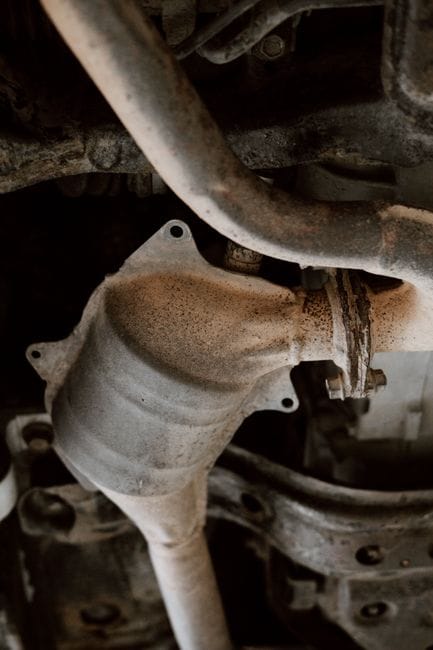
The P0420 catalyst code can be triggered by several distinct failure modes. While a degraded catalytic converter is the most common cause, it is far from the only one. In fact, a significant percentage of P0420 diagnoses turn out to be false positives caused by other issues. Understanding the full range of causes will save you from unnecessary converter replacement.
Catalyst Thermal Degradation
The most common cause of P0420 is thermal degradation of the catalyst substrate. Over time, exposure to high temperatures — especially from engine misfires that send unburned fuel into the exhaust — can cause the ceramic honeycomb structure to melt, sinter, or collapse. This reduces the surface area available for chemical reactions and diminishes the catalyst’s oxygen storage capacity. Thermal degradation is often irreversible and requires converter replacement.
Catalyst Poisoning
Catalyst poisoning occurs when contaminants coat the active precious metal sites (platinum, palladium, rhodium) on the catalyst surface, preventing them from facilitating chemical reactions. Common poisons include:
- Oil contamination: Worn piston rings or valve seals allow engine oil to enter the combustion chamber and exhaust stream.
- Coolant contamination: A blown head gasket can introduce ethylene glycol into the exhaust.
- Fuel contamination: Excess sulfur in fuel or the use of leaded fuel (rare in modern vehicles) can poison the catalyst.
- Silicone contamination: Improper use of silicone-based sealants or gaskets near the exhaust system.
Physical Damage
Physical damage to the catalytic converter — such as from road debris impacts, corrosion, or manufacturing defects — can cause the substrate to crack, break apart, or become partially blocked. A restricted converter will cause exhaust backpressure, leading to poor performance and potentially triggering P0420.
Oxygen Sensor Malfunction
A faulty downstream oxygen sensor can generate a false P0420 code. If the sensor is slow to respond, has a damaged wiring harness, or is contaminated, it may produce voltage signals that mimic catalyst failure. Similarly, an upstream sensor that is failing can cause the ECM to misinterpret the catalyst’s efficiency. Testing both sensors before condemning the converter is essential.
Exhaust Leaks
Exhaust leaks before or after the catalytic converter can introduce outside air into the exhaust stream, skewing oxygen sensor readings. A leak between the upstream sensor and the converter can cause the downstream sensor to read artificially lean, while a leak between the converter and the downstream sensor can cause artificially rich readings. Both scenarios can trigger P0420 without any actual catalyst failure.
Engine Misfires
Engine misfires (P030
0–P0308) send unburned fuel and oxygen into the exhaust system, which can overwhelm the catalytic converter’s capacity and cause the downstream oxygen sensor to see abnormal fluctuations. Even a single-cylinder misfire can generate enough raw fuel to damage the catalyst over time, and the ECM may set P0420 as a secondary code alongside the misfire code. Always address misfire codes before diagnosing P0420, as the misfire may be the root cause of the catalyst failure.
Fuel System Issues
A rich fuel mixture — caused by faulty fuel injectors, a failing fuel pressure regulator, or a stuck-open purge valve — can dump excess fuel into the exhaust. This raises exhaust temperatures and accelerates catalyst degradation. Conversely, a lean condition can cause the catalyst to overheat due to excess oxygen. Both scenarios can trigger P0420, and correcting the underlying fuel issue may restore catalyst efficiency without replacement.
Diagnosing the P0420 Catalyst Code: A Step-by-Step Approach

Proper diagnosis of P0420 requires a systematic approach. Jumping straight to converter replacement is the most expensive and often incorrect path. The following diagnostic tree will help you isolate the true cause with confidence.
Step 1: Scan for All Codes and Freeze Frame Data
Before anything else, perform a full OBD-II scan. Record all stored and pending codes, not just P0420. Pay special attention to misfire codes (P0300–P0308), oxygen sensor codes (P0130–P0175), and fuel trim codes (P0171, P0172, P0174, P0175). Also capture freeze frame data — the engine RPM, load, coolant temperature, and fuel trim values at the moment the code was set. This data provides critical clues about the conditions that triggered the fault.
Step 2: Check for Exhaust Leaks
Visually inspect the entire exhaust system from the exhaust manifold to the tailpipe. Look for signs of soot, rust holes, loose clamps, or damaged gaskets. A smoke test is the most reliable method — introduce smoke into the exhaust system under pressure and watch for leaks. Pay particular attention to the connections around the oxygen sensors and the converter flanges.
Step 3: Test the Oxygen Sensors
Using a scan tool with live data capability, monitor the voltage signals from both the upstream and downstream oxygen sensors on Bank 1. At idle and steady cruise, the upstream sensor should oscillate between 0.1V and 0.9V at a frequency of about 1–2 Hz. The downstream sensor should remain relatively flat, oscillating slowly between 0.4V and 0.5V. If the downstream sensor mirrors the upstream sensor’s rapid oscillations, the catalyst is likely failing. However, if the downstream sensor is sluggish, stuck, or producing erratic voltages, the sensor itself may be faulty.
Step 4: Perform a Catalyst Efficiency Test
Many professional scan tools offer a catalyst efficiency test mode. This test forces the ECM to run the catalyst monitor while you drive under specific conditions — typically steady throttle at 40–55 mph for several minutes. The scan tool will display the catalyst’s oxygen storage capacity as a percentage. If it reads below the manufacturer’s threshold (usually around 90%), the converter is confirmed as degraded.
Step 5: Check Fuel Trims and Engine Health
Review long-term and short-term fuel trim values. If fuel trims are significantly positive (indicating a lean condition) or negative (indicating a rich condition), address those issues first. A healthy engine with proper fuel trims is essential for accurate catalyst diagnosis. Also check for vacuum leaks, intake restrictions, and ignition system health.
Step 6: Verify the Repair
Step 6: Details
After any repair — whether replacing the converter, oxygen sensor, or fixing an exhaust leak — clear the codes and perform a full drive cycle to allow the ECM to run the catalyst monitor. The drive cycle typically involves cold start, idle, acceleration, and steady-state cruise at highway speeds. If the monitor runs and passes without setting P0420, the repair is confirmed.
Repair Options: Replacing vs. Repairing the Catalytic Converter

Once you’ve confirmed that the catalytic converter itself is the culprit, you face several repair options. Each has its own cost, reliability, and legal considerations.
OEM Catalytic Converter Replacement
Original Equipment Manufacturer (OEM) converters are designed specifically for your vehicle and are guaranteed to meet emissions standards. They are the most reliable option but also the most expensive — typically ranging from $1,200 to $2,500 for parts and labor. OEM converters are required in California and other states that follow CARB (California Air Resources Board) regulations, where aftermarket converters must be explicitly approved for your vehicle.
Aftermarket Catalytic Converter Replacement
Aftermarket converters are significantly cheaper — usually $300 to $800 for parts plus labor. However, quality varies widely. Direct-fit aftermarket converters from reputable brands (such as MagnaFlow, Walker, or Eastern Catalytic) are generally reliable and EPA-compliant. Universal “weld-in” converters are cheaper still but require fabrication and may not fit properly. Be cautious: some cheap aftermarket converters fail within months and may not pass emissions testing.
Catalytic Converter Cleaning (Limited Effectiveness)
Some products claim to clean catalytic converters and restore efficiency. These additives are designed to remove carbon deposits and sulfur contamination. While they can occasionally help with mild poisoning, they are ineffective for thermal degradation, physical damage, or severe contamination. In most cases, cleaning is a temporary measure at best and a waste of money at worst.
Oxygen Sensor Spacer / Defouler (Not Recommended)
Some DIYers install a spacer or “defouler” between the downstream oxygen sensor and the exhaust pipe to move the sensor out of the direct exhaust stream, tricking the ECM into thinking the catalyst is working. This is illegal in all 50 states for emissions purposes, can cause the ECM to run incorrect fuel trims, and will not pass an OBD-II emissions inspection. We strongly advise against this approach.
When to Repair vs. Replace
If the catalyst is failing due to an underlying issue — such as an oil leak, coolant leak, or misfire — you must fix the root cause first. Otherwise, the new converter will fail prematurely. If the converter is simply at the end of its service life (typically 100,000–150,000 miles), replacement is the only viable option. Always weigh the cost of replacement against the vehicle’s overall value — if the car is worth less than the repair cost, it may be time to consider other options.
Tools and Costs: What You Need to Diagnose and Fix P0420

Having the right tools is essential for accurate diagnosis and repair. Here’s what you’ll need and what it will cost.
Essential Diagnostic Tools
- OBD-II scan tool with live data: A basic code reader costs $20–$50, but a scan tool with live data streaming and catalyst test capability costs $100–$300. Professional-grade tools like the Autel or Snap-On range from $500 to $2,000+.
- Digital multimeter: For testing oxygen sensor wiring and voltage signals. A quality multimeter costs $30–$100.
- Smoke machine: For detecting exhaust leaks. Professional smoke machines cost $200–$500, though rental options exist at many auto parts stores.
- Infrared thermometer: For checking converter inlet vs. outlet temperatures. A working converter should show a temperature increase of 100–200°F from inlet to outlet. Cost: $20–$50.
- Backpressure gauge: For testing exhaust restriction. Cost: $50–$150.
Cost Breakdown by Repair Path
| Repair | Parts Cost | Labor Cost | Total Estimate |
|---|---|---|---|
| Oxygen sensor replacement | $50–$200 | $80–$150 | $130–$350 |
| Exhaust leak repair
|