Timing Belt Broke While Driving: What Happens Next?
It was a cold December morning back in 2018, pouring rain on the interstate outside Portland. This young guy pulls into the shop on a flatbed, his 2005 Honda Accord soaked and looking defeated. He tells me he was doing about 65 mph in the fast lane when the engine just quit—no warning, no weird noises beforehand, just sudden silence. The dash lit up, and he coasted to the shoulder. Turns out his timing belt snapped right there on the highway. I’ve seen this scene play out dozens of times over the years, and it always hits the owner hard because most folks don’t think about that rubber belt hidden under the cover until it’s too late.
He’d bought the car used with 120,000 miles, figured the belt had been done, but no records. That Accord has an interference engine, so when the timing belt broke while driving, the valves kept crashing into the pistons until everything stopped. We pulled the head and found eight bent valves and scored pistons. Bill came to just over $3,200 for the valve job and full timing kit. He was lucky it didn’t hole a piston—he drove away after, but it was an expensive lesson.I’ve had customers cry in my bay over this. One lady with a VW Jetta lost the belt at a stoplight, thought it was just a dead battery at first. Another guy in a Subaru Outback snapped his on a back road—towed 50 miles. Point is, a timing belt failure doesn’t give second chances. If you’re reading this because you’re worried about yours, stick around. I’ll walk you through exactly what happens, the damage you can expect, and how to keep it from turning your reliable daily into a shop queen.
What Actually Happens When the Timing Belt Snaps
Picture this: your engine’s spinning along, crankshaft turning the pistons up and down, camshaft opening and closing the valves in perfect sync—all held together by that toothed rubber belt. When the timing belt breaks, the camshaft stops dead, but the crankshaft keeps going from momentum. Valves get stuck open right as pistons slam upward.
In a non-interference engine, there’s enough clearance that nothing hits. Engine dies, you coast to the side, replace the belt, and you’re back on the road. Rare these days—think older Toyota 22R or some Honda D-series.
In an interference engine, it’s ugly fast. Pistons smack open valves, bending them like pretzels. Sometimes valves break off, pistons get gouged, or debris scores cylinder walls. It all happens in seconds. I’ve seen heads where every intake valve is bent, exhausts too on bad ones.
Here’s a real one from last year: Customer’s 2012 Acura TL, belt done at 80k by previous owner, but they skipped the water pump. Pump seized at 140k, shredded the belt at 70 mph. Eight bent valves, two dropped seats, one cracked piston. We ended up sourcing a used engine because rebuild quotes hit $6k.
Interference vs. Non-Interference: Why It Matters
Interference vs. Non-Interference: Details
Most cars built after 2000 are interference designs—better power and efficiency, but zero forgiveness on belt failure. Common interference engines:
- Honda K-series (most Accords, Civics 2001+)
- Toyota 2ZR, 1ZZ (Corolla, Matrix post-2000)
- Subaru EJ25 (Outback, Forester)
- VW/Audi 2.0T
- Many Hyundai/Kia 4-cylinders
Non-interference holdouts are fewer: some older GM 3.1/3.4L, Chrysler 2.4L pre-2000s, a handful of Mazda/Ford. Always check your model—don’t guess.
Signs Your Timing Belt Was About to Go (And Why There Often Aren’t Any)
Truth is, good belts rarely give warning. They just snap one day. But watch for these:
- Ticking noise from the front (worn tensioner or idler)
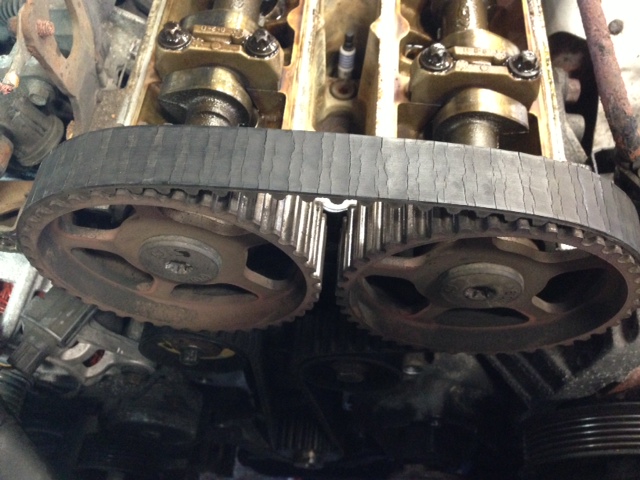
- Visible cracks, glazing, or missing teeth when you inspect
- Oil or coolant leaks onto the belt (softens rubber fast)
- Misfires or rough idle if it jumps a tooth first
Pro tip: Pop the upper cover off every oil change and look. Takes five minutes. I’ve caught cracked belts that way and saved customers thousands.
What to Do If Your Timing Belt Breaks on the Road
- Coast to a safe spot—don’t try restarting, it’ll make damage worse.
- Call a tow—do NOT have someone try starting it again.
- Get it to a shop for diagnosis: leak-down test or borescope to check valves.
I’ve had a couple lucky ones where the belt broke at idle and no valves bent. Rare, but it happens—maybe 5-10% on interference engines.
Diagnosing the Damage After a Broken Timing Belt
First step: New belt on, hand-crank the engine two full turns. If it binds, stop—valves are hitting pistons.
Next: Compression or leak-down test. Zero compression on cylinders means bent valves.
Then pull the head(s). Count bent valves, check guides/seats, inspect pistons. Mild cases: just valves and gasket. Bad ones: machine head, new pistons, maybe short block.
Repair Options and Cost Breakdown
| Scenario | Typical Parts | Labor (shop rates) | Total Range |
|---|---|---|---|
| Non-interference or lucky interference (no damage) | Full timing kit + water pump (~$300-500) | 6-10 hours | $800-1,500 |
| Mild valve damage (head repair) | Kit + valves/guides/seals/machining (~$800-1,500) | 15-25 hours | $2,500-4,500 |
| Severe damage (pistons too) | Kit + reman head(s) or used engine | 20-40 hours | $4,000-7,000+ |
Shop experience: Gates and Continental kits are my go-to—reliable through the full interval. Dayco belts are fine, but I’ve seen more tensioner issues with their kits. Always do the water pump, tensioner, idlers—saving $100 now costs thousands later.
Tools You’ll Need for a DIY Timing Belt Job
Must-haves:
- Basic sockets/wrenches (10mm-19mm common)
- Torque wrench (ft-lbs and in-lbs)
- Crank pulley holder tool (~$30 on Amazon)
- Jack, stands, wheel chocks
- Full timing belt kit (Gates/Continental recommended, $250-450)
Nice-to-haves:
- Cam/crank locking tools (engine-specific, $50-150)
- Impact gun for crank bolt
- Harmonic balancer puller
FAQ: Real Questions I’ve Heard in the Shop
How much does it cost to fix a broken timing belt?
If no damage: $800-1,500. With bent valves: $2,500-5,000 typical. Full engine swap: $5,000-8,000.
Can you drive with a broken timing belt?
No. Engine won’t run. Tow it.
Is my engine interference or non-interference?
Check Gates catalog or your manual. Most Hondas, Toyotas 2000+, Subarus, VWs are interference.
Will a timing belt break without warning?
Usually yes. Inspect every 30k miles.
Should I replace the water pump with the timing belt?
Always. It’s right there, and seized pumps kill belts.
What’s better—engine rebuild or replacement after damage?
Depends on mileage. Under 150k, rebuild head. Over, used engine often cheaper. See our guide on [engine rebuild options](engine-rebuild-vs-replacement).
How often should I replace my timing belt?
60k-100k miles or 7-10 years. Check your [replacement intervals](timing-belt-replacement-interval).
Final Thoughts From the Bay
A snapped timing belt while driving is every mechanic’s least favorite tow-in. It’s preventable, and the fix before failure is way cheaper than after. If your car’s pushing 100k with no belt history, get it done—don’t gamble. Learn the full [timing belt replacement](timing-belt-replacement-guide) process and intervals to stay ahead.
I’ve seen too many good engines wrecked over a $400 kit. Do the maintenance, drive happy. That’s my take after 20 years turning wrenches.
Top Timing Belt Broke While Driving – Our Picks