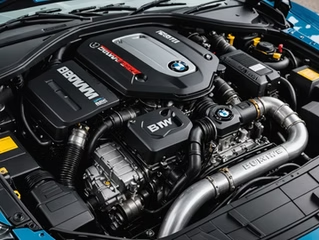
Engine Stalling: Common Causes and Solutions
It was a rainy Tuesday afternoon in late fall, around 3 p.m., when a silver 2012 Honda Accord pulled into the bay with the check engine light flashing and the owner looking white-knuckled. The customer, a nurse on her way home from a 12-hour shift, said the car had been stalling engine randomly—sometimes at stoplights (idle stall), other times while cruising on the highway (driving stall). She’d barely made it to the shop without it dying in traffic.
After hooking up the scan tool, we pulled a P0335 code for the crankshaft position sensor. A quick test showed intermittent signal loss. Replacing the sensor (about $45 part, 45 minutes labor) fixed it completely. I’ve seen this exact scenario dozens of times over 15+ years—engine stalling is one of the most frustrating and dangerous issues we deal with in the shop.
Common Symptoms & Causes
Engine stalling happens when the engine suddenly loses power and shuts off, either at idle or while driving. It can leave you stranded or, worse, in the middle of traffic. The good news? Most cases are fixable, often with DIY tools and some patience. In this guide, we’ll cover the most common causes of a stalling engine, how to diagnose them, and practical fixes—with real shop experience and specific details.
Quick Answer: Top Causes of Engine Stalling
- Fuel delivery issues(bad fuel pump, clogged filter, failing relay) — most common for sudden driving stall
- Ignition problems(faulty coils, plugs, or crankshaft position sensor)
- Air/fuel mixture problems(vacuum leaks, dirty throttle body, bad MAF sensor)
- Idle control failures(faulty idle air control valve or throttle position sensor)
- Sensor failures(CKP, camshaft, or MAP sensor)
If your car only stalls hot or cold, or only at idle, jump to the troubleshooting section below.
 Common Causes and Solutions” width=”2121″ height=”1414″ />
Tools & Materials List
Diagnosis & Inspection
To diagnose and fix most engine stalling issues, you’ll need:
Must-Have Tools(~$150-300 total if buying new):
- OBD-II scanner (basic models like Innova 3020 or BlueDriver, $40-120) — reads codes and live data
- Digital multimeter ($20-50) — for testing sensors and relays
- Basic hand tools: ratchet set (3/8″ drive), sockets (10mm-19mm), extensions, pliers
- Fuel pressure gauge kit ($30-60) — tests fuel pump pressure
- Vacuum gauge ($20) — checks for leaks
Repair Options & Cost
Nice-to-Have:
- Scan tool with bidirectional control ($200+) — commands idle air control valve
- No-idle smoke machine ($100+) — finds vacuum leaks fast
Parts costs vary by vehicle—check RockAuto or Amazon for your make/model/year.
Safety Warnings
Common Causes of Engine Stalling
Here are the top culprits I’ve seen in the shop, ranked by how often they cause engine dies issues.
1. Fuel System Problems
Fuel delivery failures top the list for sudden driving stall.
- Bad fuel pump or low fuel pressure— The pump (in-tank on most cars) can fail gradually. Symptoms: stalling under load, especially on hills. Pressure should be 40-60 psi (check your spec). I’ve seen pumps fail at 80,000-150,000 miles.
- Faulty fuel pump relay— Relay clicks but doesn’t hold power. Engine may stall after 10-15 minutes of driving.
- Clogged fuel filter— Restricts flow. Common on older imports.
Pro tip: Add fuel system cleaner (like Sea Foam or Techron) every 5,000 miles—prevents many issues.
2. Ignition System Failures
No spark = instant stall.
- Worn spark plugs or coils— Misfires lead to idle stall. Replace plugs every 60,000-100,000 miles (iridium last longer).
- Crankshaft position sensor (CKP)— Fails intermittently, causes sudden engine dies while driving. Common on Hondas/Fords.
Real story: A 2015 Ford F-150 owner came in after multiple highway stalls. CKP was dropping signal—$60 part, fixed it.
3. Air Intake and Vacuum Issues
Engine needs proper air/fuel mix.
- Vacuum leaks— Cracked hoses or intake gasket. Causes high/rough idle then stall.
- Dirty throttle body or bad idle air control valve(IAC)— Carbon buildup restricts bypass air.
- Faulty MAF sensor— Dirty or failed, leans out mixture.
4. Sensor and Electrical Problems
Modern engines rely on sensors.
- Throttle position sensor (TPS)— Bad reading causes hesitation/stall.
- Mass airflow (MAF) or MAP sensor— Incorrect air reading.
- Alternator or battery issues— Low voltage starves modules.
5. Other Causes
- EGR valve stuck— Recirculates too much exhaust.
- Torque converter issues(automatics) — Rare, but stalls at stop.
- Bad gas— Water/contamination.
Troubleshooting Section: Step-by-Step Diagnosis
Troubleshooting Section: Details
Start simple—always scan for codes first.
- Scan for codes— Use OBD-II scanner. Look for P0300-P030X (misfire), P0335 (CKP), P0171/P0174 (lean), P0101 (MAF).
- If no codes— Check basics: fuel level, air filter, battery voltage (12.6V off, 13.8-14.5V running).
- Fuel pressure test— Key on, engine off: 40-60 psi typical. Running: holds steady.
- If stalling at idle— Clean throttle body with CRC Throttle Body Cleaner (spray, wipe). Test IAC with scanner.
- If random driving stall— Monitor live data for CKP signal drop or fuel trim extremes.
If X happens, check Y:
- Stalls hot after 10-20 min → fuel pump relay
- Stalls only at idle → IAC or vacuum leak
- Stalls under load → fuel pump/filter
- No-start + stall history → CKP sensor
Cost Analysis
DIY vs Professional Costs (average 2010-2020 vehicles):
- Fuel pump replacement: DIY $300-600 (parts $150-400, tools), Shop $800-1,500
- CKP sensor: DIY $50-150 (part $30-100), Shop $200-400
- Throttle body cleaning: DIY $20 (cleaner), Shop $150
- Fuel filter: DIY $30-80, Shop $150-300
Money-saving tips:Buy OEM or trusted aftermarket (Bosch,Denso for sensors). Do fuel filter every 30,000 miles. Avoid cheap eBay sensors—they fail fast.
Long-term: Fixing early prevents towing ($150+) or stranded costs.
FAQ
Top Engine Stalling – Our Picks
Conclusion
Engine stalling is rarely a mystery once you diagnose systematically—fuel delivery, ignition, and air issues cover 80% of cases. Most fixes are moderate difficulty, with DIY costs under $500 if you catch it early. I’ve watched customers save thousands by addressing small problems before they snowball into pumps or wiring harnesses.
From a mechanic’s perspective: Don’t ignore intermittent stalling engine symptoms. The shop stories that stick are the ones where a $60 sensor prevented a $1,200 tow and pump job. Grab your scan tool, start with codes, and you’ll likely pinpoint it quickly. Stay safe out there—your car should run reliably, not play Russian roulette at every stoplight.