how often to flush transmission
How Often to Flush Transmission: The Mileage Guide That Actually Matches Your Driving
Transmission fluid is the hydraulic lifeblood of your vehicle’s gearbox. Flushing it means completely replacing that fluid to remove old contaminants, metal shavings, and degraded additives. A simple drain-and-refill only removes about a third of the old fluid. A flush uses a specialized machine to push out nearly 100% of the used fluid. This maintenance procedure directly determines the longevity of your transmission’s internal components. Getting the interval wrong — either too early or too late — can cost you thousands in repairs.
The core question every driver faces is not just whether to flush, but how often. The answer is rarely a single universal number. The true interval depends on several factors: your vehicle’s make and model, the transmission type (automatic, CVT, or dual-clutch), your driving conditions, and the fluid your manufacturer specifies. Driving conditions include towing, stop-and-go traffic, and highway cruising. Most owners’ manuals suggest a generic 30,000 to 60,000-mile window. That figure is often a compromise that ignores how your driving habits actually stress the fluid.
This guide goes beyond the generic maintenance schedule. It gives you a mileage framework that matches your real-world usage. We break down the science of fluid degradation and provide a driving-condition-based interval calculator. We also honestly address when a flush is not recommended. Sometimes a flush can do more harm than good on a high-mileage transmission. By the end, you will have a data-driven decision tree that saves you money and protects your vehicle’s most complex mechanical system.
What Is a Transmission Flush and How Does It Differ from a Drain-and-Fill?

Before you decide how often to flush transmission fluid, you need to know what the service actually does. A transmission flush is a machine-based service that pushes old fluid out of the system and replaces it with fresh fluid in one continuous operation. It does not just empty the pan. It clears fluid from every component the fluid touches, including the torque converter and the cooler lines.
The Machine-Based Process: What Actually Happens in Your Bay
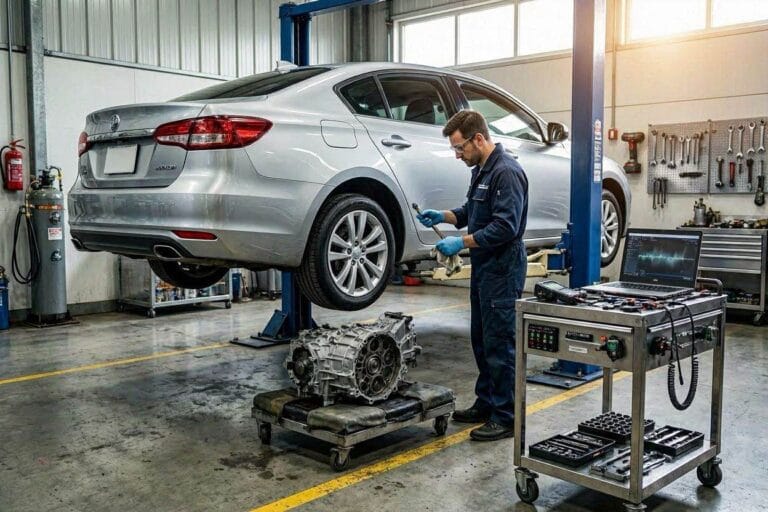
A flushing machine connects to the transmission’s cooler lines, which are the hoses that carry transmission fluid to the radiator for cooling. The machine pumps new fluid in while old fluid is expelled under pressure.
Flush vs. Drain-and-Fill: The Critical Distinction That Changes Your Interval
The distinction between a flush and a drain-and-fill is not just procedural — it fundamentally changes how often you need the service. A drain-and-fill removes only the fluid sitting in the pan, typically 30% to 40% of the total system capacity. The fluid trapped inside the torque converter and cooler lines remains untouched. This means a drain-and-fill is a partial refresh, and it must be performed more frequently — often every 30,000 miles — to maintain fluid quality over time. A full flush, by contrast, replaces nearly 100% of the fluid, which extends the effective service interval to 50,000 or even 60,000 miles under normal conditions. However, a flush is more aggressive and carries a higher risk on high-mileage transmissions where old fluid may be holding dislodged debris in suspension. Understanding this distinction is the first step in choosing the right interval for your vehicle.
The Factory Interval Myth: Why Owner’s Manuals Are Not One-Size-Fits-All
Most owner’s manuals list a single interval for transmission fluid service, often 30,000 or 60,000 miles. But that number is a legal compromise, not an engineering recommendation tailored to your driving. Manufacturers must publish a schedule that works for the average driver in average conditions — which means it is wrong for almost everyone in one direction or the other.
Normal vs. Severe Service Schedules: The Hidden Clauses in Your Manual
Dig deeper into your owner’s manual and you will find a second schedule, usually buried in a footnote or an appendix: the “severe service” schedule. This applies if you tow, drive in stop-and-go traffic, idle for extended periods, drive in extreme heat or cold, or use your vehicle for commercial purposes. Under severe service, the recommended interval often drops by half — from 60,000 to 30,000 miles, or from 30,000 to 15,000. Most drivers qualify for the severe schedule without realizing it. If you commute in urban traffic, you are already in the severe category. The manual’s “normal” schedule assumes highway cruising at moderate temperatures, which is a minority of real-world driving.
Why the Same Car Can Have Different Intervals Across Model Years
Manufacturers revise their recommendations based on field data, fluid chemistry changes, and transmission design updates. A 2018 model may specify 60,000 miles, while the 2022 version of the same car with the same transmission may say 45,000. This is not a marketing decision — it reflects real-world failure data and improved testing. Always check the interval for your specific model year, not a generic rule of thumb. Also, if your vehicle is equipped with a CVT (continuously variable transmission), the interval is often shorter because CVT fluid degrades faster under heat and shear stress. Dual-clutch transmissions (DCTs) have their own fluid requirements and intervals, which are often shorter than traditional automatics.
Mileage Intervals by Transmission Type: ATF, CVT, and DCT
The type of transmission in your vehicle is the single biggest factor in determining how often to flush transmission fluid. Each design has different fluid requirements, thermal loads, and failure modes.
Traditional Automatic (ATF): The 30/60 Rule
For traditional automatic transmissions using conventional ATF, the standard interval is 30,000 miles for severe service and 60,000 miles for normal service. However, if you use a synthetic ATF, you can often extend the normal-service interval to 75,000 miles, provided your manufacturer approves it. The key is to check your owner’s manual for the specific fluid specification — using the wrong fluid, even if it is the right viscosity, can cause premature wear and shift quality issues.
CVT (Continuously Variable Transmission): Shorter Intervals, Higher Stakes
CVTs are more sensitive to fluid degradation than traditional automatics. The fluid in a CVT must handle both hydraulic pressure and belt-to-pulley friction, which generates significant heat. Most manufacturers recommend a CVT fluid change every 30,000 to 45,000 miles, regardless of driving conditions. Some high-performance CVTs, such as those in Subaru or Nissan models, may require service as early as 25,000 miles under severe conditions. Skipping a CVT flush can lead to belt slip, shuddering, and eventual transmission failure — a repair that often costs more than the car’s value.
DCT (Dual-Clutch Transmission): The Special Case
Dual-clutch transmissions use a wet clutch system that shares fluid with the gearbox. This fluid must lubricate gears, actuate clutches, and manage heat — a demanding job. Most DCTs require a fluid change every 40,000 to 60,000 miles, but some performance-oriented DCTs, like those in BMW or Porsche models, may require service every 30,000 miles. DCT fluid is expensive, and the service often requires special tools and procedures, so it is not a DIY job for most owners.
Driving Conditions: The Real Interval Multiplier
Your driving habits are the multiplier that adjusts the factory interval up or down. The table below shows how different conditions affect the recommended flush frequency.
Severe Conditions That Cut Your Interval in Half
Towing, hauling heavy loads, driving in mountainous terrain, stop-and-go city traffic, extreme temperatures (both hot and cold), and frequent short trips (under 5 miles) all qualify as severe service. If any of these apply to you, reduce the manufacturer’s normal interval by 50%. For example, if your manual says 60,000 miles for normal service, flush at 30,000 miles. If you tow regularly, consider 25,000 miles as your ceiling.
Normal Conditions: When You Can Stretch the Interval
If you primarily drive on highways at moderate speeds, in temperate climates, with minimal idling and no towing, you can follow the manufacturer’s normal schedule. Some synthetic fluids allow a 10% to 20% extension beyond the factory interval, but only if your transmission is in good health and you have been using the correct fluid. Do not stretch the interval if you are unsure of the service history — a used car with unknown maintenance is always a candidate for an immediate flush
and inspection before you trust any extended interval.
How to Calculate Your Personal Flush Interval
Start with your manufacturer’s normal-service interval. Then apply the following multipliers: if you tow or haul heavy loads, multiply by 0.5; if you drive in stop-and-go traffic for more than 50% of your trips, multiply by 0.6; if you live in extreme climates (above 95°F or below 0°F), multiply by 0.7; if you take frequent short trips under 5 miles, multiply by 0.8. Take the lowest resulting number as your maximum interval. For example, a 60,000-mile normal interval with towing and city driving becomes 30,000 miles (60,000 × 0.5). This calculation gives you a personalized number that matches your actual driving, not a generic guess.
Signs Your Transmission Needs a Flush Before the Mileage Milestone
Mileage is a useful guide, but your transmission will often tell you when it needs fresh fluid before you hit the number. Ignoring these warning signs can turn a $200 flush into a $3,000 rebuild.
Fluid Color and Smell: The First Diagnostic You Can Do Yourself
Healthy transmission fluid is bright red or pink, translucent, and has a slightly sweet smell. If the fluid appears dark brown or black, has a burnt odor, or contains visible particles, it is overdue for a change. Check the dipstick (if your vehicle has one) or have a mechanic sample the fluid from the pan. Dark fluid indicates thermal breakdown and oxidation, which means the additives have been depleted and the fluid is no longer protecting your transmission.
Shifting Symptoms: What Your Gearbox Is Trying to Tell You
Delayed engagement when shifting from Park to Drive, harsh or jerky shifts, slipping gears, or a transmission that hesitates before responding are all signs of degraded fluid. These symptoms occur because old fluid loses its hydraulic pressure and friction-modifying properties. If you experience any of these, do not wait for the mileage interval — flush the system immediately. However, if the transmission is already slipping severely, a flush may not fix it, and in some cases, it can make the problem worse by dislodging debris that was temporarily holding the clutches together.
When NOT to Flush: The High-Mileage Caution
There is a long-standing debate in the automotive community about whether to flush a high-mileage transmission that has never been serviced. The answer is nuanced, and getting it wrong can destroy your gearbox.
The 100,000-Mile Rule: Why Some Transmissions Should Never Be Flushed
If your vehicle has over 100,000 miles and there is no record of regular transmission fluid changes, a full flush is risky. The old fluid may contain clutch material and wear particles that are actually helping the transmission grip. A flush removes these particles, and the new, thinner fluid can cause the transmission to slip. In this case, a drain-and-fill is the safer option — it replaces a portion of the fluid without disturbing the debris that has settled in the torque converter and valve body. Perform a drain-and-fill, drive for 500 miles, then repeat. This gradual approach allows the transmission to adapt to the new fluid without shock.
When a Flush Is Recommended Even on High Mileage
If the transmission has been regularly serviced throughout its life, a flush is safe even at high mileage. The key is consistency — a transmission that has seen fresh fluid every 30,000 miles will handle a flush at 150,000 miles without issue. The danger is not the mileage itself, but the inconsistency of maintenance. If you are buying a used car with unknown history, assume the worst and start with a drain-and-fill rather than a flush.
Cost, Labor Time, and DIY vs. Professional Service
The cost of a transmission flush varies widely depending on your vehicle, the type of fluid required, and whether you go to a dealership, an independent shop, or do it yourself.
Average Costs by Transmission Type
For a traditional automatic, a professional flush typically costs between $150 and $300, including fluid and labor. CVT flushes are more expensive, ranging from $200 to $400, because the fluid is pricier and the procedure is more involved. DCT services are the most costly, often $300 to $500, due to specialized fluid and equipment requirements. Dealerships charge a premium, but they use the exact OEM-specified fluid and have the correct equipment. Independent shops are cheaper but may use aftermarket fluid — always verify that it meets your manufacturer’s specification.
DIY Flush: Is It Worth the Risk?
A DIY flush is possible if you have the right equipment — a fluid pump, a catch container, and the correct fluid. The process involves disconnecting the cooler lines and running the engine to pump out old fluid while adding new fluid. However, the risk of overfilling, underfilling, or introducing air into the system is high. A mistake can cause catastrophic transmission failure. For most drivers, the $150 to $300 professional cost is worth the peace of mind. If you do attempt it yourself, consult your vehicle’s service manual and use a fluid pump designed for transmission service.
Transmission Filter Replacement and Pan Drop Service: The Companion Services
A flush is not the only maintenance your transmission needs. The filter and pan gasket are critical components that should be addressed at the same time.
When to Replace the Filter
Most manufacturers recommend replacing the transmission filter every 30,000 to 60,000 miles, which aligns with the flush interval. The filter catches metal shavings and clutch material, and over time it becomes clogged, restricting fluid flow. A clogged filter can cause the same symptoms as low fluid — slipping, delayed engagement, and overheating. If your transmission has a serviceable filter, replace it with every flush. Some newer transmissions have sealed, non-serviceable filters that are designed to last the life of the unit, but these are rare.
The Pan Drop Service: What It Adds to a Flush
The Pan Drop Service: Details
A pan drop service involves removing the transmission pan, cleaning out the accumulated sludge, replacing the filter, and reinstalling the pan with a new gasket. This is more labor-intensive than a simple flush, but it removes debris that a flush cannot — the material that has settled at the bottom of the pan. A pan drop service typically costs $200 to $400, depending on the vehicle. For high-mileage transmissions, combining a pan drop with a flush is the most thorough approach, but it is also the most expensive. If your budget is tight, prioritize the flush and replace the filter at the next interval.
Fluid Top-Off vs. Full Flush: When a Top-Off Is Enough
A transmission fluid top-off is not a substitute for a flush — it is a stopgap measure for minor leaks or low fluid levels. If your fluid level is low due to a small leak, topping off is acceptable in the short term, but you must address the leak and plan for a full flush at the next interval. Topping off does not remove contaminants or restore degraded additives. It only restores the fluid level to the correct range. Relying on top-offs instead of flushes will eventually lead to transmission failure, as the old fluid continues to degrade and accumulate debris.
Manufacturer-Specific Recommendations: A Quick Reference
While the general guidelines above apply to most vehicles, some manufacturers have specific recommendations that override the generic advice.
Ford, GM, and Chrysler: The Big Three
Ford generally recommends a transmission flush every 30,000 miles for severe service and 60,000 for normal service, but newer models with the 10-speed automatic may extend to 75,000 miles. GM’s recommendations vary widely by model — the Silverado with the 6-speed automatic calls for 45,000 miles, while the 8-speed in the Camaro suggests 50,000. Chrysler (now Stellantis) often specifies 60,000 miles for normal service, but their ZF 8-speed transmissions are “lifetime-filled” according to the factory — though most independent mechanics recommend servicing them at 60,000 miles anyway.
Toyota, Honda, and Nissan: The Japanese Approach
Toyota is conservative, often recommending 60,000 miles for normal service and 30,000 for severe. Honda uses a different philosophy — many of their transmissions are sealed and do not have a dipstick, and the factory interval is often 60,000 miles, but Honda dealers recommend 30,000 for severe conditions. Nissan’s CVTs are the exception — they require fluid changes every 30,000 miles regardless of conditions, and skipping this service is the leading cause of CVT failure in their vehicles.
European Brands: BMW, Mercedes, and Audi
European manufacturers often claim “lifetime” fluid that never needs changing. This is a marketing position, not an engineering reality. BMW’s ZF transmissions are labeled as lifetime-filled, but ZF itself recommends a fluid change every 60,000 to 80
000 miles. Mercedes-Benz has shifted its stance in recent years, now recommending fluid service on many 7-speed and 9-speed automatics at 40,000 to 50,000 miles, especially under severe conditions. Audi’s dual-clutch S tronic transmissions require fluid changes every 35,000 to 40,000 miles, and the mechatronic unit (the transmission’s electronic control module) often shares the same fluid, making timely service critical. If you own a European vehicle, ignore the “lifetime” label — budget for regular fluid service to protect your investment.
How to Verify Your Vehicle’s Specific Interval
With so many variables, how do you know the right interval for your exact vehicle? The answer lies in a combination of official documentation and practical verification.
Reading Your Owner’s Manual Correctly
Do not just look at the maintenance schedule table — read the footnotes and the severe-service section. Many manuals list the severe-service interval in a separate column or a footnote that is easy to miss. If you cannot find it, check the manufacturer’s website or contact a dealership with your VIN. The VIN-specific maintenance schedule is the most accurate source, as it accounts for your vehicle’s exact build date and options.
Using the VIN to Get the Factory-Approved Schedule
Most automakers offer a free online portal where you can enter your VIN and retrieve the official maintenance schedule for your specific vehicle. This is the gold standard — it overrides any generic advice, including this guide. If the factory schedule conflicts with the general recommendations here, follow the factory schedule first, then adjust for your driving conditions using the multipliers discussed earlier. When in doubt, err on the side of more frequent service — the cost of a flush is trivial compared to the cost of a transmission replacement.
Frequently Asked Questions About Transmission Flushes
Can a transmission flush fix a slipping transmission?
No. A flush can prevent slipping if the fluid is degraded, but it cannot repair mechanical wear. If your transmission is already slipping, a flush may temporarily improve shift quality, but the underlying issue — worn clutches, bands, or torque converter — will require a rebuild or replacement. In some cases, a flush on a severely worn transmission can make slipping worse by removing the friction particles that were providing grip.
Is it safe to flush a transmission with 150,000 miles?
It depends on the service history. If the transmission has been regularly maintained, a flush is safe at any mileage. If the fluid has never been changed, a flush is risky — opt for a drain-and-fill instead, and repeat it after 500 miles to gradually introduce fresh fluid.
How long does a transmission flush take?
A professional flush typically takes 30 to 60 minutes, depending on the vehicle and the equipment used. A pan drop service adds another 30 to 45 minutes. Plan for about an hour and a half for a comprehensive service.
Does a transmission flush improve fuel economy?
Yes, marginally. Fresh fluid reduces internal friction, which can improve fuel economy by 1% to 3%. The effect is small but noticeable, especially in vehicles that were running on severely degraded fluid.
Can I mix different brands of transmission fluid?
You should not mix different types of fluid (e.g., ATF and CVT fluid), but mixing different brands of the same type is generally acceptable if they meet the same specification. However, for a flush, you should use a single brand and type to ensure consistent additive chemistry.
Final Verdict: The Mileage Guide That Matches Your Driving
There is no single “correct” interval for a transmission flush — the right number depends on your vehicle, your driving habits, and your maintenance history. Here is the bottom line:
– **Traditional automatic (ATF):** Flush every 30,000 miles for severe service, 60,000 for normal service. Synthetic fluid can extend normal service to 75,000 miles.
– **CVT:** Flush every 30,000 to 45,000 miles, regardless of conditions. Do not skip this service.
– **DCT:** Flush every 40,000 to 60,000 miles, or 30,000 for performance models.
– **High-mileage (100,000+ with unknown history):** Use a drain-and-fill instead of a flush, and repeat after 500 miles.
– **Severe conditions (towing, city driving, extreme weather):** Cut the normal interval in half.
The most important takeaway is this: a transmission flush is cheap insurance. The $150 to $400 you spend every 30,000 to 60,000 miles is a fraction of the $3,000 to $6,000 cost of a transmission rebuild. If you are unsure about your vehicle’s history, start with a drain-and-fill and establish a regular service schedule going forward. Your transmission will thank you with years of reliable, smooth-shifting performance.