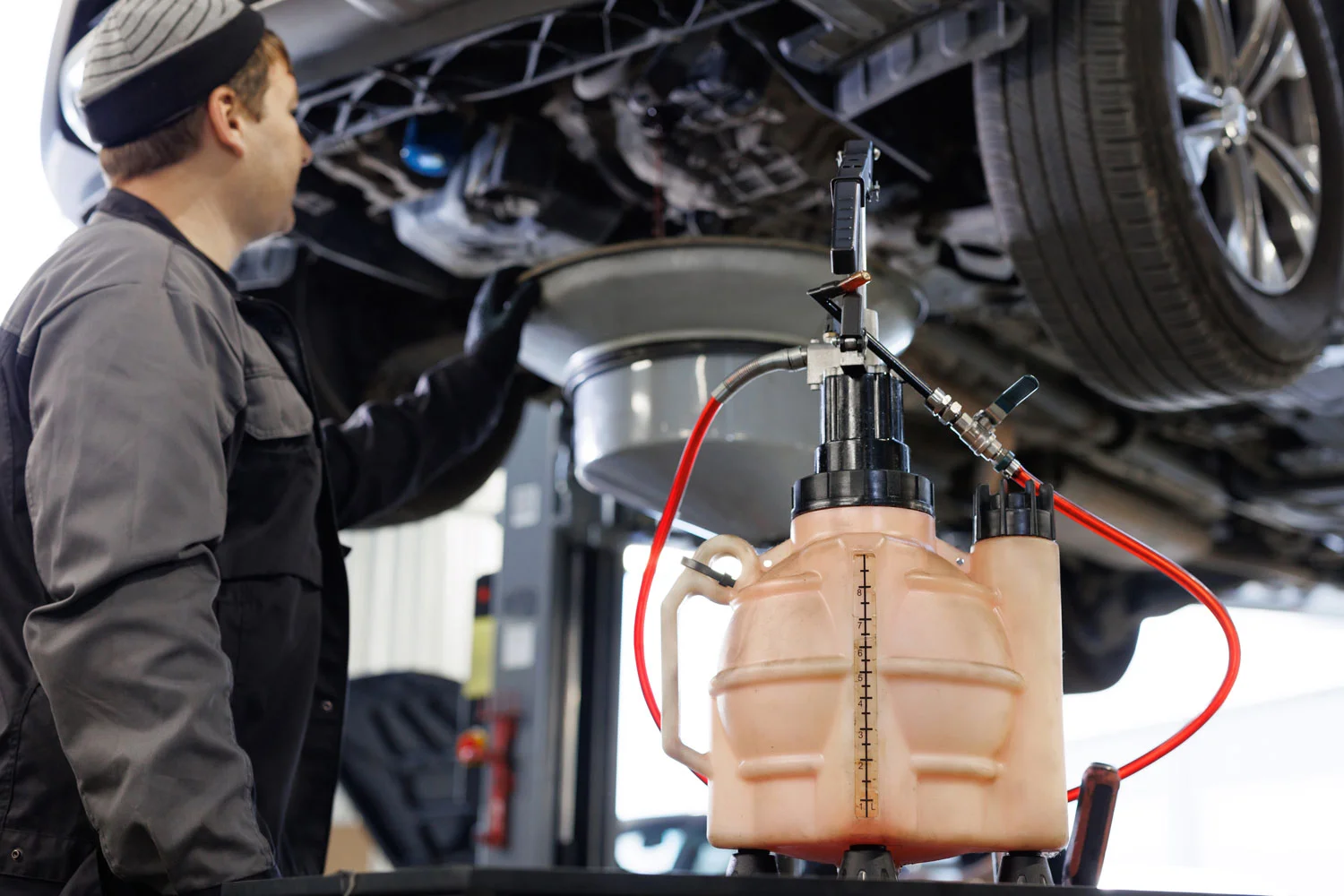
Last Tuesday, a customer rolled into my bay with a 2015 Honda Accord that sounded like it was mixing marbles in a blender. She’d been ignoring the “change transmission fluid” reminder for about 40,000 miles past the recommended interval. The fluid that drained out looked like used motor oil—black, gritty, and smelling like burnt toast. What should’ve been a simple $150 transmission fluid change turned into a $3,200 rebuild because the clutch packs had disintegrated.
I’m sharing this because after 17 years of turning wrenches and rebuilding transmissions, I’ve seen this scenario play out dozens of times. A transmission fluid change is one of those maintenance tasks that seems expensive until you skip it. Then it becomes really expensive.
Here’s what most people don’t realize: your transmission fluid does more than just lubricate gears. It’s a hydraulic fluid that operates clutch packs, provides cooling, prevents corrosion, and keeps your transmission from turning into an expensive paperweight. When that fluid breaks down, your transmission doesn’t die suddenly—it dies slowly, expensively, and usually right after the warranty expires.
Why Transmission Fluid Actually Matters (And Why “Lifetime” Fluid is Marketing BS)
Let me be straight with you: there’s no such thing as lifetime transmission fluid. I don’t care what your owner’s manual says. I’ve cut open transmissions with “lifetime” fluid at 100,000 miles, and the clutch material floating in that fluid tells a different story.
Transmission fluid serves five critical functions. It lubricates hundreds of moving parts spinning at thousands of RPM. It hydraulically operates clutch packs and bands that shift gears. It cools components that generate tremendous heat during normal operation. It prevents metal surfaces from corroding. And it suspends wear particles to keep them from grinding between precision components.
Over time, heat cycles break down the fluid’s molecular structure. Additives deplete. Friction modifiers wear out. The fluid oxidizes and turns acidic. Those clutch packs I mentioned? They shed microscopic material that turns your fluid into an abrasive slurry. By 60,000 miles, most transmission fluid has lost 30-40% of its effectiveness.
I’ve personally seen the difference between maintained and neglected transmissions. A 2012 Toyota Camry came in last month with 180,000 miles and original transmission—the owner had changed the fluid every 40,000 miles religiously. The fluid drained out pink and clean. Compare that to another Camry, same year, 120,000 miles, never serviced. That transmission lasted another 8,000 miles before it needed rebuilding.
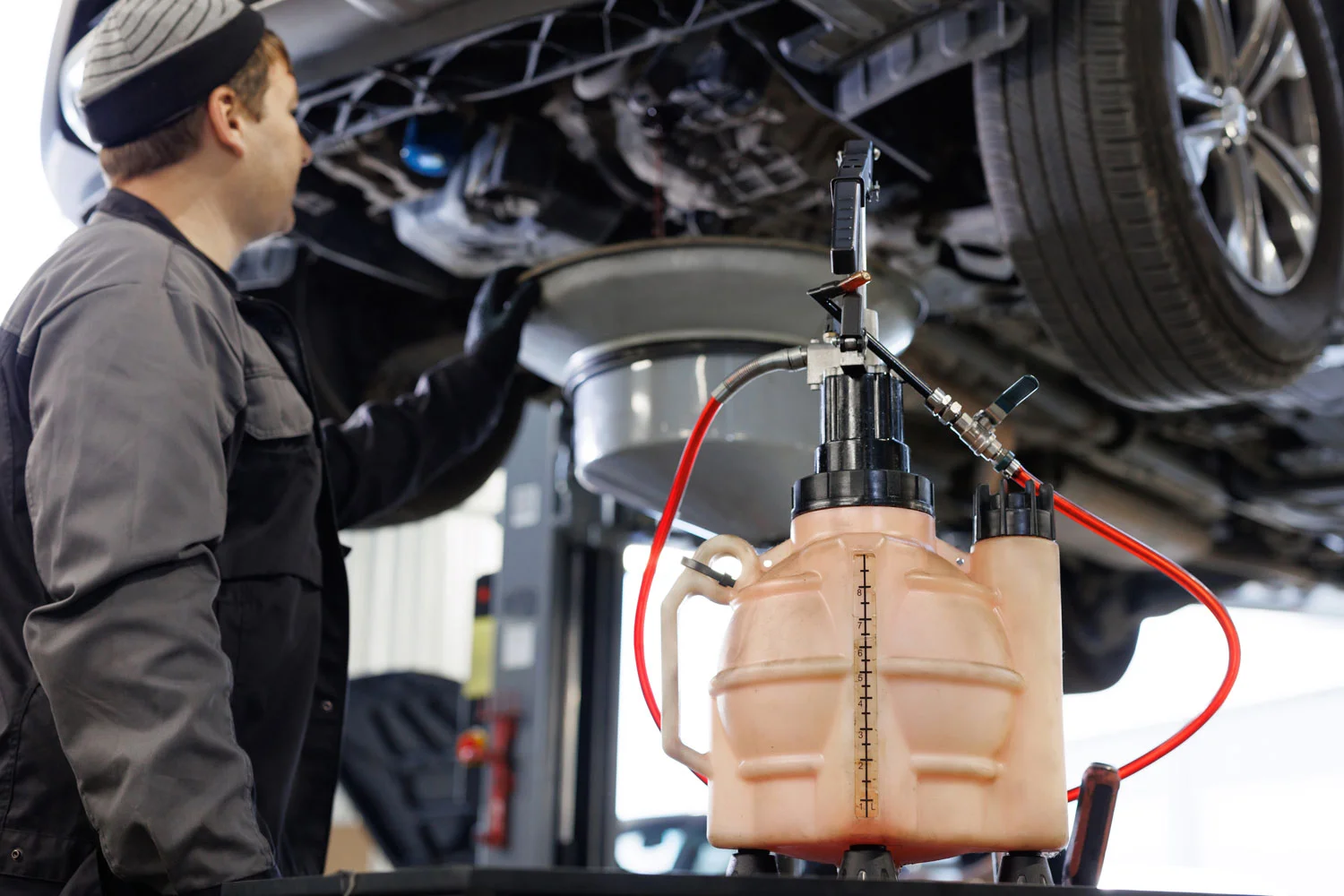
Understanding Different Transmission Fluid Types
Walk into any auto parts store and you’ll see a wall of transmission fluid bottles. Here’s what you actually need to know, because using the wrong fluid is like putting diesel in a gas engine—expensive and stupid.
ATF stands for Automatic Transmission Fluid, but that’s where simplicity ends. Modern vehicles use highly specialized formulas. Your 2018 Ford F-150 requires Mercon ULV. Your 2020 Honda CR-V needs ATF DW-1. These aren’t interchangeable. The friction modifiers, viscosity, and additive packages are engineered specifically for your transmission’s clutch materials and operating pressures.
I’ve repaired transmissions where someone used “universal” ATF thinking they’d save $15. The universal fluid didn’t have the right friction characteristics, causing shuddering and premature clutch wear. Three months later, they were back with a $2,800 repair bill. Learn more about the specific requirements for your vehicle in our detailed guide on [transmission fluid types](transmission-fluid-types).
Common ATF Specifications You’ll Encounter
| Specification | Common Applications | Key Characteristics |
|---|---|---|
| Dexron VI | GM vehicles 2006+ | Backward compatible with older Dexron specs, improved thermal stability |
| Mercon V | Ford 2000-2006 | Specific friction modifiers for Ford clutch materials |
| Mercon LV | Ford 2006+ | Low viscosity for fuel economy, NOT backward compatible |
| ATF+4 | Chrysler/Dodge/Jeep | Unique additive package, do not substitute |
| SP-IV/DW-1 | Honda/Acura | Formulated for Honda’s specific clutch materials |
| WS/T-IV | Toyota/Lexus | World Standard fluid, designed for extended service intervals |
Fluid Change vs Flush: What’s Actually Better?
This debate comes up constantly in the shop, and I’ll give you the truth that most quick-lube places won’t tell you: neither method is universally better. The right choice depends on your transmission’s condition, mileage, and service history.
A fluid change (also called a drain-and-fill) removes 30-50% of the old fluid. You drop the pan, replace the filter if accessible, and refill with fresh fluid. Simple, safe, and what most manufacturers recommend. It costs $80-$150 DIY or $150-$250 professionally.
A transmission flush uses a machine to force new fluid through the system while simultaneously removing old fluid. It exchanges 90-95% of the fluid. Sounds great, right? But here’s the problem: if your transmission has 80,000 miles of accumulated sludge and varnish, that flush can dislodge debris and plug up valve bodies or clog passages. I’ve seen transmissions fail within 500 miles of a flush because chunks of material got pushed into critical areas.
My rule is simple: if the fluid is still red or pink and you’ve maintained regular service intervals, a flush is fine. If the fluid is brown or black, if you’ve never serviced it before, or if you’re past 75,000 miles without service, stick with a drain-and-fill. For a deeper comparison of these methods and when to use each, check out our article on [fluid flush procedures](transmission-flush-vs-drain).
Tools and Materials You’ll Need
Essential Tools (Must Have)
- Floor jack and jack stands – 3-ton minimum capacity ($80-$150 for quality set)
- Socket set – Including 10mm, 12mm, 14mm sockets ($30-$60)
- Torque wrench – 10-150 ft-lb range ($40-$100)
- Oil drain pan – Minimum 8-quart capacity ($15-$30)
- Funnel with long neck – For refilling through dipstick tube ($8-$15)
- Rags and brake cleaner – For cleaning pan and magnet ($10-$20)
- New fluid – Typically 4-6 quarts ($30-$60 depending on spec)
- Transmission filter kit – If applicable ($25-$60 with gasket)
- Nitrile gloves – ATF is messy and toxic ($8 for box of 50)
Optional Tools (Nice to Have)
- Fluid pump – For sealed transmissions without dipsticks ($25-$40)
- Magnet retrieval tool – For dropped bolts ($10-$15)
- Work light – LED rechargeable recommended ($20-$50)
- Plastic scraper – For removing old gasket material ($5-$10)
- Transmission funnel adapter – Vehicle-specific, makes filling easier ($15-$25)
Total DIY Cost: $250-$500 for tools (one-time investment) + $60-$120 per service for fluids and filters
Step-by-Step Transmission Fluid Change Process
I’m going to walk you through this exactly how I do it in the shop. This applies to most traditional automatic transmissions with serviceable pans. If your vehicle has a sealed transmission, the process differs—I’ll cover that afterward.
Preparation Phase (15-20 minutes)
1Locate your transmission pan and drain plug. Park on level ground and engage the parking brake. Crawl under the vehicle and find the transmission pan—it’s usually rectangular and located behind the engine. Some pans have drain plugs; most don’t.
2Verify your fluid type and quantity. Check your owner’s manual or the transmission dipstick for the specific ATF requirement. Note the capacity—most transmissions hold 5-8 quarts total, but you’ll only drain 3-5 quarts in a pan drop. Buy extra; you can always return unopened bottles.
3Raise and secure the vehicle. Jack up the front of the vehicle and support it on jack stands rated for your vehicle’s weight. Place jack stands on the vehicle’s frame or designated jacking points—never on suspension components or the oil pan. Give the vehicle a firm shake to verify stability.
Draining the Old Fluid (20-30 minutes)
4Position your drain pan strategically. Here’s where experience matters: when you loosen the last few pan bolts, fluid will come out fast. Position your drain pan slightly forward of where you think it’ll drip. Trust me on this—I’ve mopped shop floors enough times to know fluid always shoots farther than expected.
5Remove pan bolts in the correct sequence. If there’s a drain plug, remove it first and let the pan drain for 10 minutes. If not, loosen all pan bolts except the corners, then carefully loosen the corner bolts while supporting the pan. Remove the front bolts last so the pan tilts backward and drains away from you. Expect 3-5 quarts to drain.
6Inspect the old fluid and pan. Pour some drained fluid into a clear container. It should be red or pink. Brown means oxidation; black means you’re late on service; metallic particles mean internal wear. Check the magnet in the pan for metal shavings—a thin coating is normal, but chunks or excessive material indicates problems.
Filter Replacement and Pan Cleaning (15-25 minutes)
7Remove the old filter. Most filters are held by 2-4 bolts or friction-fit into the valve body. For bolted filters, remove the bolts and carefully pull the filter straight down—residual fluid will drain out. For friction-fit filters, twist gently while pulling. Some transmissions have internal filters that aren’t serviceable during a pan drop.
8Clean the pan and magnet thoroughly. Use brake cleaner and a clean rag to remove all old gasket material, sludge, and debris from the pan. Clean the magnet completely—any remaining particles will circulate through your fresh fluid. Inspect the pan for cracks or damage; dented pans must be replaced as they won’t seal properly.
9Clean the transmission mating surface. This is critical for preventing leaks. Use a plastic scraper to remove old gasket material from the transmission housing. Never use metal scrapers; they can gouge the aluminum and create permanent leak paths. The surface must be completely clean and smooth.
Reassembly (20-30 minutes)
10Install the new filter and gasket. Install the new filter in the same orientation as the old one. If your kit includes O-rings, lubricate them with a small amount of fresh ATF before installation. For the pan gasket, some techs use RTV sealant, but I prefer the gasket alone on most applications. If using RTV, apply a thin, continuous bead and let it tack up for 10 minutes before installing the pan.
11Install the pan with proper torque sequence. Hand-thread all bolts first to verify alignment. Then torque in a cross-pattern, starting from the center and working outward. Most transmission pans require **120-150 inch-pounds** (10-12.5 ft-lbs)—not foot-pounds. Overtightening warps the pan and cracks gaskets; undertightening causes leaks.
Refilling and Final Checks (15-20 minutes)
12Add fluid through the dipstick tube or fill plug. Using a long-neck funnel, add approximately 75% of the amount you drained. For example, if 4 quarts drained, add 3 quarts initially. This prevents overfilling, which causes foaming and erratic shifting.
13Start the engine and cycle through gears. With the engine idling and your foot on the brake, shift through all gear positions (P-R-N-D-2-1) and pause 2-3 seconds in each. This circulates fluid through the valve body and clutch packs. Return to Park.
14Check and adjust fluid level. With the engine running and at operating temperature (180-200°F), check the dipstick. Fluid should be in the “hot” range. Add fluid in small increments—about 1/2 quart at a time—checking after each addition. The difference between correct level and overfilled is often just 1 pint.
15Test drive and recheck. Drive the vehicle for 10-15 minutes, including highway speeds and multiple gear changes. Park on level ground, let it idle for 2 minutes, and recheck the level. Look underneath for leaks. Check again after 50 miles and 500 miles.
Special Procedures for Sealed Transmissions
Modern vehicles increasingly use sealed transmissions without dipsticks. These still require fluid changes despite manufacturer claims—the procedure just differs.
Sealed transmissions typically have a fill plug on the side of the case and a drain plug on the bottom. The fill plug doubles as the level check. The process involves draining from the bottom plug, refilling through the fill plug until fluid runs out, and installing both plugs. The tricky part is getting the fluid temperature precisely between 90-110°F (depending on manufacturer) during the level check.
You’ll need a fluid temperature scanner or scan tool that reads transmission temp. Fill until fluid drips from the fill hole at the specified temperature, then install the plug. Torque specs are critical here—typically **20-25 ft-lbs for aluminum plugs** and **15-20 ft-lbs for plastic plugs**.
Honestly, sealed transmissions are where I’d recommend professional service unless you have the right tools and experience. The cost difference is minimal, and incorrect fluid level causes immediate damage. Some dealerships charge $200-$300 for this service, but independent shops usually run $150-$200.
Transmission Fluid Change Cost Breakdown
DIY Costs (Traditional Pan Service)
| Item | Quantity | Cost Range |
|---|---|---|
| ATF (specific to your vehicle) | 4-6 quarts | $30-$80 |
| Transmission filter kit | 1 | $25-$60 |
| Pan gasket/RTV sealant | 1 | $10-$20 |
| Brake cleaner and rags | – | $10-$15 |
| Total DIY (per service) | $75-$175 |
Professional Service Costs
| Service Type | Cost Range | Time |
|---|---|---|
| Quick-lube chain (drain-and-fill) | $100-$150 | 45-60 minutes |
| Independent shop (drain-and-fill) | $150-$250 | 1-2 hours |
| Dealership (drain-and-fill) | $200-$350 | 1-2 hours |
| Independent shop (flush service) | $200-$300 | 1.5-2 hours |
| Dealership (flush service) | $300-$450 | 1.5-2 hours |
Long-Term Cost Comparison
Over 150,000 miles with recommended 40,000-mile intervals:
- DIY services (3 services): $225-$525 + tool investment
- Independent shop (3 services): $450-$750
- Dealership (3 services): $600-$1,050
- Neglecting service: $2,500-$5,500 (transmission rebuild/replacement)
Service Intervals: When to Actually Change Your Fluid
This is where manufacturers lie to you. They want you to believe “lifetime fluid” lasts the lifetime of the vehicle. What they mean is the lifetime of the warranty—typically 60,000-100,000 miles. After that, you’re on your own.
The recommended intervals for your specific vehicle are covered in detail in our guide on [recommended service schedule](automatic-transmission-service-intervals), but here are my real-world recommendations based on driving conditions:
Normal Driving Conditions
If you mostly drive on highways, rarely tow, live in moderate climates, and avoid stop-and-go traffic, follow these intervals:
- Traditional automatics: Every 60,000 miles
- CVT transmissions: Every 40,000-50,000 miles
- Dual-clutch transmissions: Every 40,000 miles
Severe Driving Conditions
If any of these apply, cut the intervals in half:
- Frequent towing or hauling heavy loads
- Regular stop-and-go city driving
- Operating in extreme heat (Arizona, Texas summers)
- Operating in extreme cold (sustained below 20°F)
- Mountainous terrain or off-road use
- Taxi, delivery, or commercial use
I drive a 2016 Silverado that tows my equipment trailer weekly. I change the fluid every 30,000 miles religiously. My transmission has 165,000 miles and shifts like new. My buddy has the same truck, never towed anything, changed fluid at 100,000 miles. His transmission started slipping at 118,000 miles.
Troubleshooting Common Issues
Shifting Problems After Fluid Change
If your transmission shifts rough or slips after a fluid change, you’ve got one of three problems. First, check the fluid level—90% of post-service issues are incorrect level. Too low causes slipping; too high causes foaming and erratic behavior.
Second possibility: you dislodged debris during the service. If fluid was black and neglected, changing it can free varnish deposits that clog passages. This typically resolves within 100-200 miles as debris gets caught by the filter. If it doesn’t improve, you might need a second drain-and-fill to flush the loosened material.
Third possibility: wrong fluid. If someone put Dexron in a Honda that requires DW-1, you’ll get shuddering and harsh shifts. The only fix is draining it completely and refilling with correct fluid. This is expensive and why I’m obsessive about fluid specifications.
Leaks After Pan Installation
Pan leaks after service usually mean one of three things: overtightened bolts (most common), undertightened bolts, or contaminated gasket surface. If it’s leaking, don’t just tighten the bolts harder. Drop the pan, inspect the gasket for damage, clean both surfaces again, install a new gasket, and torque properly.
A slow seep from pan corners is sometimes acceptable on high-mileage transmissions where the case has minor warping. As long as it’s not dripping, monitor it. A few drops on your driveway per week won’t hurt, but active dripping means you need to address it.
Fluid Level Diagnosis
| Symptom | Likely Cause | Solution |
|---|---|---|
| Delayed engagement (pause before moving) | Low fluid level | Add fluid 1/2 quart at a time until level is correct |
| Harsh shifts or slipping | Low fluid or wrong fluid type | Check level first, verify fluid specification |
| Fluid coming out dipstick tube | Overfilled (foaming) | Drain excess immediately—causes severe damage |
| Erratic shifting, bubbles in fluid | Overfilled or air in system | Drain to proper level, cycle gears 20 times |
| No movement in any gear | Severely low fluid or internal failure | Check level immediately, tow to shop if zero fluid |
When to Call a Professional
I fix transmissions for a living, but even I know when to refer work out. Call a transmission specialist if:
- You see metal chunks (not just fine dust) on the pan magnet
- The fluid smells burnt even after changing
- Shifting problems persist after correcting fluid level
- You notice unusual noises during gear changes
- The transmission goes into limp mode (stuck in one gear)
- There’s a complete loss of a specific gear
Transmission repairs start at $1,500 for minor valve body work and run $2,500-$5,500 for rebuilds. Replacements can hit $6,000-$8,000 installed. If you catch problems early through regular fluid changes and inspections, you can often prevent catastrophic failures.
CVT Transmissions: Special Considerations
Continuously Variable Transmissions need extra attention. The fluid in a CVT works harder than conventional ATF because it has to transmit power through metal bands or chains instead of gears. This creates enormous friction and heat.
CVT fluid degrades faster—I recommend changes every 40,000 miles regardless of what the manufacturer says. Nissan CVTs are notorious for early failure when fluid isn’t changed. I’ve rebuilt dozens of Nissan CVTs with 80,000-120,000 miles that never had fluid service. The failures follow a pattern: shuddering starts around 60,000 miles, gets worse by 80,000, and becomes undriveable by 100,000.
CVT fluid is expensive—$10-$15 per quart—and you can’t substitute conventional ATF. Ever. The friction characteristics are completely different. Using regular ATF in a CVT will destroy it within 1,000 miles. CVT transmissions also require precise fill amounts; overfilling causes belt slippage.
Frequently Asked Questions
How much does a transmission fluid change cost at a shop versus DIY?
Professional transmission fluid changes range from $150-$350 depending on whether you visit a quick-lube chain, independent shop, or dealership. DIY costs run $75-$175 for materials only, but you need to factor in the time investment (2-3 hours) and tool costs if you’re starting from scratch.
The real cost comparison comes over time. If you plan to keep your vehicle past 100,000 miles, you’ll need 2-3 services. Paying a shop $600-$900 total versus spending $225-$450 DIY means you save $300-$500. However, if you mess up and cause a leak or use wrong fluid, that savings evaporates fast.
I generally tell people: if you’re mechanically inclined and have done basic maintenance before, DIY saves money. If you’ve never worked under a car, the $150-$200 for professional service buys you peace of mind and warranty coverage if something goes wrong.
Can I just add transmission fluid without changing it?
You can, but you shouldn’t make it a habit. Adding fluid addresses low levels but doesn’t remove contaminated fluid. Think of it like adding fresh coffee to a pot of week-old coffee—you’re diluting the problem, not solving it.
If you’re down a quart, topping off is fine temporarily. But if you’re regularly adding fluid, you have a leak that needs repair. Transmission fluid doesn’t evaporate or get consumed—if the level drops, it’s going somewhere. Most leaks start small but worsen over time. A $50 seal replacement now prevents a $3,000 transmission replacement later.
I’ve seen customers add quart after quart for months, ignoring the growing puddle in their driveway. By the time they bring it in, the transmission has been running low for so long that internal damage is done. Fix leaks immediately and change fluid on schedule rather than constantly topping off degraded fluid.
What happens if I never change my transmission fluid?
Nothing happens immediately, which is why people neglect it. But around 80,000-100,000 miles, the consequences arrive fast. First, you’ll notice delayed engagement—a pause before the transmission moves when you shift to Drive or Reverse. Then comes harsh shifting or slipping between gears. Eventually, the transmission fails completely.
Inside the transmission, neglected fluid causes a cascade of problems. Worn additives mean clutch packs slip and burn. Oxidized fluid turns acidic and corrodes metal components. Suspended debris acts like sandpaper on precision parts. Varnish builds up in passages, blocking fluid flow. The heat generated by increased friction accelerates the damage.
The average cost to rebuild a failed transmission is $2,500-$4,500. Replacement transmissions run $3,500-$6,500 installed. Compare that to $150-$250 per fluid change every 50,000 miles, and the math is obvious. I’ve seen $300 in preventive maintenance save people $5,000 in repairs.
Is black transmission fluid bad, or can I keep driving?
Black fluid is bad—really bad. Fresh ATF is bright red or pink. It darkens gradually to brown as it ages normally. When it turns black, the fluid has oxidized severely and is full of suspended clutch material and metal particles. This usually happens after 80,000-120,000 miles without service.
Can you keep driving? Technically yes, but you’re on borrowed time. Black fluid has lost most of its lubricating and hydraulic properties. Every mile driven accelerates wear. I’ve seen transmissions last another 20,000 miles with black fluid, and I’ve seen them fail within 2,000 miles. There’s no way to predict which yours will be.
Here’s what I do when customers bring me vehicles with black fluid: I drain and fill immediately, then do another drain-and-fill at 500 miles, then again at 1,500 miles. This progressive approach removes contamination gradually without shocking the system. Attempting a flush on severely neglected fluid often causes immediate failure because debris plugs up critical passages.
Can I mix different brands of transmission fluid if they’re the same type?
Mixing brands of the same specification is technically acceptable but not ideal. If your transmission requires Dexron VI, any Dexron VI fluid meets the base specification. However, each manufacturer’s additive package differs slightly in friction modifiers, anti-foaming agents, and detergents.
In emergency situations—like you’re on a road trip and need to add a quart—mixing brands won’t cause immediate damage. But for a complete fluid change, stick with one brand. I’ve seen minor shift quality changes when customers mix brands, though nothing catastrophic.
The bigger concern is mixing specifications. Never mix Mercon V with Mercon LV, or Dexron III with Dexron VI, or ATF+4 with anything else. These have incompatible additive packages and different friction characteristics. Mixing specifications causes harsh shifts, slipping, and potential damage.
Do I need to change the filter every time I change the fluid?
If the filter is accessible (which it is in most traditional automatic transmissions with drop pans), yes—change it every time. The filter costs $25-$40 and takes 5 extra minutes to replace. Skipping it means you’re circulating fresh fluid through a dirty filter full of the contaminants you just drained out.
Some modern transmissions have internal filters that aren’t meant to be serviced at regular intervals. These are typically designed to last 100,000-150,000 miles. If accessing the filter requires removing the valve body—a complex job requiring special tools and expertise—it’s reasonable to skip it during routine fluid changes and address it only if transmission problems develop.
I always recommend changing the filter when accessible because it’s cheap insurance. The filter traps metal particles and clutch material that would otherwise circulate and cause wear. I’ve seen filters so clogged they restricted fluid flow, causing delayed engagement and shifting problems that mimicked more serious internal failures.
Will changing very old transmission fluid cause problems?
This is a myth that refuses to die, and it’s based on a misunderstanding of what actually happens. The theory is that dirty fluid has friction that “helps” worn clutches grip better, and clean fluid will cause them to slip. This is technically true but irrelevant in practice.
If your clutches are so worn that they rely on contaminated fluid for friction, your transmission is already failing. Changing the fluid won’t kill a healthy transmission—it’ll just expose problems that were already there. I’ve changed fluid in transmissions with 150,000+ miles countless times without issues.
The real risk is the method, not the act itself. Aggressive flushing on a severely neglected transmission can dislodge chunks of varnish that plug passages. That’s why I use the progressive drain-and-fill method on high-mileage vehicles: three services spaced 500 miles apart gradually refreshes the fluid without shocking the system. This approach has saved dozens of transmissions I thought were on their last legs.
How do I check my transmission fluid level correctly?
The correct procedure depends on your vehicle. Traditional transmissions with dipsticks are checked with the engine running, transmission in Park, on level ground, at operating temperature (usually 180-200°F after 10-15 minutes of driving).
Here’s the exact process I use: Drive the vehicle for 15 minutes to reach operating temperature. Park on level ground and leave the engine running. Pull the dipstick, wipe it clean, reinsert it fully, wait 3 seconds, then pull it out and read the level. The fluid should be between the “hot” marks. If it’s above or below, adjust in small increments—the difference between correct and overfilled is often just half a quart.
Sealed transmissions without dipsticks require different procedures. Most have a fill plug that doubles as a level check, and the fluid must be at a specific temperature (usually 90-110°F) during checking. This requires a temperature scanner or scan tool. If you have a sealed transmission, I strongly recommend professional service—incorrect level causes immediate damage, and you can’t check it easily afterward.
Final Thoughts from a Mechanic’s Perspective
After 17 years of rebuilding transmissions and dealing with the aftermath of neglected maintenance, I can tell you with absolute certainty: transmission fluid changes are the cheapest insurance you can buy for your vehicle.
The difference between a transmission that lasts 200,000 miles and one that fails at 120,000 usually comes down to fluid maintenance. I’ve seen identical vehicles—same year, same model, same mileage—where the only difference was fluid service intervals. One owner followed the schedule and drove their car to 250,000 miles on the original transmission. The other ignored it and needed a $4,200 rebuild at 118,000 miles.
For DIYers with basic mechanical skills, this is a manageable weekend project that saves $100-$200 per service. The tools you need are basics that’ll serve you for decades of vehicle ownership. Take your time, follow the torque specs, use the correct fluid, and you’ll do just as good a job as most shops.
If you’re not comfortable working under your vehicle or don’t have the time, spending $150-$250 at a reputable independent shop is money well spent. Just avoid the quick-lube chains that hire inexperienced techs and push unnecessary flush services. Find a transmission specialist or independent mechanic who understands the difference between maintenance and aggressive selling.
Most importantly, don’t believe the “lifetime fluid” marketing. No fluid lasts forever, and manufacturers define “lifetime” as the warranty period, not the vehicle’s actual lifespan. Change your fluid every 40,000-60,000 miles regardless of what the manual says, and your transmission will likely outlast the rest of your vehicle.
The $300-$500 you spend on maintenance over 150,000 miles prevents the $2,500-$5,500 you’d spend on a rebuild or replacement. That’s a 5-to-1 return on investment for an hour of work every few years. In 17 years of wrenching, I’ve never met anyone who regretted maintaining their transmission—but I’ve met hundreds who regretted neglecting it.