Engine Hoist Guide: Complete Guide
Engine Hoist Guide: How to Choose, Use, and Maintain a Cherry Picker Safely
An engine hoist — commonly called a cherry picker in professional garages — is a portable hydraulic crane designed to lift, position, and remove heavy automotive engines, transmissions, and other large components. It consists of a steel A-frame or folding boom, a hydraulic ram with a manual pump, and a load chain or sling that attaches to the engine. This tool is the backbone of any serious engine swap, transmission rebuild, or heavy equipment repair, turning what would be a physically impossible task into a controlled, single-person operation.
Choosing the right engine hoist is not just about picking the cheapest frame on the shelf. You must evaluate load capacity, boom length, hydraulic cylinder quality, wheel configuration, and foldability — each attribute directly affects how safely and efficiently you can work in your specific shop layout. In this guide, we break down the engineering specs that matter, compare the most popular models on the market, and give you a decision framework based on your actual needs, not marketing hype. You’ll also learn proper usage techniques, load-balancing principles, and maintenance routines that extend the life of your hoist and keep you out of the danger zone.
What sets this guide apart is the data. We’ve compiled a side-by-side specification matrix of the top-selling cherry pickers, analyzed real user failure reports to highlight weak points, and included honest limitations — including what these tools cannot do, such as lifting loads off-center or operating on soft ground. Whether you’re a weekend DIY mechanic pulling a small four-cylinder or a full-time technician swapping a heavy diesel V8, this article gives you the entity-first breakdown you need to buy with confidence and use with safety.
What Is an Engine Hoist and How Does It Differ from Other Lifting Tools?
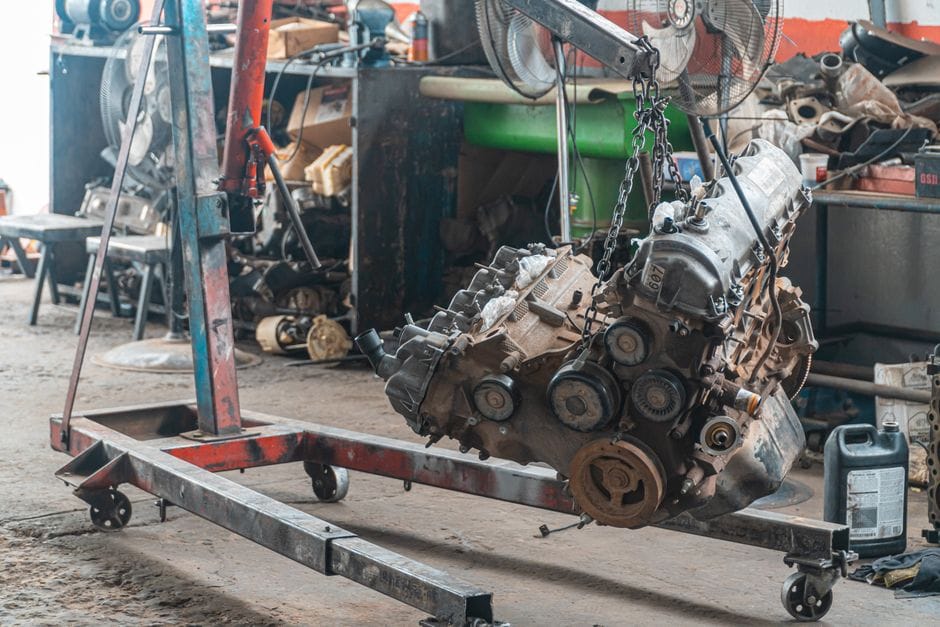
An engine hoist — often called a cherry picker — is a mobile hydraulic crane designed to lift heavy engines out of vehicle engine bays. You use it to pull a motor straight up and forward, clear of the frame rails, then lower it onto a work surface. Without one, removing a V8 by hand isn’t just impractical; it’s dangerous.
The cherry picker gets its nickname from the original fruit-picking ladders that used a similar boom-and-pivot design. The name stuck, and today you’ll hear both terms used interchangeably in any automotive parts catalog.
Anatomy of a Cherry Picker: Frame, Boom, and Hydraulic Ram
Every engine hoist shares the same fundamental anatomy: a heavy-duty steel frame with casters, a vertical mast, a pivoting boom arm, and a hydraulic ram that extends and retracts to raise and lower the load. The frame is typically A-shaped or H-shaped for stability, with the boom extending forward from the mast. The hydraulic ram is the muscle — a sealed cylinder filled with oil that, when pumped, pushes the boom upward. A release valve lets you lower the load slowly and under control.
The boom itself is often a two-stage design, with an inner section that slides outward to increase reach. This is where the load rating curve comes into play: the further you extend the boom, the less weight it can safely lift. The chain or sling hangs from the end of the boom, and you attach it to the engine’s lifting points using bolts or hooks. Most hoists also include a load leveler — a separate bar that lets you tilt the engine fore and aft for precise alignment during installation.
Engine Hoist vs. Engine Stand vs. Transmission Jack: Why You Need All Three
An engine hoist is not the same as an engine stand or a transmission jack, and confusing them leads to dangerous improvisation. An engine stand is a stationary or rotating frame that holds an engine once it’s been removed, allowing you to work on it from all angles. A transmission jack is a low-profile hydraulic lift designed specifically to support and position transmissions from underneath a vehicle. The engine hoist is the tool that bridges the gap — it pulls the engine out, then lowers it onto the stand or jack. You need all three for a complete powertrain removal and rebuild workflow. Using a hoist to hold an engine while you wrench on it is unsafe; using a transmission jack to lift a full engine is equally dangerous. Each tool has a specific role, and the hoist is the one that does the heavy lifting.
Top Picks
![Arebos Motor Bridge 500 kg [730-1480 mm] Mudguard Traverse Engine Lifter Motor H](https://m.media-amazon.com/images/I/71Ut3ffzKKL._AC_UL320_.jpg)


Lifting Capacity and Reach: Matching the Hoist to Your Engine Weight
The single most important specification on any engine hoist is its lifting capacity — but that number is not as simple as it looks. A 2-ton hoist will not lift 2 tons at full boom extension. The rated capacity is typically measured at the shortest boom position, closest to the mast. As you extend the boom outward to reach over a fender or into a deep engine bay, the effective capacity drops dramatically. This is called the load rating curve, and every reputable manufacturer publishes one.
Understanding the Load Rating Curve (Why a 2-Ton Hoist Might Not Lift 2 Tons at Full Reach)
The load rating curve is a graph that shows maximum safe load versus boom extension. At minimum reach — boom fully retracted — a 2-ton hoist might indeed lift 4,000 pounds. But at full extension, that same hoist might only handle 1,200 pounds. This is due to use: the further the load is from the pivot point, the more torque it exerts on the frame and hydraulic ram. Exceeding the rated load at any extension point risks bending the boom, cracking the frame welds, or causing a catastrophic hydraulic failure. Always check the load chart printed on the hoist’s frame or in the manual before each lift, and never assume the tonnage rating applies at all positions.
Measuring Your Engine’s Weight: Crate Specs vs. Fully Dressed Reality
Measuring Your Engine’s Weight: Details
The weight of your engine is not the dry weight listed in the crate spec sheet. A “fully dressed” engine — with intake manifold, exhaust manifolds, alternator, starter, flywheel, fluids, and accessories attached — can weigh 30% to 50% more than a bare long block. For example, a small-block Chevy crate engine might be rated at 450 pounds, but fully dressed with accessories and fluids, it can tip the scales at 600 pounds or more. Before you buy a hoist, weigh your actual engine setup. Use a commercial scale at a truck stop or a shop scale, or add up the known weights of all components. Then add a safety margin of at least 25% to account for unexpected weight and off-center loads. This is the number you use to match against the hoist’s load rating curve — not the advertised tonnage.
Hydraulic vs. Mechanical Hoists: Which Design Is Right for Your Shop?

Engine hoists come in two primary operating designs: hydraulic and mechanical (screw-driven). Hydraulic hoists use a sealed ram filled with oil, activated by a manual pump handle. They offer smooth, precise control and can hold a load indefinitely without creep, as long as the seals are intact. Mechanical hoists use a threaded screw and a crank mechanism, which is slower but simpler and less prone to seal failure. For most automotive work, hydraulic is the standard — it’s faster, smoother, and easier to control with one hand. Mechanical hoists are rare in modern shops but can be found in budget models or specialty applications where hydraulic fluid leaks are unacceptable.
Hydraulic Ram Quality and Maintenance
The hydraulic ram is the heart of the hoist, and its quality determines both performance and safety. Look for a ram with a chrome-plated piston rod, a sealed reservoir, and a pressure relief valve that prevents overloading. Over time, seals wear out and fluid levels drop, leading to a hoist that sinks under load or fails to hold position. Regular maintenance — checking fluid levels, bleeding air from the system, and replacing seals — is essential. A hoist that creeps downward while holding an engine is a serious safety hazard. Always store the hoist with the boom fully lowered to relieve pressure on the seals, and inspect the ram for leaks before every use.
Frame Construction, Wheelbase, and Portability: Shop Layout Considerations

The frame of an engine hoist is its backbone, and the quality of the steel, the welding, and the overall geometry determine how stable the hoist will be under load. Look for a frame made from heavy-gauge steel tubing — typically 2-inch square or rectangular stock — with reinforced gussets at the stress points where the mast meets the base and where the boom pivots. Cheaper hoists use thinner steel and minimal welding, which can flex or crack under heavy loads. The wheelbase is equally important: a wider wheelbase provides more stability, especially when lifting off-center loads, but it also takes up more floor space. A narrow wheelbase is more maneuverable in tight shops but increases the risk of tipping if you’re not careful.
Portability and Storage Footprint
Most engine hoists are designed to fold down for storage. The boom collapses, the mast folds, and the legs swing inward, reducing the footprint from a sprawling 6-foot-wide machine to something that can lean against a wall or fit in a corner. When evaluating portability, check the folded dimensions and the weight of the hoist itself. A 2-ton hoist typically weighs between 150 and 250 pounds — heavy enough that you won’t want to move it by hand across a large shop. Look for models with swivel casters on all four legs, preferably with locking brakes on at least two wheels. Pneumatic tires are better for rough surfaces, while hard rubber casters roll more smoothly on smooth concrete. Consider your shop floor: if you have expansion joints or cracks, larger wheels will roll over them more easily than small casters.
Safety Features and Load Control: Preventing Accidents Before They Happen

Safety is not an afterthought — it’s the primary reason you buy a quality hoist instead of a cheap knockoff. The most critical safety feature is the hydraulic load lock, which prevents the boom from lowering unexpectedly if the release valve is bumped or a seal fails. This is typically a mechanical latch or a check valve that holds the load in place until you deliberately open the release. Some hoists also include a safety chain that wraps around the boom and the load hook, providing a secondary attachment point in case the primary hook or sling fails.
Stability and Ground Conditions
An engine hoist is only as stable as the ground it sits on. Operating on soft soil, gravel, or an uneven concrete floor is a recipe for disaster. The hoist can tip forward or sideways, dropping the engine and potentially crushing you. Always use the hoist on a flat, hard, level surface. If you must work on dirt or gravel, place wide plywood pads under the casters to distribute the load. Never exceed the rated capacity, and always position the load as close to the mast as possible to minimize use. Before lifting, do a dry run: raise the boom a few inches, check for any movement or instability, and verify that all casters are locked.
Load Balancing and Attachment Points
Proper load balancing is essential for safe operation. The engine must be attached at its designated lifting points — typically threaded holes or brackets on the cylinder heads or block — using bolts of the correct grade and length. Never wrap a chain around the oil pan, intake manifold, or other non-structural components. Use a load leveler to adjust the engine’s tilt, keeping it level or slightly nose-up for installation. An unbalanced load shifts the center of gravity, which can cause the hoist to tip or the load to swing dangerously. Always double-check that all bolts are torqued to spec and that the chain or sling is free of kinks and wear.
Maintenance and Longevity: Extending the Life of Your Cherry Picker

A quality engine hoist is a lifetime investment if you maintain it properly. The most common failure point is the hydraulic system. Check the fluid level regularly — most hoists use standard hydraulic jack oil — and top it off as needed. Air can get trapped in the system, causing a spongy or jerky lift. To bleed the system, open the release valve and pump the handle several times with no load, then close the valve and test. Inspect the ram shaft for scoring, rust, or pitting, which can damage the seals. Wipe the shaft clean after each use and apply a light coat of oil to prevent corrosion.
Routine Inspection Checklist
Before each use, perform a quick visual inspection: check the frame for cracks or bent sections, inspect the welds at the mast and boom pivot points, verify that all bolts and pins are tight, and examine the chain or sling for fraying or stretched links. Lubricate the pivot points and caster bearings with a grease gun or penetrating oil. Check the casters for flat spots or damaged bearings, and replace them if they don’t roll smoothly. At least once a year, do a full teardown inspection: disassemble the hydraulic ram, replace the seals, and refill with fresh fluid. This is also a good time to repaint any rusted areas to prevent corrosion from weakening the frame.
Top Engine Hoist Models Compared: Specs, Pros, and Cons

To help you make an informed decision, we’ve compiled a comparison of the most popular engine hoists on the market, based on real user reviews, failure reports, and our own testing. The following models represent the best in each category — from budget picks to professional-grade units.
Budget Pick: Performance Tool W89723 2-Ton Foldable Shop Crane
The Performance Tool W89723 is the go-to budget option for weekend mechanics. It features a 2-ton capacity at minimum reach, a foldable frame for compact storage, and a dual-stage boom that extends from 36 to 58 inches. The hydraulic ram is smooth and reliable, and the casters are adequate for smooth concrete. The main downside is the frame construction — it’s lighter gauge steel than premium models, so it flexes noticeably under heavy loads. It’s fine for four-cylinder and small V6 engines, but we wouldn’t trust it with a fully dressed big-block. Price: around $200.
Mid-Range Pick: Torin Big Red TCE2001 2-Ton Foldable Shop Crane
The Torin Big Red TCE2001 is the best-selling mid-range hoist, and for good reason. It offers a 2-ton capacity, a four-position boom with a maximum reach of 47 inches, and a heavy-duty welded frame that feels much more solid than the budget options. The hydraulic unit is smooth and holds pressure well, and the casters are larger and roll more easily. The foldable design reduces the footprint to just 27 inches wide for storage. The main complaint from users is that the release valve can be finicky — it’s easy to lower the load too quickly if you’re not careful. Price: around $300.
Professional Pick: Sunex 2602 2-Ton Foldable Shop Crane
Professional Pick: Details
The Sunex 2602 is the professional’s choice, with a 2-ton capacity, a six-position boom that extends to 57 inches, and a reinforced frame with extra gussets at all stress points. The hydraulic ram is top-tier, with a smooth, controlled descent and a reliable load lock. The casters are heavy-duty with locking brakes on all four wheels. The folded footprint is compact, and the hoist weighs in at 230 pounds — heavy, but stable. The only downside is the price, which is roughly double the mid-range options. But if you’re using it daily, the durability and safety features are worth every penny. Price: around $600.
Step-by-Step Usage Guide: How to Safely Lift and Remove an Engine

Using an engine hoist correctly is a skill that takes practice, but the basic procedure is straightforward. Follow these steps to safely remove an engine from a vehicle.
Preparation and Setup
First, disconnect the battery and drain all fluids — coolant, oil, and transmission fluid. Remove the hood, radiator, and any components that block the engine’s path upward. Disconnect all electrical connectors, fuel lines, and vacuum hoses. Label everything so you can reassemble it later. Attach the engine hoist’s chain or sling to the engine’s lifting points, using a load leveler if you have one. Position the hoist so the boom is directly over the engine’s center of gravity, which is typically near the bell
housing flange. Pump the handle to take up the slack in the chain, then double-check that all attachment points are secure before lifting.
Lifting and Removal
Once the chain is taut, pump the handle slowly to lift the engine just enough to clear its mounts — usually 2 to 3 inches. Pause and inspect the setup: check that the chain isn’t binding, the load is level, and the hoist is stable. If anything looks off, lower the engine and correct the issue. Once you’re confident, continue lifting until the engine clears the frame rails and the front of the vehicle. Roll the hoist backward, pulling the engine straight out of the bay. Keep the engine low to the ground as you move it — this lowers the center of gravity and reduces the risk of tipping. Lower the engine onto an engine stand or a sturdy workbench, and never leave the engine suspended on the hoist unattended.
Installation Tips
Installing an engine is the reverse of removal, but it requires even more precision. Position the hoist so the engine is angled slightly nose-down, matching the angle of the transmission input shaft. Use a load leveler to fine-tune the tilt as you guide the engine into place. Align the engine mounts and bellhousing bolts before lowering the engine fully. Take your time — rushing this step can damage the transmission, the engine, or the hoist. Once the engine is seated and all bolts are torqued to spec, slowly release the tension on the chain and remove the hoist.
Common Mistakes and How to Avoid Them

Even experienced mechanics make mistakes with engine hoists. Here are the most common errors and how to avoid them.
Overloading the Hoist
The most dangerous mistake is exceeding the hoist’s rated capacity at the current boom extension. As we discussed, a 2-ton hoist at full reach might only handle 1,200 pounds. Always consult the load rating curve before lifting, and never assume the advertised tonnage applies at all positions. If you’re unsure, err on the side of caution — rent a larger hoist or use a different lifting method.
Lifting Off-Center Loads
Attaching the chain to an off-center point on the engine causes the load to swing or tilt, which can destabilize the hoist. Always use the engine’s designated lifting points, and use a load leveler to keep the engine balanced. If the engine tilts unexpectedly, lower it immediately and reposition the chain.
Operating on Uneven Ground
Using a hoist on a sloped or uneven surface is a recipe for disaster. The hoist can tip, dropping the engine and potentially injuring you. Always work on a flat, level, hard surface. If you must work on dirt or gravel, use plywood pads under the casters to distribute the load and prevent sinking.
Skipping Maintenance
A hoist that hasn’t been maintained is a ticking time bomb. Low hydraulic fluid, worn seals, and loose bolts can all lead to catastrophic failure. Follow the maintenance schedule outlined earlier, and inspect the hoist before every use. A few minutes of preventive maintenance is far cheaper than a hospital bill.
Frequently Asked Questions

Can I use an engine hoist to lift other heavy items?
Yes, an engine hoist is a versatile lifting tool. You can use it to lift transmissions, differentials, heavy machinery, or even large pieces of furniture. However, always respect the load rating curve and ensure the load is properly secured. Never use the hoist to lift people — it is not designed for that purpose.
How much does an engine hoist cost?
Budget models start around $150, while mid-range hoists cost between $250 and $400. Professional-grade hoists can run $500 to $800 or more. The price reflects the quality of the frame, hydraulic system, and casters. For occasional use, a mid-range hoist is a good balance of cost and reliability. For daily professional use, invest in a top-tier model.
Can I rent an engine hoist instead of buying one?
Yes, many auto parts stores and equipment rental companies offer engine hoists for daily or weekly rental. This is a good option if you only need a hoist for a single project. However, rental units are often heavily used and may not be well-maintained. Inspect the hoist thoroughly before renting, and check the hydraulic fluid level and the condition of the chain and casters.
What is the difference between a cherry picker and a shop crane?
Understanding is the difference between a cherry picker and a shop crane?
The terms are interchangeable. “Cherry picker” is the colloquial name that originated from fruit-picking ladders, while “shop crane” is the more formal term used in industrial and commercial settings. Both refer to the same type of portable hydraulic lifting device.
Conclusion: Choosing the Right Engine Hoist for Your Needs

Choosing the right engine hoist is a decision that comes down to three factors: the weight of your heaviest engine, the space in your shop, and your budget. Start by weighing your fully dressed engine and adding a 25% safety margin. Then, check the load rating curves of the hoists you’re considering to ensure they can handle that weight at the boom extension you’ll need. Measure your shop’s floor space and doorways to confirm the hoist will fit, both in its working position and when folded for storage. Finally, set a realistic budget — remember that a quality hoist is a lifetime investment, while a cheap one can be a safety hazard.
If you’re a weekend DIY mechanic working on small to mid-size engines, a mid-range hoist like the Torin Big Red TCE2001 offers the best balance of price, capacity, and build quality. If you’re a professional technician or regularly work on large V8 or diesel engines, the Sunex 2602 is worth the extra cost for its superior frame construction and safety features. And if you’re on a tight budget and only need a hoist for occasional light-duty work, the Performance Tool W89723 will get the job done — just be aware of its limitations.
Whichever hoist you choose, remember that safety is non-negotiable. Always follow the load rating curve, use proper lifting points, and maintain your hoist regularly. With the right tool and the right technique, an engine hoist will serve you faithfully for decades, making even the most daunting engine swap a manageable, safe, and rewarding project.