It was a Tuesday morning, about 20 degrees outside, when Sarah rolled her 2016 Honda Civic into my bay with that unmistakable stumbling idle. She’d been dealing with it for three weeks, and now the check engine light had finally joined the party. “It feels like the car’s about to stall every time I stop at a red light,” she told me, wrapping her coat tighter against the shop’s drafty entrance.
I plugged in my scanner before she’d even finished talking. P0301—cylinder one misfire. But here’s what fifteen years in this business teaches you: a misfire code is just the beginning of the story. I popped the hood, pulled the spark plug from cylinder one, and there it was—black, sooty, fuel-fouled. The injector had been dribbling fuel instead of atomizing it properly. Classic clogged fuel injector behavior.
Sarah’s case isn’t unique. I see bad fuel injector symptoms at least twice a week, and the signs are almost always the same. The problem is, most drivers ignore these warning signs until they’re stranded or facing a $1,200 repair bill. Let me walk you through exactly what to watch for, so you can catch injector problems before they empty your wallet.
Quick Answer
Bad fuel injectors typically show nine key symptoms: rough idle, engine misfires, poor acceleration, reduced fuel economy, difficulty starting, fuel smell, increased emissions, engine surging, and clicking sounds from the injectors. Most issues stem from carbon buildup or electrical failures. Professional cleaning costs $50-$150 per injector, while replacement runs $150-$400 each plus labor.
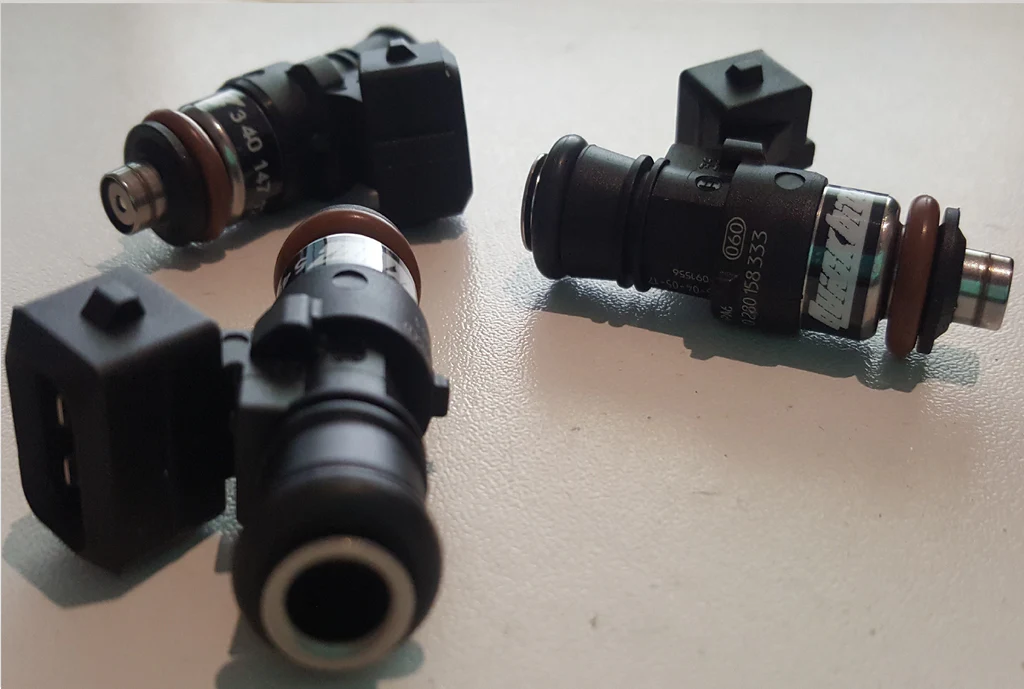
Understanding Fuel Injector Function
Before we dive into symptoms, you need to understand what these little bastards actually do. Fuel injectors are electromagnetically-controlled valves that spray atomized fuel directly into your engine’s intake manifold or combustion chamber. They open and close thousands of times per minute, pulsing fuel in precise amounts based on signals from your engine control module (ECM).
Modern port fuel injectors operate at 40-65 PSI, while direct injection systems can hit 2,000+ PSI. That’s serious pressure. The injector has to atomize fuel into a fine mist—we’re talking droplets around 20-100 microns—so it mixes properly with incoming air. When that spray pattern gets disrupted by carbon deposits or the injector’s solenoid starts failing, everything goes sideways.
I’ve pulled injectors that looked like they’d been dipped in tar. That carbon buildup comes from fuel additives, poor-quality gasoline, and normal combustion byproducts getting baked onto the injector tip. It takes about 50,000-80,000 miles for most injectors to develop enough carbon to cause noticeable symptoms, though I’ve seen it happen in as little as 30,000 miles with cheap gas.
The 9 Critical Bad Fuel Injector Symptoms
1. Rough Idle and Engine Vibration
This is usually the first symptom drivers notice. Your engine should idle smoothly at 600-900 RPM (varies by vehicle). With a bad injector causing rough idle, you’ll feel a shake or vibration through the steering wheel and seat. The tachometer might bounce between 500-800 RPM instead of holding steady.
What’s happening: One or more injectors aren’t delivering the right fuel quantity, creating an imbalance between cylinders. Your ECM tries to compensate by adjusting the fuel trim, but it can only do so much. I’ve measured fuel trims at +25% on vehicles with severely clogged injectors—that’s the computer adding 25% more fuel trying to maintain the proper air-fuel ratio.
Pro Tip from the Shop:
If your rough idle gets worse when you turn on the AC or headlights, that’s a strong indicator of injector problems. The added electrical load reveals the weakness in an already struggling fuel delivery system. I use this test all the time to confirm injector issues before I even hook up my scope.
2. Engine Misfires and Misfire Codes
Misfire codes (P0300-P0308) are the check engine light’s way of screaming “something’s wrong with combustion!” A misfiring injector either delivers too much fuel, too little, or fuel at the wrong time. Either way, you get incomplete combustion in that cylinder.
Here’s how I diagnose it: If you have a P0301 (cylinder 1 misfire), I’ll swap the injector from cylinder 1 with another cylinder and clear the codes. If the misfire follows the injector to the new cylinder, bingo—bad injector. If the misfire stays at cylinder 1, I’m looking at spark plugs, coils, or compression issues instead.
I’ve seen misfires caused by injectors stuck open (dumping fuel), stuck closed (no fuel), or cycling erratically. The stuck-open scenario is particularly nasty—it’ll foul your spark plug within a few hundred miles and can even wash oil off the cylinder walls, leading to accelerated wear. Learn more about diagnosing engine misfires in different scenarios.
3. Poor Fuel Economy (The Wallet Test)
If your fuel economy drops by 15-25% without explanation, start looking at your injectors. Bad injectors waste fuel in two ways: they either spray too much (overfueling) or they spray it poorly (incomplete combustion), and both scenarios mean you’re burning extra gas for the same amount of driving.
I had a 2018 Ford F-150 in the shop last month averaging 12 MPG when it should’ve been getting 19. Four of the eight injectors were leaking at their seals, dumping fuel constantly even when closed. The ECM was adding fuel to compensate for what it thought was a lean condition. After replacing those four injectors ($280 each, $420 for labor), the truck went right back to 18.5 MPG.
Track your fuel economy for two tanks. If you’re down more than 10% from normal and you haven’t changed your driving habits, get those injectors checked. For more strategies on improving efficiency, check out these fuel economy improvement tips.
4. Hard Starting or Extended Cranking
Your car should fire up within 2-3 seconds of cranking. If it takes 5-10 seconds or multiple attempts, especially when cold, you’ve got a fuel delivery problem. Clogged injectors can’t deliver enough fuel for cold starts, which require a richer mixture.
I’ve diagnosed this by watching fuel pressure during cranking and monitoring injector pulse width with my oscilloscope. A healthy injector pulses 3-5 milliseconds during cold start on most vehicles. A clogged injector might need 8-10 milliseconds to deliver the same fuel volume, and even then it’s not atomizing properly.
Important Warning:
If you’re cranking for more than 15 seconds repeatedly, stop. You can overheat the starter motor (they’re rated for 30-second duty cycles) or flood the engine if an injector is stuck open. I’ve replaced three starters this year that failed because owners kept cranking on flooded engines. Let it sit for 5 minutes between attempts.
5. Strong Fuel Odor
Smelling raw gas is never good. It means fuel is going somewhere it shouldn’t—either leaking externally or dumping into the cylinders without burning completely. A leaking injector O-ring or a stuck-open injector will both create this symptom.
Check your oil dipstick. If it smells like gas or the level has risen (yes, risen), you’ve got fuel dilution from an injector dumping into the cylinder. I’ve seen oil levels increase by a full quart over 500 miles from this problem. That diluted oil loses its lubricating properties fast—I’ve seen camshaft wear on engines that ran like this for just 2,000 miles.
The smell is often strongest when you first shut off the engine. That’s because residual fuel pressure can push past a weak injector seal. If you smell gas in your garage overnight, get it diagnosed immediately. Raw fuel plus hot engine components equals fire risk.
6. Failed Emissions Test
Bad injectors will absolutely destroy your emissions numbers. Too much fuel creates high CO (carbon monoxide) and HC (hydrocarbons) readings. Too little fuel or poor atomization creates high NOx (nitrogen oxides). Either way, you’re failing the test.
I see this constantly: someone fails emissions, throws parts at it (O2 sensors, catalytic converters), and still fails. Then I test the injectors and find spray patterns that look like garden hoses instead of atomized mist. A proper cleaning or replacement fixes it immediately.
The EPA regulations require hydrocarbon levels below 100 PPM on most modern vehicles. I’ve measured 400+ PPM on cars with severely fouled injectors. That’s four times the legal limit, all from carbon buildup you can’t even see without pulling the injectors.
7. Loss of Power and Poor Acceleration
When injectors can’t deliver fuel fast enough or in sufficient quantity, you lose power. It’s that simple. Your engine needs a specific air-fuel ratio (14.7:1 for gasoline) to make rated horsepower. Deviate from that, and power drops.
This symptom is most noticeable during hard acceleration or when climbing hills. The engine bogs down, feels sluggish, or even surges as the ECM tries to compensate. I had a Mazda 6 in here last week that couldn’t maintain highway speed uphill. All four injectors were flowing at about 70% capacity due to carbon buildup. After ultrasonic cleaning, the car drove like it was new.
Mechanic’s Perspective:
Want a quick test? Find a safe stretch of road and do a full-throttle acceleration from 20 MPH. Your car should pull smoothly and strongly. If it hesitates, stumbles, or feels like it’s hitting a wall around 3,500-4,000 RPM, that’s often restricted fuel flow from clogged injectors. Just don’t do this test if your check engine light is already on—you could cause more damage.
8. Engine Surging at Highway Speed
This one drives people crazy. You’re cruising at 65 MPH on the highway, and the engine RPM fluctuates by 100-200 RPM without you touching the throttle. The car speeds up and slows down slightly in a rhythmic pattern. That’s typically an injector that’s cycling between partially clogged and temporarily clear.
What happens is carbon deposits temporarily restrict fuel flow, the ECM adds more throttle to compensate, then a piece of carbon breaks loose, flow increases, and the ECM pulls back. It’s a constant hunt for equilibrium that the computer can never quite achieve.
I’ve replicated this on my test bench by deliberately partially blocking an injector screen. The flow rate oscillates as pressure builds and releases past the restriction. It’s incredibly annoying to drive, but it’s also a clear diagnostic indicator of injector fouling.
9. Audible Clicking or Ticking from Injectors
Fuel injectors make a subtle clicking sound when they fire—it’s the electromagnetic solenoid opening and closing. On most cars, you can’t hear this over normal engine noise. But when an injector starts failing electrically, that click gets louder or develops a different tone.
I use a mechanic’s stethoscope to listen to each injector individually. A healthy injector makes a crisp, consistent “tick-tick-tick” sound at idle (about 10 times per second at 600 RPM). A failing injector might click irregularly, make a buzzing sound, or click louder than the others. Sometimes you’ll hear nothing at all, which means it’s electrically dead.
The clicking test is especially useful for diagnosing intermittent problems. I’ve caught injectors that would work fine cold but start clicking erratically once warmed up, indicating a coil winding that’s breaking down with heat. This is distinct from normal injector clicking operation and signals impending failure.
Diagnostic Tools and Testing Procedures
Here’s how I actually test injectors in the shop, not the theoretical textbook approach but what actually works day-to-day.
Visual and Sound Inspection
Required Tools:
- Mechanic’s stethoscope ($15-30, Harbor Freight or Amazon) – Essential for hearing individual injector operation
- Flashlight (bright LED preferred) – For visual inspection around injector areas
- Inspection mirror ($8-15) – To see injector connections and check for leaks
- Shop towels – For checking fuel leaks and wiping injector exteriors
Start simple: With the engine idling, use the stethoscope to listen to each injector. They should all sound similar in volume and rhythm. Pop the hood and look for external fuel stains around the injector O-rings or electrical connectors. Even a small weep can indicate a failing seal.
Electrical Testing
Most fuel injectors have a resistance of 12-16 ohms (though some high-impedance injectors run 2-5 ohms). Use a multimeter to check each injector’s resistance with the key off and connector unplugged. More than 2 ohms variance between injectors usually indicates a problem.
I also check the power and ground signals with a test light or oscilloscope. You should see battery voltage on one terminal and a ground pulse from the ECM on the other when cranking. No pulse? You’ve got a wiring or ECM issue, not an injector problem.
Professional Testing Costs:
$75-125
$150-250
$100-180
$325-555
Flow Testing (The Gold Standard)
This is the most definitive test, but it requires removing the injectors. I use a flow bench that pulses each injector at 43.5 PSI (the industry standard test pressure) while collecting the fuel in graduated cylinders. After 30 seconds, I compare the volumes.
All injectors should flow within 5% of each other. If one flows 50ml while another flows 40ml, that’s a 20% variance—way too much. That injector is either partially clogged or has a worn pintle that can’t seal properly. I’ve also seen spray pattern problems that don’t show up in flow testing, which is why I always do both flow and spray pattern analysis.
Fuel Injector Cleaning vs. Replacement
This is where drivers make expensive mistakes. Not every injector problem requires replacement, but not every problem can be fixed with a $12 bottle of fuel additive either.
When Cleaning Works
Professional ultrasonic cleaning can restore injectors with carbon buildup or varnish deposits. I’ve seen flow rates improve from 70% to 98% after proper cleaning. The process involves removing injectors, placing them in an ultrasonic bath with specialized cleaning solution, then flow testing to verify results.
For a detailed guide on the complete cleaning process, check out our fuel injector cleaning guide. It covers both professional ultrasonic cleaning and effective at-home methods.
Cost for professional cleaning runs $50-80 per injector. For a four-cylinder, that’s $200-320 total. It takes about 2 hours including removal and reinstallation. Success rate is about 85% for carbon-related issues in my experience.
Reality Check:
Those fuel injector cleaner additives you pour in your tank? They work for maintenance, not repair. If you’ve already got symptoms, you’re past the point where a $15 bottle of Techron will fix it. I use these products preventatively every 10,000 miles, but once you’ve got a misfiring injector, you need mechanical intervention.
When Replacement is Necessary
Replace injectors when you have electrical failures (bad solenoid coil), mechanical failures (worn pintle, broken spring), or internal leaks that allow fuel to pass when closed. These issues can’t be cleaned away.
I always recommend OEM injectors when possible. Yes, they cost more—$150-400 per injector versus $40-120 for aftermarket—but I’ve had a 30% failure rate on cheap Chinese injectors within the first year. Bosch, Denso, and Delphi remanufactured injectors are acceptable alternatives and run about 60% of OEM cost.
Replacement Cost Breakdown (Per Injector):
$40-120
$90-180
$150-400
$8-15
$120-360
$168-895
*Labor varies significantly based on engine configuration. V6 and V8 engines often require intake manifold removal, adding 1-2 hours.
Common Causes of Fuel Injector Failure
Understanding why injectors fail helps you prevent future problems. Here’s what I’ve learned from thousands of repairs:
Poor Fuel Quality
This is the biggest culprit. Cheap gas lacks sufficient detergents to prevent carbon buildup. I’ve cut open injectors from cars that exclusively used discount gas stations, and the internal screens and pintles were covered in varnish. Cars that used Top Tier gas (Shell, Chevron, Costco) had noticeably cleaner injectors.
Water contamination from underground storage tanks is another issue. I’ve seen entire fuel systems destroyed by a bad batch of gas. If you fill up and your car immediately starts running rough, drain the tank before you drive another mile.
Neglected Fuel Filters
Your fuel filter should be replaced every 30,000-50,000 miles depending on the vehicle. Miss that service, and debris flows straight into your injectors. I’ve found metal shavings, rust particles, and even dirt in clogged filters. All of that would’ve ended up in the injectors if the filter hadn’t caught it.
On newer vehicles with in-tank filters, this is less of an issue because those filters typically last 100,000+ miles. But on older cars with inline filters, stay on top of the maintenance schedule.
Age and Heat Cycling
Injectors don’t last forever. The solenoid coil’s insulation breaks down from heat cycles (engine off/on). The pintle and seat wear from millions of impacts. O-rings harden and crack. I typically see electrical failures starting around 120,000-150,000 miles on most vehicles.
Direct injection engines are harder on injectors because of the higher pressures and temperatures. I’ve replaced GDI injectors as early as 60,000 miles on certain models (looking at you, early 2010s Ford EcoBoost engines).
Prevention and Maintenance
An ounce of prevention is worth a pound of injector cleaning. Here’s my maintenance protocol that I follow on my own vehicles:
My Personal Prevention Schedule:
- Every fill-up: Use Top Tier gas whenever possible
- Every 10,000 miles: Add a bottle of Chevron Techron or BG 44K to a full tank
- Every 30,000 miles: Replace fuel filter (if external type)
- Every 60,000 miles: Professional fuel system service
- Monitor continuously: Track fuel economy and idle quality—catch problems early
I’ve followed this schedule on my 2011 Toyota Tacoma with 187,000 miles, and the injectors still flow at 96% of specification. That’s essentially new performance after nearly 200,000 miles.
Frequently Asked Questions
How much does it cost to fix bad fuel injectors?
Professional injector cleaning typically runs $200-400 for a four-cylinder engine (all injectors), while replacement costs $600-2,400 depending on the number of cylinders and whether you use OEM or aftermarket parts. Labor adds $150-400 depending on engine accessibility. I’ve done simple four-cylinder jobs in 1.5 hours, but V6 engines that require intake manifold removal can take 4+ hours.
For DIY repairs, ultrasonic cleaning equipment costs around $150-300 if you want to do it yourself, plus injector removal tools. Most home mechanics can handle injector removal on inline engines but struggle with V-configuration engines. If you’re mechanically inclined and have a weekend, you can save $200-600 in labor costs.
Can I drive with a bad fuel injector?
Technically yes, but you’re causing additional damage every mile. A misfiring cylinder dumps unburned fuel into the exhaust, which can overheat and destroy your catalytic converter—that’s a $1,200-2,500 repair on top of the injector issue. I’ve seen cats glow red-hot from raw fuel burning in the exhaust.
You’re also diluting your engine oil with fuel, which reduces lubrication. I’ve measured 10-15% fuel dilution in oil from engines driven 1,000 miles with stuck-open injectors. That accelerates bearing and camshaft wear significantly. And if the injector is dumping fuel into the cylinder, you risk hydrolock if enough fuel accumulates.
My advice: Get it to a shop within 50 miles or tow it. The cost of towing ($75-150) is nothing compared to replacing a catalytic converter or rebuilding an engine with damaged bearings.
Will fuel injector cleaner fix my symptoms?
If you’re experiencing minor symptoms like slightly rough idle or a small drop in fuel economy, a quality fuel system cleaner used consistently over 2-3 tanks might help. Products like Chevron Techron, BG 44K, or Sea Foam can dissolve light carbon deposits.
But let’s be real: If you’re already getting misfire codes, hard starting, or severe roughness, you’re way past the bottle-of-cleaner stage. I’ve never seen an additive fix a truly clogged or failing injector. At that point, you need professional cleaning or replacement.
Use cleaners preventatively, not reactively. Once symptoms appear, bite the bullet and get proper diagnosis and repair.
How long do fuel injectors last?
In ideal conditions with quality fuel and regular maintenance, port fuel injectors typically last 100,000-150,000 miles. Direct injection systems tend to fail earlier, around 80,000-120,000 miles, due to the higher pressures and temperatures they operate under.
I’ve seen injectors last 200,000+ miles on vehicles that exclusively used Top Tier gas and ran fuel system cleaner regularly. Conversely, I’ve replaced injectors at 40,000 miles on cars that only used cheap gas from questionable stations.
Your driving habits matter too. Lots of short trips without letting the engine fully warm up contributes to carbon buildup. Highway driving tends to keep injectors cleaner.
Should I replace all injectors at once?
If one injector fails and the others are flowing within spec, you can replace just the bad one. But here’s my shop policy: If your car has over 100,000 miles and one injector fails, I strongly recommend replacing all of them.
Why? Because injectors wear similarly. If one fails at 120,000 miles, the others are probably close behind. You’ll save money on labor by doing them all at once rather than paying for multiple repairs over the next year. Plus, having all fresh injectors ensures balanced fuel delivery and optimal performance.
On newer vehicles under 80,000 miles, replacing just the failed injector is usually fine.
Can bad fuel injectors damage my engine?
Absolutely. A stuck-open injector dumps raw fuel into the cylinder, which washes oil off the cylinder walls and dilutes your crankcase oil. This leads to accelerated wear on pistons, rings, and bearings. I’ve seen engines with 10% fuel dilution in the oil develop rod knock within 5,000 miles.
Lean-running injectors (clogged or restricted) can cause detonation and pre-ignition, which creates hotspots that can burn holes in pistons. I’ve torn down engines with piston damage directly attributable to lean fuel conditions from bad injectors.
And don’t forget the catalytic converter damage I mentioned earlier. That’s a $1,500-3,000 repair that could’ve been avoided with a $400 injector replacement.
What’s the difference between port and direct injection problems?
Port fuel injectors spray into the intake manifold, so carbon buildup on the intake valves is a separate issue. Direct injection sprays fuel directly into the combustion chamber at much higher pressures (2,000+ PSI vs 40-65 PSI).
GDI injectors fail differently. They’re more susceptible to clogging from carbon because they operate at higher temperatures. They also tend to have electrical failures from the high-pressure operation stressing the solenoid. Replacement costs are higher too—$250-600 per injector versus $150-400 for port injectors.
Some modern engines use both systems (dual injection). These are actually more reliable because the port injection keeps the intake valves clean while the direct injection provides the performance benefits.
Final Thoughts from the Shop
Bad fuel injector symptoms aren’t something to ignore. That rough idle you’ve been tolerating for weeks? It’s costing you money every day in wasted fuel and potential damage to your catalytic converter. The misfires you clear with your cheap code reader? They’re warning you before something expensive breaks.
Look, I get it. Nobody wants to spend $800 on injector cleaning or $1,500 on replacement. But I’ve seen what happens when people wait too long. Sarah’s $400 injector job would’ve been $2,800 if she’d waited another month and destroyed her cat. That F-150 with leaking injectors? The owner had already wasted $300 in extra fuel before he brought it in.
Catch these symptoms early, get a proper diagnosis, and fix the problem before it snowballs. Use quality fuel, run cleaner every 10,000 miles, and pay attention to how your car idles and accelerates. Your wallet will thank you.
And remember: if you’re not comfortable diagnosing this yourself, that’s fine. Most shops will do a comprehensive fuel system diagnosis for $100-150. That’s cheap insurance compared to guessing and throwing parts at the problem.
Now get out there and listen to your engine. It’s trying to tell you something.