It was a Tuesday in late November—gray sky, drizzle on the shop bay door, and the kind of cold that sneaks into your joints if you’re under a car too long. A customer rolled in with a 2000 Nissan Altima that wouldn’t start. No crank, no start, just a hollow *clunk* when he turned the key. I popped the valve cover, spun the crank pulley by hand, and watched the camshafts sit still. Snap. Timing belt shredded at 112,000 miles. He’d ignored the maintenance sticker from his last oil change that read “Inspect timing belt – due at 105k.” Now? Cylinder head gasket, bent valves, and a $2,300 repair instead of a $400 one.
I’ve been turning wrenches for 17 years, ASE Master certified since 2008, and I’ve seen more Nissans with catastrophic interference engine failures from neglected timing belts than I can count. But here’s the good news: if you own a belt-driven Nissan and stay on top of it, you’re golden. And if you’re willing to get your hands dirty, this guide will walk you through exactly what you need—by model, by year, by engine—so you don’t end up like that guy in the rain.
Does Your Nissan Even Have a Timing Belt?
Before you buy a single part, let’s clear up the biggest confusion: not all Nissans use timing belts. In fact, many switched to timing chains in the early 2000s—and chains typically last the life of the engine (though not always—more on that in a sec).
Here’s the critical split:
- Timing Belt Models: Most Nissans from the 1980s through early 2000s (exact cutoff varies by model and engine).
- Timing Chain Models: Starting in the early 2000s, Nissan began phasing in chains. The 2002+ Altima 2.5L (QR25DE), for example, uses a chain. The 2004+ Maxima (VQ35DE) also switched to a chain.
This is why saying “nissan altima timing belt” without specifying the year is like asking “Does a Ford have a carburetor?”—it depends entirely on the decade.
Want to know for sure? Check your owner’s manual, look up your VIN on Nissan’s service portal, or pop the timing cover (or oil cap) and listen: belts are quiet until they fail; chains often develop a distinctive metallic rattle when worn.
Still unsure? Learn about timing chain vs belt differences so you don’t waste time (or money) on the wrong repair.
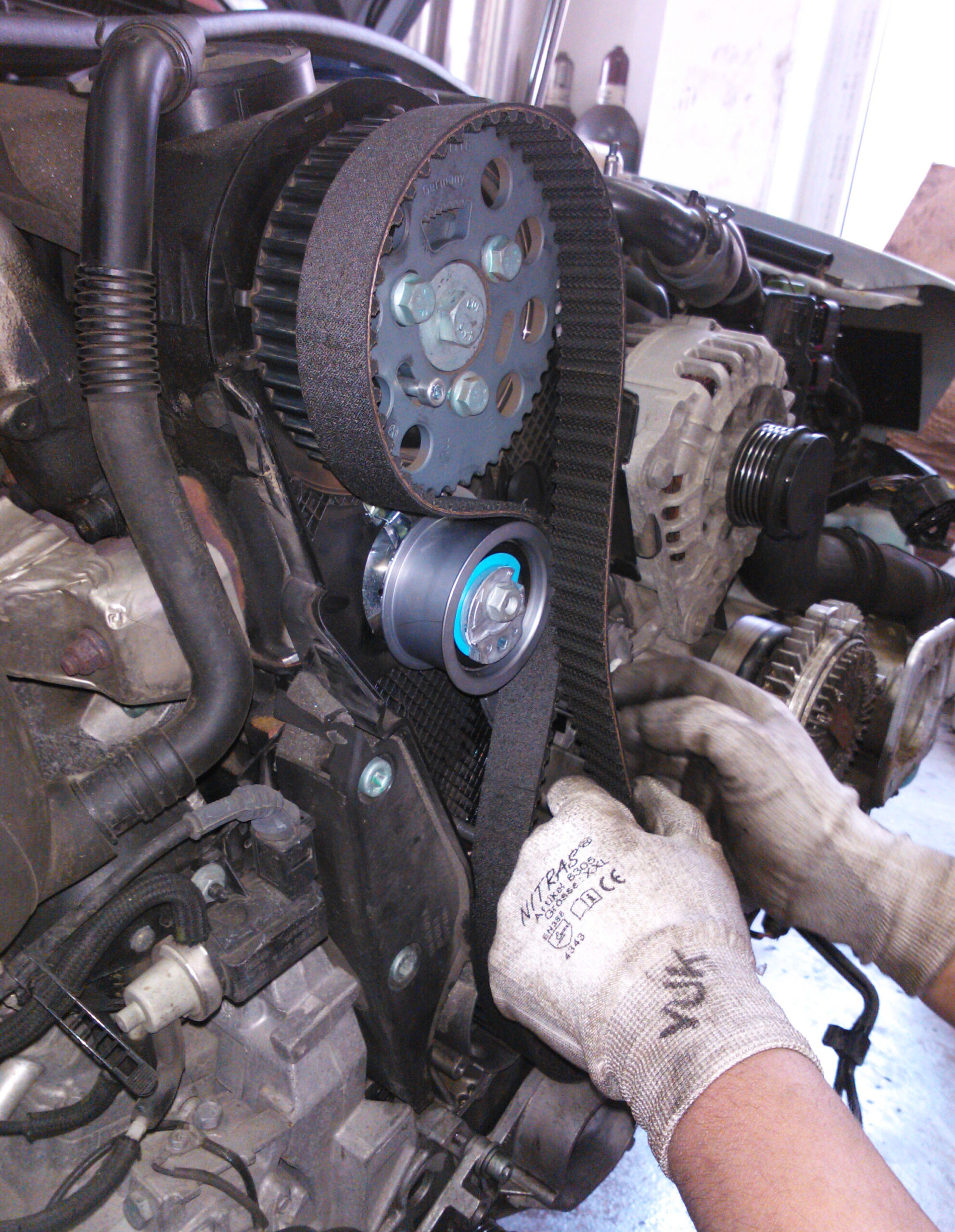
Timing Belt vs. Timing Chain: What’s Under Your Hood?
Nissan’s transition wasn’t overnight. Some models had belt and chain variants in the same year depending on trim or engine. Let’s break it down model by model.
Nissan Altima
The Altima is the poster child for confusion here.
- 1993–2001 Altima: Uses a timing belt if equipped with the KA24DE (2.4L 4-cylinder) or VG30E (3.0L V6). Both are interference engines—meaning if the belt snaps, pistons collide with valves.
- 2002–2006 Altima: The 2.5L (QR25DE) switched to a timing chain. The 3.5L V6 (VQ35DE) also uses a chain.
- 2007+ Altima: All engines use timing chains.
So if you’re Googling “nissan altima timing belt” for a 2005 model, you’re probably barking up the wrong tree—unless you’ve got a rare Canadian-market 2.4L, which Nissan kept through 2005 in some regions.
Nissan Maxima
The Maxima followed a similar path:
- 1995–2003 Maxima (VQ30DE engine): Timing belt.
- 2004+ Maxima (VQ35DE engine): Timing chain.
Yes, that means a 2003 Maxima needs a belt replacement, but a 2004 does not. And no, you can’t assume because your neighbor’s 2003 Maxima needed one that your 2005 does too.
Fun fact: I once had a customer insist his 2006 Maxima had a belt because “the dealership told him so.” Turns out, the service writer misread the repair history from a previous owner’s 1999 Maxima. Always verify.
Other Common Nissan Models
| Model | Years (Belt) | Engine(s) | Interference? |
|---|---|---|---|
| Sentra | 1991–2000 | GA16DE, SR20DE | Yes |
| Pathfinder | 1990–1995 | VG30E | Yes |
| 240SX | 1989–1998 | KA24DE | Yes |
| Quest | 1993–1998 | VG30E | Yes |
| Xterra | 2000–2004 | KA24DE | Yes |
Note: The 2005+ Xterra (VQ40DE V6) uses a timing chain, not a belt.
Timing Belt Replacement Interval: Don’t Guess—Know
Nissan’s official nissan timing belt interval for belt-equipped models is typically 105,000 miles or 84 months (7 years)—whichever comes first. But here’s what the manual *doesn’t* say: if you drive in extreme heat, dusty conditions, or do lots of short trips, I recommend replacing it at **60,000–90,000 miles**.
Why? Belts degrade from heat cycles and moisture, not just mileage. I’ve pulled brittle, cracked belts off desert trucks with only 78,000 miles that looked like they’d been baking in an oven.
Check out our full guide on replacement intervals to see how climate and driving style affect your schedule.
Tools & Materials List
MUST-HAVE TOOLS
- Socket Set: 10mm, 12mm, 14mm, 17mm, 19mm (both standard and deep)
- Breaker Bar: 1/2″ drive (you’ll need leverage on the crank pulley bolt)
- Timing Light or Degree Wheel: For setting TDC (Top Dead Center)
- Crankshaft Holder Tool: Nissan OEM 09258-00100 or equivalent (prevents crank from spinning)
- Torque Wrench: 10–150 ft-lbs range (critical—more below)
- Pulley Puller: For removing the crank pulley (harmonic balancer)
- Allen Keys: 4mm, 5mm, 6mm (for tensioner bolts)
NICE-TO-HAVE (But Extremely Helpful)
- Air ratchet (saves hours on cover bolts)
- Engine hoist or support bar (to remove motor mount on some models)
- Digital calipers (to measure belt wear if reusing)
- Magnetic pickup tool (for dropped bolts in timing cover)
MATERIALS
- Timing Belt Kit: Gates T420, Aisin TBA-35, or OEM Nissan 13029-73J00 (VG30E) / 13029-2F500 (KA24DE)
- New Water Pump: Highly recommended—same labor, and they often fail shortly after belt replacement
- Cam/Crank Seals: OE or NOK brand (part of most kits)
- Engine Coolant: Nissan Long Life Blue or equivalent (2.5–3.0 quarts, depending on model)
- New Thermostat: Stant 45359 (for older models) or OEM
- RTV Silicone: Nissan RTV 999MP-A700 or Permatex Ultra Grey
Cost to buy all tools? Around $300–$500 if you start from scratch. But if you already have a basic socket set and torque wrench, you’re looking at $100–$150 for specialty items. Most AutoZone, O’Reilly, or Advance Auto stores will loan the pulley puller and crank holder for free with a deposit.
Step-by-Step Timing Belt Replacement (KA24DE Example: 1995–2001 Altima, 240SX, Xterra)
Estimated time: 5–8 hours for a first-timer. 3–4 hours if you’ve done it before.
Disconnect the battery. Always start here. Then drain the coolant (radiator petcock or lower hose). Place a pan underneath—Nissan blue coolant stains concrete.
Remove accessories. You’ll need to take off the serpentine belt, alternator, A/C compressor (just unbolt and hang it—don’t disconnect lines), and sometimes the power steering pump. Keep all bolts organized in labeled bags.
Remove the motor mount (passenger side). On Altima/Xterra, you must support the engine with a jack and wood block before removing the mount. Failure to do this = cracked exhaust manifold or oil pan.
Remove crank pulley. The crank bolt is torqued to **181 ft-lbs** (245 Nm). Use the crank holder tool and a 1/2″ breaker bar. Do NOT use an impact gun—it can damage the crank nose. Once loose, use a 3-jaw puller to remove the pulley. [Photo: Crank pulley with puller attached]
Remove timing cover. There are 10–14 bolts (10mm). Some are hidden behind the oil pan rail—use a wobble extension. Clean old RTV carefully; don’t gouge the aluminum.
Inspect and mark the old belt. Before removal, mark rotation direction with a paint pen. Check for fraying, glazing, or missing teeth. Count the teeth between marks to verify alignment later.
Relieve tension and remove belt. Loosen the tensioner bolt (6mm Allen), rotate the tensioner away, and lock it in place with a pin or small drill bit through the hole. Remove the belt.
Replace water pump, seals, and thermostat. Now’s the time. The water pump bolts are small (10mm)—don’t strip them. Torque to **71 in-lbs** (8 Nm). Apply RTV only to the pump-to-block surface if required (check TSB NTB02-079).
Install new belt. Align cam and crank sprockets to TDC marks (crank keyway at 12 o’clock; cam dowel pins at 12). Install belt counterclockwise: crank → idler → left cam → right cam → tensioner. Keep tension on the non-tensioner side.
Set tension. Remove the tensioner pin. Rotate the crank **two full revolutions by hand** slowly. Recheck TDC alignment. If off by even one tooth, repeat. Once aligned, torque tensioner bolt to **32 ft-lbs** (43 Nm).
Reassemble in reverse. Torque crank pulley to **181 ft-lbs**. Refill coolant slowly, burp air by running engine with radiator cap off until thermostat opens. Check for leaks.
Troubleshooting Common Issues
Even with perfect alignment, things can go sideways. Here’s what I see most often:
- Engine runs rough after replacement: Check cam timing—off by one tooth on KA24DE causes severe misfire. Recheck TDC marks.
- Squealing on startup: Tensioner not seated, or belt installed backwards. Ensure rotation direction matches old belt marks.
- Coolant leak at timing cover: RTV not applied properly, or cover bolts not torqued evenly. Sequence matters—start center, work outward.
- “Check Engine” light with P0340 (Cam Sensor): Cam sprocket moved during install. Recheck alignment—even 2° off can trigger this code.
If you’re not confident, professional repair costs range from **$600–$1,200** for belt + water pump. But if you’ve already bent valves? Add **$1,500–$2,500** for cylinder head work. That’s why this job is worth doing right—or not at all.
Cost Analysis: DIY vs. Pro
| Item | DIY Cost | Shop Cost |
|---|---|---|
| Timing Belt Kit (Gates) | $85 | $120 (markup) |
| Water Pump | $45 | $95 |
| Thermostat & Gasket | $20 | $40 |
| Coolant (3 quarts) | $15 | $25 |
| Labor | $0 (your time) | $400–$700 |
| Total | $165–$200 | $680–$980 |
Pro tip: Buy a complete kit from RockAuto or Amazon—it’s cheaper than buying parts separately, and you won’t forget the idler pulley (a common rookie mistake).
Still on the fence? See our full breakdown of replacement costs, timing chain vs belt, replacement intervals to compare long-term value.
FAQ: Real Questions from Real Customers
How much does a Nissan timing belt replacement cost?
For belt-equipped models (e.g., 1998 Altima), expect to pay $600–$900 at a shop for belt, water pump, and seals. DIY costs $165–$200 in parts. But remember: if your Nissan uses a timing chain (like a 2005 Altima), you likely don’t need this service at all—unless the chain is noisy or stretched.
Does a 2003 Nissan Maxima have a timing belt or chain?
The 2003 Maxima uses the VQ30DE engine, which has a timing belt. The switch to a timing chain happened in 2004 with the VQ35DE. If you own a 2003, replace the belt by 105,000 miles—or sooner if you live in hot climates.
Can I replace just the timing belt, or do I need the whole kit?
You *can* replace just the belt, but I’ve seen tensioners fail 5,000 miles after a “belt-only” job. Spend the extra $30 on a kit with pulleys and tensioner. Your future self (and your engine) will thank you.
How do I know if my timing belt is bad?
Belts rarely give warning signs. But if you hear a rhythmic ticking from the front of the engine, see oil leaks from the timing cover, or notice inconsistent idle, inspect it. Better yet—replace it on schedule. Once it snaps, it’s too late.
What’s the difference between a timing belt and timing chain?
Belts are rubber with teeth, quieter but wear out. Chains are metal, last longer but can stretch or rattle. Most Nissans before 2002 use belts; most after use chains. Learn more in our guide to timing chain vs belt.
Can I do this job in my driveway?
Yes—if you have jack stands, a torque wrench, and patience. You’ll need to lift the car, remove wheels, and possibly drop the subframe on some models. Never work under a car supported only by a jack.
Final Thoughts: Should You DIY Your Nissan Timing Belt?
If your Nissan has a timing belt, this is one of the most critical maintenance jobs you’ll ever do. Get it wrong, and you’re looking at a new engine. But get it right, and you’ve just saved $700 while protecting your investment.
Difficulty level: **Moderate to Difficult**. You need mechanical aptitude, the right tools, and the discipline to follow torque specs exactly. If you’ve successfully replaced a water pump or head gasket before, you can handle this.
From my bay: I’d rather see a clean, well-documented DIY belt job than a rushed dealership service where they reuse the old water pump “to save you money.” Take your time. Double-check alignment. And never, ever skip the water pump.
Because in the end, that $200 you spend today could save you from a $2,300 bill—and a Tuesday morning in the rain wondering what went wrong.