The $3,200 Lesson I’ll Never Forget
It was a soggy Tuesday in late November—rain drumming against the shop bay doors, the kind of gray day that makes even a coffee break feel heavy. A customer rolled in with a 2008 Honda Accord. She’d just bought it for $4,500 from a “good deal” private seller. “Runs fine,” she said, smiling, “but the check engine light’s been on a while.”
I scanned it. Cylinder misfire, P0303. Not great, but not a death sentence. So we popped the hood. That’s when I saw it: the timing cover was sweating oil, and the valve cover gasket hadn’t been touched since the Bush administration. But the real kicker? The seller told her “the timing belt was just done.”
Turns out, it was never changed. Not once. The car had 112,000 miles on it. We cracked the cover. The belt looked like chewed licorice—cracked, frayed, and glazed in places. She was a crankshaft revolution away from bent valves and a total engine teardown.
I’ve seen enough timing belts self-destruct to know this: ignoring your timing belt replacement interval isn’t a risk—it’s a countdown. And the repair bill? $3,200 for a new short block, head rebuild, and labor. All because someone skipped a $600 maintenance item. Don’t be that person.
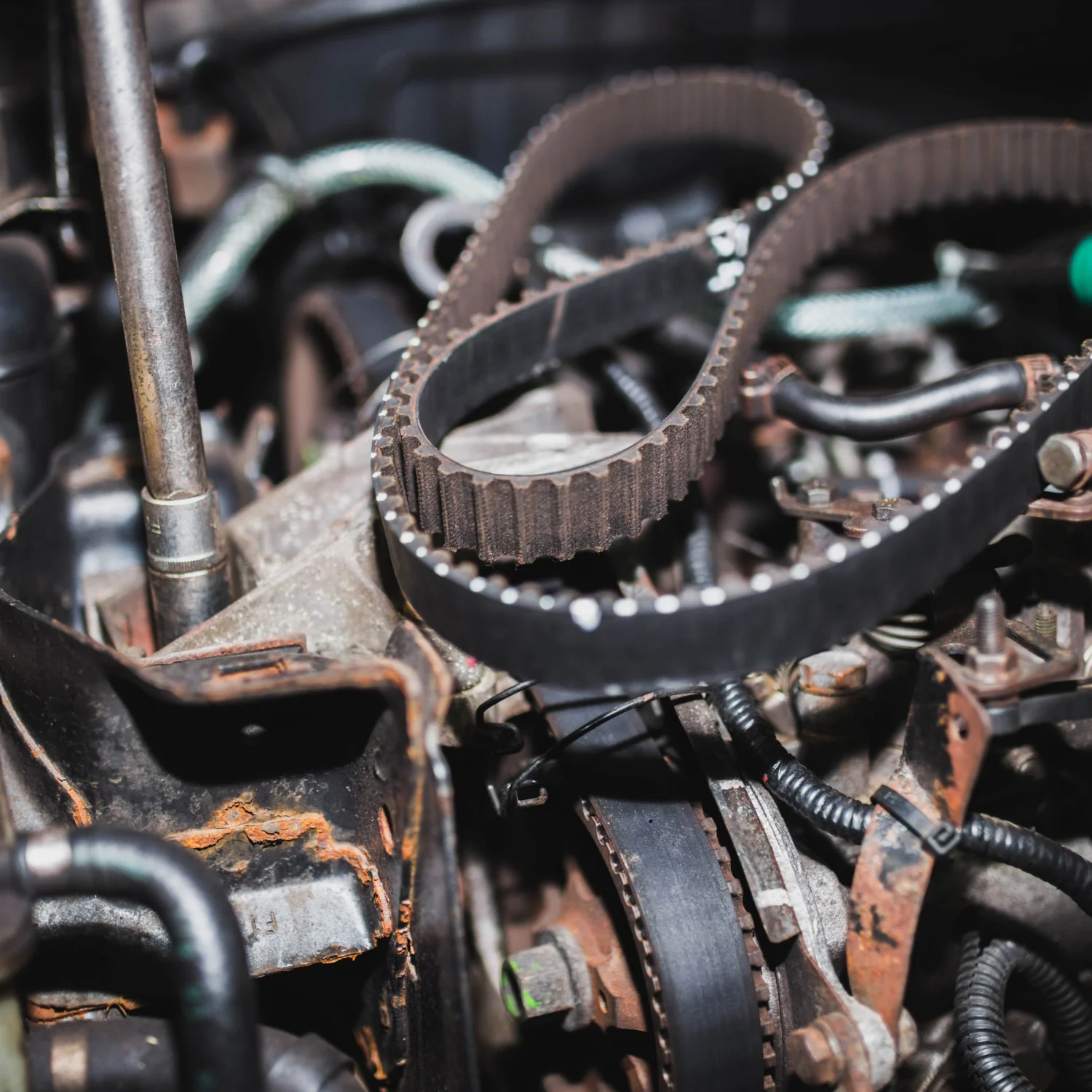
What Is a Timing Belt—and Why Does It Matter?
Your engine’s timing belt synchronizes the crankshaft and camshaft, ensuring your pistons and valves don’t occupy the same space at the same time. In “interference engines”—which most modern cars are—if the belt snaps, the pistons will slam into the open valves. The results? Bent valves, shattered lifters, and often, a dead engine.
Unlike timing chains (which often last the life of the engine), timing belts are made of reinforced rubber with teeth. They wear, crack, and eventually break. No warning. No second chances.
That’s why knowing your timing belt replacement interval isn’t just smart—it’s essential.
Manufacturer-Specific Timing Belt Replacement Intervals
Here’s the hard truth: there’s no universal rule. I’ve worked on Toyotas that chug past 120,000 miles on the original belt, and Hondas that shredded at 60,000 in Arizona heat. Below is a model-specific breakdown based on OEM service schedules, TSBs, and real-world shop experience.
Honda: Play It Safe or Pay the Price
Honda’s interference engines are legendary for their efficiency—and their intolerance for neglected timing belts.
- Accord (2003–2017, 4-cylinder): Replace every **60,000–105,000 miles** or **7 years**, whichever comes first. The 2.4L K24 engine is especially sensitive. Learn more in our [Honda Accord intervals](honda-accord-timing-belt) guide.
- Civic (2001–2005, D17 engine): 110,000 miles or 7 years—but I’ve seen 2003 models fail at 78,000 in high-heat climates.
- CR-V (2002–2006): 105,000 miles or 7 years. Post-2007 models switched to timing chains.
Pro Tip: Always replace the water pump at the same time. It’s driven by the timing belt, and labor overlaps. OEM Honda water pump (Part #19200-PWA-003) lasts longer than aftermarket units like Gates or Aisin—but costs $30 more.
Toyota: Conservative but Forgiving
Toyota’s reputation for reliability extends to their timing systems—but only if you follow the book.
- Camry (1997–2006, 4-cylinder 2.2L/2.4L): Replace at **90,000 miles or 72 months**. Ignore the “up to 105,000” rumors—TSB-0157-06 explicitly warns against exceeding 90K in hot climates. See our full [Toyota Camry intervals](toyota-camry-timing-belt) breakdown.
- Corolla (1998–2008, 1ZZ-FE engine): 90,000 miles or 6 years. Note: This engine suffered from oil consumption issues—extra heat accelerates belt wear.
- 4Runner / Tacoma (3.4L V6, 1995–2004): 90,000 miles or 7 years. Uses a dual overhead cam with hydraulic tensioners—don’t skip the idler pulley.
Real Talk: I’ve seen 2004 Camrys hit 130,000 on the original belt—but that’s luck, not maintenance. Don’t roll the dice.
Subaru: The Silent Killer
Most Subarus from 1990–2012 use timing belts. And nearly all are interference engines.
- Legacy / Outback (2000–2009, EJ25): Replace every **105,000 miles or 105 months (8.75 years)**. Yes—Subaru uses *months*, not years. Miss that window, and you’re gambling.
- Forester (1998–2010): Same 105K/105-month rule. The 2.5L SOHC is especially vulnerable.
Subaru’s tensioner design is prone to slow leaks. If you hear a faint whine at 2,500 RPM, get it inspected immediately.
Other Notable Makes
| Make / Model | Engine | Replacement Interval | Notes |
|---|---|---|---|
| Mazda Protegé / 3 (2004–2009) | 2.0L MZR | 60,000 miles or 5 years | Short interval due to high-revving design |
| Nissan Altima (2002–2006) | 2.5L QR25DE | 105,000 miles or 7 years | Non-interference—belt failure won’t destroy engine |
| Hyundai Elantra (2001–2006) | 2.0L Beta | 60,000 miles or 4 years | Aggressive interval—don’t ignore |
| Volkswagen Jetta (2005–2010) | 2.5L I5 | 105,000 miles or 7 years | Uses hydraulic tensioner—check for oil leaks |
Warning: If your car isn’t listed here, check your owner’s manual. Or better yet, [learn the full timing belt replacement guide, Honda Accord intervals, Toyota Camry intervals](timing-belt-replacement-guide, honda-accord-timing-belt, toyota-camry-timing-belt) for detailed model walkthroughs.
Tools & Materials List
Replacing a timing belt isn’t beginner-friendly—but with the right gear, it’s manageable for a committed DIYer.
Must-Have Tools
- **Socket set (10mm–19mm)** – Metric only. Craftsman or GearWrench.
- **Torque wrench** – 10–150 ft-lb range. Never guess torque on cam gears.
- **Timing belt tensioner tool** – Specific to make (e.g., OTC 6637 for Honda K-series).
- **Crank pulley holder** – Keeps crank from spinning during bolt removal.
- **Jack and jack stands** – 2-ton minimum. Never work under a car on a scissor jack.
Nice-to-Have (But Highly Recommended)
- **Harmonic balancer puller** – For stubborn crank pulleys (e.g., 2004 Camry).
- **OBD2 scanner** – To clear codes and verify cam/crank sync post-reinstall.
- **Breaker bar** – That crank bolt is often torqued to **180–220 ft-lbs**.
Parts List (Example: 2006 Honda Accord 2.4L)
- Gates T420 Timing Belt Kit ($125, includes idler/tensioner)
- OEM Water Pump (Honda #19200-PND-003, $85)
- Valve Cover Gasket + Front Crank Seal ($45)
- Coolant (2.5 quarts, Honda Type 2, $20)
Step-by-Step Replacement Overview
Remove accessories. Alternator, A/C compressor, power steering pump—anything bolted to the timing cover. Support them with wire; don’t let hoses stretch.
Align timing marks. Rotate crank to Top Dead Center (TDC). Verify cam gear marks align with cylinder head notches. [Photo: cam gear alignment on K24 engine]
Relieve tension and remove old belt. Use the correct tensioner tool to compress the hydraulic damper. Remove belt slowly—note rotation direction.
Replace water pump and seals. Remove pump (usually 3–4 bolts). Clean gasket surface with plastic scraper—never metal. Install new pump with Honda RTV or OEM gasket.
Install new belt. Start at crank gear, work counterclockwise. Keep tension on the non-tensioner side. Double-check all marks before releasing tensioner.
Verify rotation. Turn crank **two full revolutions by hand**. Recheck TDC alignment. If off by even one tooth, repeat.
Time Estimate: 5–8 hours for first-timers. Professionals do it in 3–4.
Troubleshooting Common Issues
Timing belt jobs go sideways fast if you miss subtle cues. Here’s what I’ve seen—and how to fix it.
- “My engine runs rough after replacement.” → You’re off by one tooth. Recheck cam alignment. On Hondas, the exhaust cam often slips.
- “Whining noise at idle.” → Tensioner not seated, or idler bearing failing. Replace as a set.
- “Coolant leaking after water pump install.” → Gasket not torqued evenly. Specs: 9 ft-lbs in a crisscross pattern.
- “Check engine light: P0011 (cam timing over-advanced).” → VVT gear misaligned. You’ll need a cam locking tool (e.g., OEM 07JAB-0010100).
Cost Analysis: DIY vs Professional
| Option | Parts Cost | Labor/Tool Cost | Total |
|---|---|---|---|
| DIY | $150–$250 | $0 (if tools owned) or $80 (rentals) | $150–$330 |
| Independent Shop | $120–$200 | $500–$800 (3–5 hrs @ $125–$160/hr) | $620–$1,000 |
| Dealership | OEM parts only (~$220) | $900–$1,400 | $1,100–$1,600 |
Shop Secret: Many shops charge extra for the water pump—but it’s 90% of the same labor. If they quote belt-only, ask “Is the pump included?” If not, insist on it. It’s false economy to skip it.
Safety Warnings
- Never rotate the engine with the timing belt off on an interference engine. You *will* bend valves.
- Always use OEM or premium aftermarket kits (Gates, Aisin, INA). Discount belts (e.g., Duralast) often use inferior rubber compounds.
- Wear safety glasses. Belt fragments can fly during removal.
- If you’re unsure about cam alignment—STOP. One tooth off can cost $2,000 in engine repairs.
FAQ: Real Questions from Real Customers
How much does timing belt replacement cost?
DIY: $150–$300. Professional: $600–$1,600, depending on location and whether water pump/seals are included. Subarus and VWs run higher due to complexity.
Can I drive with a bad timing belt?
No. If you hear squealing, ticking, or see oil on the belt—tow it. If the belt breaks while driving, your engine is likely destroyed. I’ve seen customers add 2,000 miles after symptoms started—don’t.
Does my car even have a timing belt?
Most cars made before 2010 do. Post-2010, many switched to chains. Check under the hood: a plastic cover on the front of the engine = belt. Metal cover = chain. Or consult your manual.
Is 90,000 miles too early to replace it?
Not if your schedule says so. Honda says 60K for severe service (short trips, hot climates). Better early than never. I’d rather you replace it at 80K than gamble at 105K.
What’s “severe service”?
Short trips under 5 miles, stop-and-go traffic, temperatures above 95°F or below 10°F, dusty conditions. If you live in Phoenix or Minneapolis—assume severe service.
Can I just replace the belt and skip the water pump?
You *can*, but shouldn’t. The pump is driven by the belt. Once the front of the engine is open, the extra 20 minutes and $80 could save you a $700 tow and repair later.
Final Thoughts: A Mechanic’s Perspective
Timing belt replacement is one of the few maintenance tasks where “if it ain’t broke” absolutely does *not* apply. I’ve watched too many good cars—and good budgets—get wrecked by a $30 rubber band.
Is it hard? Moderate difficulty. If you can change your own oil and follow a service manual, you can do this. Take your time. Double-check alignment. Use quality parts. And for heaven’s sake—don’t ignore the timing belt mileage or age limits.
Done right, this job buys you another 100,000 miles of reliable driving. Done wrong—or not at all—it buys you an engine stand and a phone call to your credit card company.
I’ll leave you with this: the customer with the Accord? She had the belt and pump replaced that day. Total out-the-door: $680. She still drives that car. Just last month, she brought it in for tires—and thanked me for saving her from a nightmare. That’s why I do this work.