Subaru Timing Belt Replacement: Complete Guide & Costs
⚡ Subaru Timing Belt Replacement — Quick Answer
- Interval: Every 105,000 miles or 105 months — whichever comes first
- Engine type: Interference — belt failure = bent valves, $2,500–$4,000 repair
- Applies to: EJ25 and EJ20 engines in Outback, Forester, Legacy, Impreza (1996–2012/2014)
- Always replace at the same time: Water pump, tensioner, all three idler pulleys, cam and crank seals
- DIY cost: $245–$400 | Shop cost: $900–$1,600
Jump to step-by-step instructions ↓ | cost table ↓ | FAQs ↓
It was a rainy Tuesday in the shop — classic Pacific Northwest drizzle. A flatbed rolled up with a 2008 Subaru Outback that looked pristine from the outside. The owner, Dave, looked like he hadn’t slept since Sunday.
He’d been doing highway speed when he heard a pop. Then nothing. Coasted to the shoulder. Wouldn’t restart.
I hooked up the scan tool. No fault codes — just a crank sensor error. I pulled the timing cover and saw it immediately. Belt snapped clean in two.
I broke the news carefully: EJ25, interference engine. His valves were almost certainly sitting against his pistons.
Dave had known the belt was due. He’d been putting it off because the car ran fine. I hear some version of that story at least four times a year.
Don’t be Dave. The timing belt on a Subaru 2.5L gives no warning before it snaps. There’s no check engine light, no noise, no shimmy. It just goes — usually at the worst possible moment.
⚠ Interference Engine Warning
The EJ25 (2.5L) and EJ20 (2.0L) Subaru engines are interference engines. When the timing belt fails, pistons contact open valves instantly. The result is bent valves and typically a full head rebuild or engine replacement at $2,500–$4,000. There is no safe way to gamble on a worn belt.
📌 In This Guide
Which Subaru Models Need a Timing Belt Replacement?
This guide covers the EJ25 (2.5L) and EJ20 (2.0L) SOHC and DOHC engines. These are the flat-four Subaru engines that use a timing belt.
| Model | Years with Timing Belt | Engine | Notes |
|---|---|---|---|
| Subaru Outback | 2000–2012 | EJ25 2.5L | 2013–2014 Limited also uses EJ25 |
| Subaru Forester | 1999–2014 | EJ25 2.5L | 2019+ switches to chain (FA-series) |
| Subaru Legacy | 2000–2012 | EJ25 2.5L | 2013+ Legacy uses FB-series (chain) |
| Subaru Impreza | 2002–2011 | EJ25 2.5L | WRX/STI have turbo-specific requirements |
| Subaru Impreza | 2012+ | FB20 2.0L | Timing chain — this guide does not apply |
ℹ Chain or Belt? Check the Engine Code
Look at the door jamb sticker for your engine displacement and code. EJ prefix (EJ25, EJ22, EJ20) = timing belt. FB or FA prefix (FB20, FB25, FA20) = timing chain — no scheduled belt replacement. If you have a 2012+ Impreza 2.0L or a 2019+ Forester, you have a chain. You do not need this service.
Critical Specifications and Torque Values
| Specification | Value | Notes |
|---|---|---|
| Replacement Interval | 105,000 miles or 105 months | Whichever comes first — Subaru official update |
| Engine Type | Interference | Belt failure = bent valves, immediate engine damage |
| Crank Pulley Bolt Torque | 132 ft-lbs (180 Nm) | Use thread locker. Do not guess this number. |
| Cam Sprocket Bolt Torque | 35 ft-lbs (47 Nm) | 10mm head |
| Idler Bolt Torque | 33 ft-lbs (45 Nm) | 12mm head — do not overtighten, aluminum ears crack |
| Tensioner Mounting Bolts | 33 ft-lbs (45 Nm) | Torque only after pin is removed and tension applied |
| Tensioner Lock Pin | 1.5mm drill bit or paperclip | Holds tensioner retracted during belt installation |
Parts: OEM vs. Aftermarket — What I Actually Use
I’ve torn down engines with 200,000 miles on the original Subaru belt. I’ve also seen aftermarket belts fail at 40,000 miles. The brand matters.
Recommended Kits
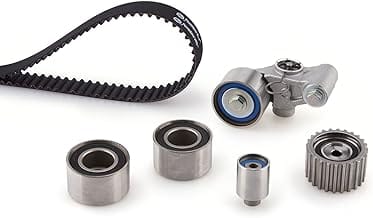
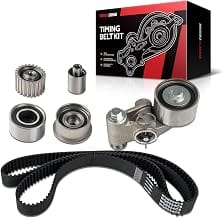
- Gates TCKWP285 — includes belt, tensioner, and idler pulleys. Solid kit. I’ve used Gates in my own vehicles with no comebacks.
- Aisin TKF-011 — Aisin is an OEM supplier for both Toyota and Subaru. When you buy Aisin aftermarket, you’re getting the same manufacturer that made the original part, at roughly half the price of buying from the dealer.
What to buy separately: The water pump and cam/crank seals are not always included in kits. Add an Aisin or GMB water pump ($45–$80) and a seal set ($15–$25). The cam and crank seals on EJ25 engines commonly weep oil at high mileage — replace them now while everything is already apart.
What to avoid: Generic no-name kits from unknown Amazon or eBay sellers. I’ve inspected counterfeit “OEM” Subaru belts that had incorrect tooth profiles and failed prematurely. For a part that costs $2,500 to replace when it fails, saving $40 on the kit is not rational.
💡 Pro Tip: Head Gasket Overlap
💡 Pro Tip: Details
On high-mileage EJ25 engines, head gasket labor and timing belt labor overlap significantly. If your head gaskets are seeping or if you’re past 150,000 miles, it’s worth addressing both at the same time. Doing them separately means paying for timing cover removal twice. Check out our timing belt replacement cost guide and timing belt problems guide before finalizing your parts order.
Tools You’ll Need
This job requires precision. Don’t improvise on the torque-critical fasteners.
Required:
- Socket set: 10mm, 12mm, 14mm, 17mm, 19mm — 6-point deep and shallow sockets
- Breaker bar: 1/2″ drive, minimum 18 inches — you need the use for the crank bolt
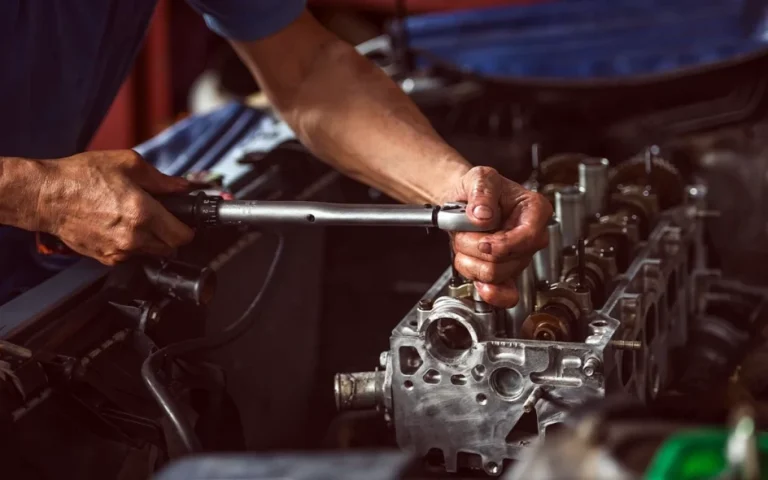
- Torque wrench: Must reach 132 ft-lbs. Not negotiable.
- Jack and jack stands: Access through the passenger-side wheel well is significantly easier than working from the top
- 1.5mm drill bit or bent paperclip: To lock the tensioner in the retracted position during belt installation
- Permanent marker or paint pen: Mark belt direction and pulley positions before removal
- RTV silicone: For the oil pump o-ring if it’s leaking — common on EJ25 engines at the crank seal area
Helpful but not mandatory:
- Subaru crank pulley holding tool (part 499987500): Makes the crank bolt significantly easier. Available as a loaner at some AutoZone locations.
- Heavy-duty strap wrench: Works as a substitute for the pulley holder on the crank removal step
Step-by-Step: Subaru Timing Belt Replacement (EJ25)
Time estimate: 4–6 hours for an experienced DIYer. Budget a full day your first time. This job is tedious, not technically complex — but one rushed timing mark alignment ruins the whole job.
⚠ Before You Start
Disconnect the negative battery terminal first. Let the engine cool completely — at least one hour after last running. Never rotate the engine backward with the belt removed. Wear eye protection throughout.
Phase 1: Access and Disassembly
Remove the crank pulley bolt. This is the hardest part of the entire job. The bolt is torqued to 132 ft-lbs from the factory and often locked with thread locker on top of that.
- Option A: Use the Subaru holding tool (499987500) to prevent rotation while breaking the bolt loose with a breaker bar.
- Option B: A heavy-duty strap wrench around the pulley works on most applications.
- If it won’t budge: Apply heat to the center of the bolt with a propane torch for 60 seconds. This breaks the thread locker. Use a breaker bar with a cheater pipe extension for additional use. Turn counterclockwise.
Once the bolt is out, the pulley usually slides off. If it sticks, tap it gently with a rubber mallet — never impact it.
Phase 2: Timing Mark Alignment and Belt Removal
Set the engine to TDC (Top Dead Center). Thread the crank bolt back in loosely and rotate the engine clockwise until timing marks align:
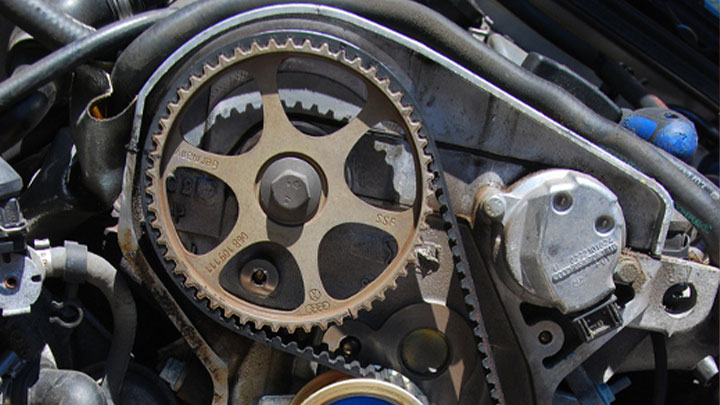
- The crank sprocket timing mark aligns with the notch on the oil pump housing behind it
- Both cam sprocket marks point inward toward each other and align with the horizontal surface of the cylinder heads
Take photographs of the marks in position. This is your reference for reassembly. Being one tooth off means the engine runs poorly or won’t start.
Phase 3: Belt Installation and Tensioning
⚠ Most Common Post-Job Mistake
Forgetting to remove the tensioner pin. The belt stays loose with the pin in, the car starts, and the timing jumps within a few hundred miles. Before closing up the covers, physically confirm the pin is out and the tensioner rod is extended against the belt.
Troubleshooting Common Post-Job Problems
| Problem | Likely Cause | Fix |
|---|---|---|
| Won’t start or cranks but doesn’t fire | Timing marks off — even one tooth is enough to prevent starting | Pull the covers and recheck all three timing marks against TDC spec. Don’t guess — verify visually. |
| Misfire or rough idle after job | One cam sprocket off by a tooth; timing mark looked close but wasn’t exact | Same fix — pull the covers and re-align. “Close” on an interference engine is not acceptable. |
| Can’t break the crank pulley bolt loose | Thread locker and years of heat cycling | Heat the bolt center with propane for 60 seconds, then use a breaker bar with a cheater pipe extension. Turn counterclockwise. Do not use an impact gun if you don’t have a pulley holder — it will spin the engine. |
| Oil leaking from the timing cover area after reassembly | Disturbed cam seal, crank seal, or oil pump O-ring during disassembly | Pull the covers again. Identify the source — look for fresh oil at each seal location. Replace the leaking seal. This is a known issue on high-mileage EJ25 engines. |
| Ticking noise from timing area after job | Belt tension incorrect, idler not fully seated, or tensioner pin still in | Check tension pin is removed. Verify idlers spin freely. If ticking persists, pull the covers and inspect belt tension and routing. |
Cost: DIY vs. Professional Subaru Timing Belt Replacement
| Component | DIY Cost | Professional Shop |
|---|---|---|
| Timing belt kit (belt, tensioner, 3 idlers) — Aisin or Gates | $180–$300 | $300–$450 (with markup) |
| Water pump | $45–$80 | $90–$150 |
| Cam/crank seal set | $15–$25 | Usually included in labor quote |
| Labor | Your time | $500–$900 (4–5 hours at $100–$150/hr) |
| Total | $245–$400 | $900–$1,600 |
Dealer quotes typically run $1,400–$1,800 on top of that. They charge book rate labor and use OEM parts at full retail.
The savings from doing this yourself — $500 to $1,200 depending on where you would have taken it — is the equivalent of a set of tires, new brakes, or two months of car payments. This single job is the most financially valuable DIY skill you can develop if you own an EJ-series Subaru.
💡 Middle-Ground Option
Order the Aisin or Gates kit from RockAuto, then take everything to an independent shop and pay labor only. Most shops will install customer-supplied parts. You pay the shop $400–$600 in labor and supply $250 in quality parts. Total: $650–$850 — significantly less than a shop that sources its own parts. Just confirm the shop is willing before you buy the parts.
Subaru Timing Belt FAQs
When should I replace the timing belt on my Subaru?
Every 105,000 miles or 105 months — whichever arrives first. This applies to all EJ25 and EJ20 engines in the Outback, Forester, Legacy, and Impreza. The 105k number is Subaru’s updated official interval. Older documentation may say 60k or 90k — use 105k for 1996 and later EJ-series engines.
What happens if the timing belt breaks on a Subaru?
Immediate, catastrophic engine damage. The EJ25 is an interference engine — when the belt snaps, pistons slam into open valves and bend them instantly. You’re looking at a head rebuild or replacement engine at $2,500–$4,000. The belt never telegraphs this failure with warning lights or noises. It just goes.
Should I replace the water pump with the timing belt?
Yes, always. The water pump is behind the timing cover and driven by the timing belt. To replace it later, you redo the entire timing job. The pump itself is $45–$80. Skipping it to save $60 and then paying another $800 in labor 15,000 miles down the road is one of the most consistently expensive mistakes I see Subaru owners make.
My car has 105,000 miles but the belt looks fine. Can I wait?
No. External appearance tells you nothing about the internal rubber compound condition or the tensioner bearing grease. I’ve pulled belts off at 110,000 miles that looked brand new — and the tensioner was seized, a week from failure. The 105k interval is the hard deadline. Looking at it doesn’t change that.
Is the Subaru timing belt replacement a beginner DIY job?
It’s intermediate. If you’ve done brakes and suspension work and you’re comfortable using a torque wrench, you can handle this. The job isn’t technically complex — it’s tedious and requires precise timing mark alignment. Budget a full day your first time. The crank pulley bolt removal is the hardest physical part; the rest is patience and attention to detail.
Why is the dealer quote $400 more than the independent shop?
Two reasons. Dealers use OEM parts exclusively at full retail markup. And they charge “book time” labor — the factory-published time estimate for the job — which is sometimes 30–40% longer than what an experienced technician actually takes. An independent shop using Aisin or Gates parts and billing actual time will always be cheaper than a dealer on a straightforward service job like this.
What other parts should I replace at the same time?
Understanding other parts should I replace at the same time?
At minimum: belt, tensioner, three idler pulleys, and water pump. While you have access: cam seals, crank seal, and the oil pump O-ring if it’s seeping. On high-mileage engines (150,000+ miles), consider the head gaskets if they’re showing any coolant seepage — the labor overlap makes it far cheaper to address both at once than separately.
Final Word
Replacing the timing belt on a Subaru EJ25 is the single most important maintenance item on these cars. Full stop. Nothing else on the scheduled maintenance list has this kind of consequence if skipped.
The job is a 7 out of 10 for difficulty — mostly because of the cramped layout and the crank bolt. It’s not about specialized knowledge. It’s about patience, precise torque, and taking the timing marks seriously.
Do it right once — with a quality kit, the water pump, and all three idlers — and you won’t touch it again for another 105,000 miles. Skip it or cut corners, and you’re rolling the dice on a $3,000 engine replacement every time you get on the highway.
The short version: Aisin TKF-011 or Gates TCKWP285 kit. Add the water pump and seals. Torque the crank bolt to 132 ft-lbs with thread locker. Verify timing marks twice before closing the covers. Pull the tensioner pin before starting the engine. That’s the whole job.
Related Guides on VehicleBar
- Timing Belt Replacement Cost: What You’ll Pay in 2026
- Timing Belt Problems: Symptoms, Diagnosis & What Happens When It Fails
- Interference vs. Non-Interference Engines: What’s the Difference?
- Timing Belt Replacement Guide: Complete Overview
- Rough Idle After Timing Work: Diagnosis & Fixes
- Subaru Spark Plug Gap Chart
- Timing Belt Replacement Interval: When to Replace It
- Toyota Camry Timing Belt or Chain? Complete Guide
Top Subaru Timing Belt Replacement – Our Picks