
Toyota Camry Timing Belt or Chain? Complete Guide
⚡ Does Your Toyota Camry Have a Timing Belt or Chain?
- 4-cylinder, 2002 and newer — timing chain, no scheduled replacement
- 4-cylinder, 1990–2001 — timing belt, replace every 90,000 miles
- V6, 2007 and newer — timing chain, no scheduled replacement
- V6, 1990–2006 — timing belt, replace every 90,000 miles
If you’re not sure, check the sticker inside the driver’s door jamb or look up your VIN at the Toyota owner’s portal. Jump to the full year-by-year chart ↓
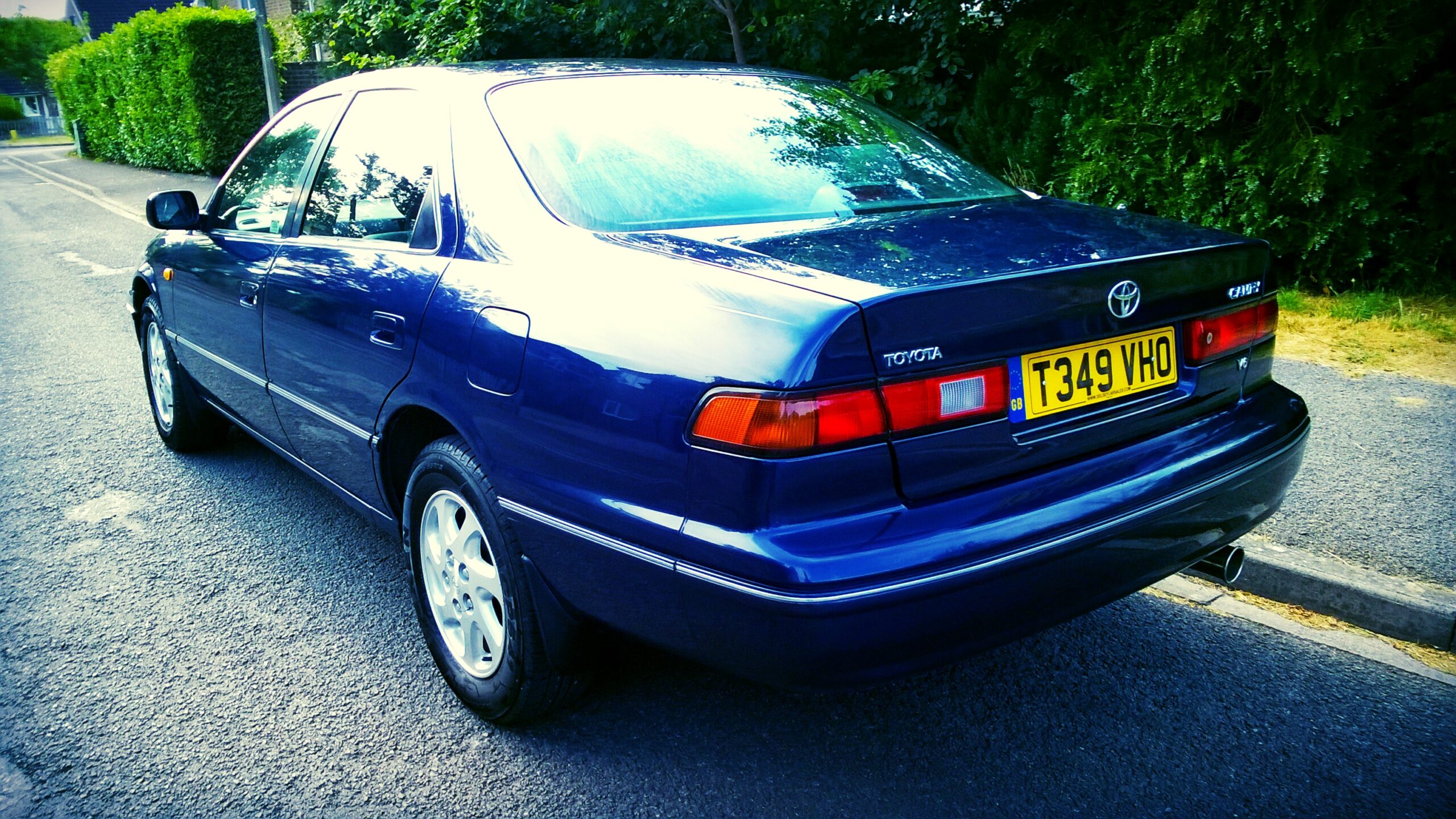
It was a cold December morning when a panicked customer pulled into my bay on a flatbed. Her 2000 Camry LE had died on the highway in rush-hour traffic. No warning lights. No weird sounds. The engine just quit.
She was shaking when she told me the story. Worried she’d bent valves and destroyed the engine.
I popped the cover and saw it immediately. The timing belt had snapped at 105,000 miles. The previous owner had skipped the 90k service. “Still runs fine” — I’ve heard that line a hundred times before something expensive happens.
She got lucky. That old non-interference 5S-FE engine saved her from major damage. No bent valves. But she still needed a tow, a full belt kit, and four days without her car.
That job is why I write guides like this one. Whether you’re doing the work yourself or just trying to understand what you’re paying for, here’s everything you need to know about the Toyota Camry timing belt and chain — year by year, engine by engine.
📌 In This Guide
Toyota Camry Timing Belt or Chain by Year — Full Chart
| Model Years | Engine | Timing Component | Interference? | Replacement Needed? |
|---|---|---|---|---|
| 1990–2001 | 4-cylinder (5S-FE, 3S-FE) | Timing Belt | Non-interference | Yes — every 90,000 miles |
| 2002–2025+ | 4-cylinder (2AZ-FE, 2AR-FE, A25A-FKS) | Timing Chain | Interference | No scheduled replacement |
| 1990–2006 | V6 (1MZ-FE, 3VZ-FE) | Timing Belt | Non-interference | Yes — every 90,000 miles |
| 2007–2025+ | V6 (2GR-FE, 2GR-FKS, 2GR-FXS) | Timing Chain | Interference | No scheduled replacement |
If your Camry is a 2010 or newer, you have a chain. I have customers with 250,000-mile 2AZ-FE engines still running the original chain — as long as they changed their oil on time. That’s the key for chain engines: oil, oil, oil.
ℹ Not Sure About Your Specific Car?
Check the sticker inside the driver’s door jamb — it shows your engine code. You can also enter your 17-digit VIN at Toyota’s owner portal (owners.toyota.com) for exact specs. If you bought the car used and don’t know the service history, assume the belt has never been replaced and act accordingly.
Timing Belt vs. Timing Chain: What’s the Actual Difference?
A timing belt is rubber reinforced with fiberglass cords. It’s quiet. It’s cheap. And it wears out — usually between 90,000 and 120,000 miles — whether it looks worn or not.
A timing chain is metal. It runs in an oil bath inside the engine. Done properly, it lasts the life of the car.
The tradeoff: chains stretch when oil is neglected. A stretched chain causes a rattle on cold starts. Ignore that long enough, and the chain jumps a tooth. Jump timing on an interference engine, and you’re looking at bent valves and a $2,000+ repair.
That’s why oil changes matter more on chain engines than anything else. Learn more about the differences in our timing belt vs. timing chain guide.
✓ Timing Chain Advantages
- Lasts the life of the engine with good oil maintenance
- No scheduled replacement interval
- Metal construction — not vulnerable to cracking or snapping from age
✗ Timing Belt Advantages
- Quieter operation — no chain rattle
- Cheaper to replace when due
- Non-interference belt engines (5S-FE, 1MZ-FE) won’t damage the engine if the belt snaps
Timing Belt Replacement Intervals for Older Camrys
Toyota’s official recommendation is 90,000 miles under normal conditions.
My recommendation is 60,000–75,000 miles if you do a lot of short-trip driving, live somewhere hot, or don’t know the car’s history.
Here’s why. I’ve pulled belts at 120,000 miles that looked fine and tested okay. I’ve also pulled engines apart after a belt shredded at 95,000 miles and left rubber fragments clogging the oil galleys. The difference between those two outcomes? Luck. Not worth gambling on.
⚠ Time Matters Too — Not Just Mileage
Rubber degrades with age, heat, and ozone exposure regardless of mileage. If your Camry has fewer than 90,000 miles but the belt is more than 8–10 years old, replace it on age alone. A low-mileage car that sits a lot is still running old rubber.
While the belt is off, always replace:
- The tensioner and idler pulley — they run constantly and fail around the same mileage
- The water pump — it’s behind the timing cover; same labor to replace it now vs. paying twice later
- Camshaft and crankshaft seals if they’re seeping
Tools & Parts for Camry Timing Belt Replacement
This covers 1997–2001 4-cylinder and 1994–2006 V6 Camrys. Chain models rarely need DIY timing work.
Tools You’ll Need
- Sockets: 10mm, 12mm, 14mm, 19mm — both 3/8″ and 1/2″ drive
- Torque wrench: Needs to reach 159 ft-lbs for the crank bolt
- Crankshaft pulley holder: Borrow one free from AutoZone or O’Reilly’s loaner program — you need it to break the crank bolt loose
- Harmonic balancer puller: Also available as a loaner at most parts stores
- Floor jack and jack stands
- Long extensions and a magnetic bolt tray
V6 only: A camshaft holding tool makes alignment much easier. The V6 job is more crowded and less forgiving of rushed timing mark alignment than the 4-cylinder.
Parts
Buy a complete kit — don’t piece it together. A genuine Toyota or Aisin kit from RockAuto or Amazon runs $200–$300 and includes the belt, tensioner, idlers, and water pump. Part number 13568-09041 covers many V6 applications.
Gates TCKWP kits are solid aftermarket. I’ve used them with zero comebacks. Aisin actually supplies OEM parts to Toyota, so either is a safe choice.
Avoid generic no-name kits. I’ve seen fake “Toyota” belts fail at 40,000 miles. The $50 you save is not worth it.
💡 Pro Tip: Buy Parts, Pay Labor-Only
Order your kit from RockAuto, then take it to an independent shop. Most indie shops will install customer-supplied parts for labor only. You save the shop’s parts markup (often 30–50%) while still getting professional installation. Just make sure you’re buying quality parts — a shop won’t warranty a job done with cheap components.
Step-by-Step: Timing Belt Replacement on the 5S-FE (1997–2001 4-Cylinder)
Time estimate: 4–6 hours for an experienced DIYer. Budget 8+ hours your first time — don’t rush the timing mark alignment.
⚠ Before You Start
Disconnect the battery before touching anything. Never rotate the engine backward with the belt removed — on any interference engine, backward rotation risks valve contact with pistons. Support the engine properly before removing the motor mount. Wear eye protection; crank pulleys under tension can slip. If you’re not fully confident aligning timing marks precisely, take it to a shop. One tooth off and the engine runs rough, won’t start, or worse.
Access the timing cover. Jack up the passenger side and remove the wheel. Disconnect the battery. Remove all accessory belts and the upper timing cover (10mm bolts).
Set the engine to TDC. Rotate the crankshaft clockwise until the mark on the crank pulley aligns with the 0 mark on the lower cover. The camshaft sprocket notch should point to 12 o’clock. Verify both marks before going further — this is everything.
Remove the crank pulley. The center bolt is 19mm and torqued to 159 ft-lbs from the factory. Use a crankshaft holder tool or a strong impact gun. Do not use a screwdriver jammed through the flexplate — that bends things.
Remove the lower timing cover, support the engine, and pull the motor mount. The mount is in the way on most 4-cylinder applications. Have a floor jack with a block of wood under the oil pan before you remove any mount bolts.
Release the tensioner and remove the old belt. Inspect the tensioner, idler, and water pump weep hole while you’re in here. If the weep hole shows any staining, replace the pump — it won’t get cheaper to reach later.
Install new tensioner and idlers. Hand-tighten only at this stage. Route the new belt exactly per the marks — start at the crank sprocket, work counterclockwise, and keep tension on the drive side.
Set belt tension. Spring-loaded tensioners on most 4-cylinders self-tension once the pin is released. Hydraulic tensioners on V6 models require bleeding. Follow the Toyota service manual procedure for your specific engine — the procedure varies.
Rotate the engine two full turns by hand and recheck timing marks. Both marks must return to exactly where they started. If either mark is off even slightly, go back and find the error before putting the cover back on.
Reinstall everything and torque the crank bolt to 159 ft-lbs. This is critical. A loose crank bolt shears the woodruff key and destroys the crankshaft snout. Use a torque wrench — not feel.
⚠ Most Common Rookie Mistake
Forgetting to pull the tensioner retaining pin before final assembly. The belt stays loose, the engine runs, and within a few hundred miles the timing jumps. Always confirm the pin is out and the tensioner is pressing against the belt before closing up the cover.
Troubleshooting: Belt and Chain Problems on Camrys
| Symptom | Likely Cause | What To Do |
|---|---|---|
| Engine cranks but won’t start after belt job | Timing marks off by one tooth | Remove the cover, recheck all timing marks against Toyota spec. One tooth is enough to prevent starting. |
| Metallic rattle on cold start (chain models) | Worn tensioner or chain guides — common on high-mileage 2AZ-FE with neglected oil | Check oil level and condition first. If oil is clean and level is correct, a tensioner or chain replacement is likely needed. |
| Misfire or rough idle near 90,000 miles (belt models) | Belt has stretched and jumped one tooth | Check timing marks with the cover off. If belt is off-spec, replace the full kit immediately. |
| Check engine light with codes P0016, P0017, P0018, P0019 | Camshaft/crankshaft correlation fault — chain stretch or VVT issue on chain models | Check oil condition first. Low or dirty oil causes VVT system problems that trigger these codes. If oil is good, have the chain and tensioner inspected. |
| Squealing from timing area at startup | Belt tensioner spring weakened or idler bearing failing | Don’t ignore this. A squealing belt tensioner is 3–5 weeks from a failure in most cases. Replace the full kit now. |
🔴 What Happens When the Belt Snaps
🔴 Understanding Happens When the Belt Snaps
Non-interference engines (5S-FE, 1MZ-FE — older Camrys): The engine stops. No internal damage. You need a tow and a new belt. Frustrating, but fixable for a few hundred dollars.
Interference engines (all chain-equipped Camrys): Chain failure means piston-to-valve contact. Bent valves. Possible head damage. Repair costs typically run $2,000–$4,000. This is why staying on top of oil changes is non-negotiable on modern Camrys.
Cost: DIY vs. Professional Camry Timing Belt Replacement
4-Cylinder Camry (1990–2001, 5S-FE/3S-FE): Cost Breakdown
V6 Camry (1990–2006, 1MZ-FE/3VZ-FE): Cost Breakdown
The V6 costs more mainly in labor, not parts. Tighter clearances and the camshaft holding tool add time a shop bills you for.
The math on doing it on time: spending $700 to $1,400 now, depending on your engine, versus $3,000 to $5,000 for an engine rebuild if the belt snaps at 110,000 miles. That’s not a close decision.
Toyota Camry Timing Belt & Chain FAQs
Does a Toyota Camry have a timing belt or chain?
It depends on the year and engine. 2002+ 4-cylinder Camrys have a timing chain. 2007+ V6 Camrys have a timing chain. Any Camry with a 4-cylinder built between 1990 and 2001, or a V6 built between 1990 and 2006, has a timing belt. Check the door jamb sticker for your engine code if you’re unsure.
How much does a Camry timing belt replacement cost?
A shop charges $800–$1,200. Dealers run $1,200–$1,600. DIY with a quality kit and borrowed tools costs $300–$550. The money-saving move: order a Gates or Aisin kit from RockAuto and pay an independent shop labor-only to install it. Most independent shops will do it — just make sure you’re bringing quality parts.
Does a 2018 Toyota Camry have a timing belt?
No. The 2018 Camry has a timing chain on both the 2.5L 4-cylinder and 3.5L V6. No scheduled replacement needed. Keep oil changes current and listen for cold-start rattles — that’s your early warning system for chain or tensioner wear.
What happens if the timing belt breaks on my Camry?
On the older non-interference engines (5S-FE, 1MZ-FE), the engine stops immediately with no internal damage. You need a tow and a new belt. On newer interference engines, a timing failure typically means bent valves and a repair bill of $2,000 or more. The older Camrys got lucky with non-interference design — newer ones don’t have that safety net.
Should I replace the water pump at the same time as the timing belt?
Yes, every time. The water pump is behind the timing cover and driven by the timing belt. Replacing it adds maybe $80 to the parts cost. Skip it, and when it starts leaking at 110,000 miles, you’re paying for the full timing job again just to reach it. This is the most consistent piece of advice I give every customer.
Can I do a Toyota Camry timing belt replacement myself?
Yes, on the 4-cylinder if you’re comfortable with basic engine work and have a torque wrench that reaches 159 ft-lbs. Budget a full day your first time. The V6 is a harder job with tighter clearances, so weigh your comfort level before attempting it solo.
How do I know if my Camry’s timing chain is going bad?
The main sign is a metallic rattling noise on cold starts that lasts more than a few seconds before quieting. Other signs: check engine light with codes P0016, P0017, P0018, or P0019, rough idle, or slightly reduced power. These almost always trace back to neglected oil changes on high-mileage engines. If you’re seeing these symptoms, get it looked at before the chain jumps a tooth.
Can I use aftermarket parts for my Camry timing belt replacement?
Yes — Gates TCKWP kits and Aisin kits are both solid choices. Aisin supplies the OEM parts for many Toyota engines directly. What to avoid: no-name kits from unknown eBay or Amazon sellers. I’ve seen counterfeit Toyota belts fail at 40,000 miles. Spend the extra $40–$60 on a brand you recognize.
Is timing belt replacement difficult on a Camry?
The 4-cylinder job is moderate — if you’ve done brakes and have basic tool confidence, you can handle it. Plan a full day your first time and don’t rush the timing mark alignment. The V6 is harder due to tighter clearances. If you’re not sure about aligning timing marks precisely, this is a job worth paying a shop to do. One tooth off means the engine won’t start or runs badly — and you’re doing the whole job again.
Final Word from the Shop
If you’ve got an older Camry with a belt, there’s no reason to gamble. The 90k service exists for a reason. A belt that looks fine can still snap without warning — rubber doesn’t announce its failure.
If you’ve got a newer chain-equipped Camry, the job is simpler: just change your oil on schedule. That chain will likely outlast the car as long as it’s getting clean oil at regular intervals.
I’ve seen too many “it was running fine yesterday” calls end with a flatbed and a weekend of stress. A few hundred bucks on schedule beats a tow, a rental car, and a four-figure repair bill every single time.
The Short Version
Belt Camry (pre-2002 4-cyl / pre-2007 V6): Replace the timing belt every 90,000 miles. Do the water pump, tensioner, and idlers at the same time. No exceptions.
Chain Camry (2002+ 4-cyl / 2007+ V6): No scheduled replacement. Change your oil every 5,000 miles with quality oil. Listen for cold-start rattles. That’s the whole job.
Related Guides on VehicleBar
- Timing Belt vs. Timing Chain: Full Comparison Guide
- Interference vs. Non-Interference Engines Explained
- Engine Won’t Start After Timing Work: Diagnosis Guide
- Rough Idle After Belt Replacement: Causes & Fixes
- Best Spark Plugs for Toyota Engines
- Toyota Camry Air Filter Replacement
- Honda Accord Timing Belt Replacement: Cost and Interval
- Timing Belt Replacement Cost: What You’ll Pay in 2025